Classical Diary: The First Voice of Cathay — An Echo Across Ten Thousand Rivers and Mountains (Extra 1)
Classical Diary Series
[Expand / Collapse]
-
How to Appreciate Classical Music — Written at the Very Beginning (Part 1)
Follow the BLOG owner’s footsteps and explore the thousand-year story of classical music.
-
The Pope’s Dove and the Millennial Chant — Gregory I (Part 2)
Listen to the development of church chant and grasp the character of religious music.
-
Budding Music, Hidden Epic — Guillaume Dufay (Part 3)
Hear the story of the founding figure in whom technique and sensibility fused in the early Renaissance.
-
Moonlight Knight and Court Poet — Gilles Binchois (Part 4)
Listen to the refined lyricism of the Burgundian School, resonating across a thousand years.
-
A Beacon on the Eve of Change — Johannes Ockeghem (Part 5)
The last master of the Burgundian School, and the founder of the Franco-Flemish School.
-
The King of French Music — Josquin des Prez (Part 6)
The mid-Renaissance turns its most glorious page in both sacred and secular music.
-
The Last Glory of Roman Orthodoxy — Giovanni Pierluigi da Palestrina (Part 7)
Together we open the storm-tossed, blood-soaked gate of the late Renaissance.
-
Orlando di Lasso of Europe, Orlando di Lasso of the World (Part 8)
The Renaissance welcomes its last master of music.
-
Echoes of an Island — William Byrd (Part 9)
England rends apart the Renaissance era’s final master of music.
Classical Music Special Series
[Expand / Collapse]
-
The First Sounds of Cathay — Echoes Across Ten Thousand Rivers and Mountains (Special 1)
Walk with the BLOG owner into the first stop of Cathay’s ten-thousand-year musical journey
Prologue: Listening to a “Silent” History
For thousands of years before the invention of the phonograph, music was the most ephemeral art in the world. In the space of a single breath, a sound completed its entire journey from birth to death. This cycle repeated day after day — lingering in the mountains, sounding with the beasts, dancing with human life. And yet the ancestors of Cathay’s creation of, and obsession with, music were already etched deep into the genes of their civilization. From the clear piping of Neolithic bone flutes to the solemn grandeur of Zhou ritual music; from the worldly sentiments of the Han Music Bureau to the final notes of life struck by the celebrated recluses of the Wei and Jin dynasties — this is a musical history of nearly ten thousand years, a “silent” symphony written jointly by texts, images, and objects unearthed from the earth.
This first special issue of Classical Diary will sail upstream, drawing on literary records, archaeological discoveries, and surviving images, to attempt a reconstruction of the magnificent trajectory of Chinese music — from its germination, to its foundation, to its pluralistic fusion — across the long span from high antiquity to the Northern and Southern Dynasties. Regrettably, it may be difficult to find playable audio for this issue of Classical Diary, but every oracle bone character, every passage from the ancient texts, every physical instrument, and every stone-carved mural is a unique echo that has crossed ten thousand rivers and a thousand mountains.
First Movement: The Sound Arising in the Eight Wilds
Before exploring the origins of Cathayan music, a macroscopic comparative perspective on civilizations is essential. The origins of Western — especially European — music can be traced to the early musical remains of the Aegean civilization of ancient Greece (such as the lyre in the frescoes of Crete), where music was mostly tied to courtly entertainment and the chanting of epics. Cathayan music, by contrast, displayed from the very start a strong ritual, functional, and philosophical character.
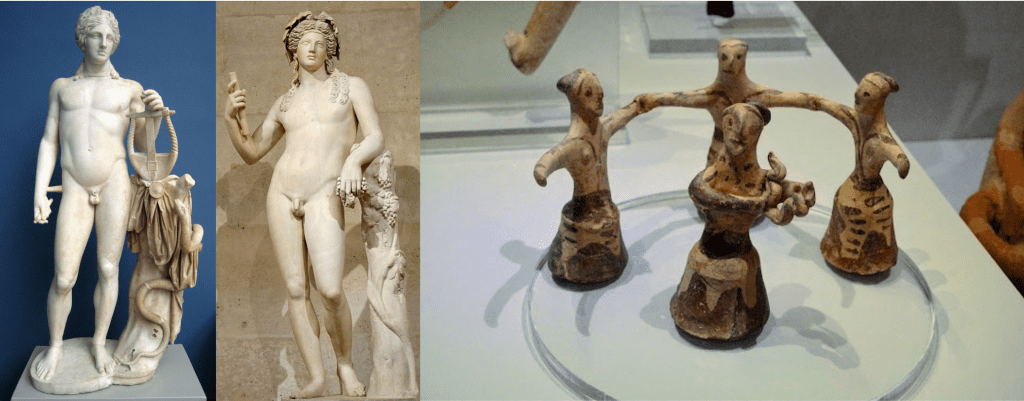
On the right is a terracotta figurine unearthed at Palaikastro, c. 1350–1300 BCE, with a small figure in the middle playing the lyre to enliven the occasion
Knowledge Point: The Divergence of the Sources of Eastern and Western Music
[Expand / Collapse]
-
Materials and Ideas: European early music — that of ancient Greece, for instance — developed earlier an abstract system of tuning based on mathematical ratios (the Pythagorean system), and its instruments (such as the aulos and the lyre) were often bound up with the worship of particular deities (such as Apollo and Dionysus), stressing music’s power to purify and educate the “soul” (ethos). By contrast, the ancestors of Cathay, starting fromnatural phenology and human bodily perception, matched pitch and temperament with yin-yang, the Five Phases, and the seasonal qi of the four seasons, forming an organic system of “resonance between Heaven and humankind.” The materials of instruments (earth, stone, hide, wood, and so on) were drawn directly from nature, and the very act of making them was itself regarded as a deed that communicated between Heaven and humankind.
Social Function: the excavation contexts of early Cathayan instruments — mostly high-rank tombs or sacrificial pits — strongly suggest that music was first and foremosta symbol of power, sacrifice, and order, not of mere aesthetics or entertainment. This has affinities with the situation in the Sumerian civilization of Mesopotamia, where instruments were property of the temples, yet the Cathayan tradition brought music into the framework of state governance earlier and more systematically (the germ of “governing the state through rites and music”). Ancient Greek music, meanwhile, developed more secular facets within the democratic life of the city-states and in public life — theatrical choruses, accompaniment for athletic contests, and the like.
Now let us cast our gaze past the dynasties of recorded history toward the hazy dawn of Chinese civilization. Music was not hidden from sight; rather, it was interwoven with the survival and beliefs of the ancestors in a more primitive and more essential way. This was an age both “sonorous” and nearly “silent” — sounds had long since rung out beside the flames of sacrifice, in the dances of victory, and in the rhythms of labor, only to dissolve at once into the winds of history. Yet the bone flutes and clay xun in the hands of archaeologists, the fragmentary phrases scattered through historical documents, and the frozen dance postures on rock paintings and pottery patterns together build a bridge to the earliest music of Cathay. The core of music in this period can be summed up as a long foundation-building, a passage from the “voice of shamans and spirits” toward the “source of ritual music” .
Concerning the origin of music, ancient Chinese texts already offered simple speculations long ago. The Lüshi Chunqiu, “Chapter on Ancient Music” records: “When Zhuxiang ruled the world of old… Shida made the five-stringed se zither, drawing in yin qi.” In The Music Canon, Volume 20, there is likewise the account that “Emperor Yao commanded Zhi to make music, and Zhi imitated the sounds of forests, mountains, streams, and valleys in his songs.” All these legends point to the ancient conception that the origin of Cathayan music lay in imitating nature and harmonizing yin and yang.
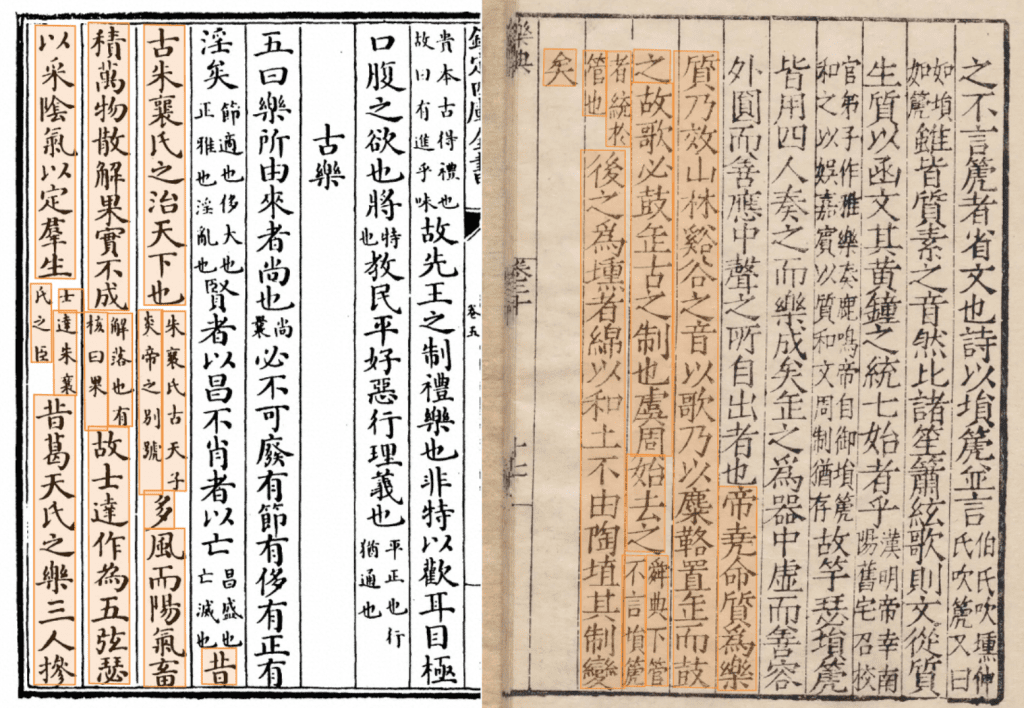
Right: “The Music Canon, Volume 20” by Huang Zuo [Ming dynasty] (Jiaqing 26th year edition)
Knowledge Point: Selected Translations from the Lüshi Chunqiu, “Ancient Music” Chapter, and The Music Canon, Volume 20
[Expand / Collapse]
-
Excerpted from the Lüshi Chunqiu (Mr. Lü’s Spring and Autumn Annals), Chapter on Ancient MusicOriginal text: When Zhuxiang ruled the world of old, the winds were frequent and yang qi accumulated unchecked, so the myriad things scattered and fell apart and the fruits never ripened. Hence Shida made the five-stringed se zither, drawing in yin qi to settle the many beings.Translation: In former times, when Zhuxiang ruled the world, winds blew constantly and yang qi grew excessive, causing the myriad things to be damaged and scattered and the fruits not to ripen. Shida therefore created the five-stringed se zither, which drew in yin qi and settled the myriad beings.Original text: In the music of the Getian clan of old, three men held ox-tails and stamped their feet, singing and dancing eight pieces: the first called Zai Min (Carrying the People), the second Xuan Niao (The Dark Bird), the third Sui Cao Mu (The Plants and Trees Follow), the fourth Fen Wu Gu (Rousing the Five Grains), the fifth Jing Tian Chang (Revering the Constancy of Heaven), the sixth Da Di Gong (Fulfilling the Merits of the Sovereign), the seventh Yi Di De (According with the Virtue of Earth), and the eighth Zong Wan Wu Zhi Ji (Summoning the Utmost of All Things).Translation: In the music of the ancient Getian clan, three performers held ox-tails, stamped their feet, and sang and danced in eight movements: the first named “Zai Min” (Carrying the People), the second “Xuan Niao” (The Dark Bird), the third “Sui Cao Mu” (The Plants and Trees Follow), the fourth “Fen Wu Gu” (Rousing the Five Grains), the fifth “Jing Tian Chang” (Revering the Constancy of Heaven), the sixth “Da Di Gong” (Fulfilling the Merits of the Sovereign), the seventh “Yi Di De” (According with the Virtue of Earth), and the eighth “Zong Wan Wu Zhi Ji” (Summoning the Utmost of All Things).
-
Excerpted from The Music Canon, Volume 20Original text: The fou is a vessel — hollow within and therefore good at containing, round without and therefore good at responding; it is from this that the sound of harmony is produced.Emperor Yao ordered Zhi to make music. Zhi then imitated the sounds of forests, mountains, streams, and valleys to compose songs, and covered a fou with deer hide and drummed upon it. Hence singing was always accompanied by the beating of the fou — this was the institution of high antiquity, abandoned only in the Yu (Shun) and Zhou eras. The Canon of Shun speaks of “xia guan” (pipes played below the hall) and does not mention the xun and chi — because they are subsumed under the category of pipes. Those who made xun in later times tempered clay with silk floss instead of firing it in a kiln — the method of manufacture had changed.Translation:The fou, as an instrument, is hollow within and thus good at containing; it is round without and thus quick to resonate — the sound of harmony arises from it.Emperor Yao ordered his minister Zhi to compose music, and Zhi, imitating the natural sounds of forests, mountains, streams, and valleys, created songs, covering the mouth of a fou with deer hide to beat out the accompaniment. Thus singing was always punctuated by the drum and the fou — this was the institution of high antiquity, and it was only in the time of Yu Shun and the Zhou dynasty that the practice began to be abolished. The Canon of Shun records the “xia guan” (instruments blown below the hall) but does not mention the xun and the chi, because both are encompassed by the category of pipes. Later makers of the xun blended clay with silk floss, no longer going through the pottery kiln, and so the method of making it changed.
The Theory of Labor Rhythms: Beyond the record in the Huainanzi, “Chapter on the Response of the Way,” which directly depicts call-and-response cries in collective labor — “Now those who lift great timbers: the one in front calls ‘ye-hu’ and those behind answer in turn — this is the song of shifting heavy loads and summoning strength” — the passage in substance reflects the sonic form of rhythm and coordination in primitive production.
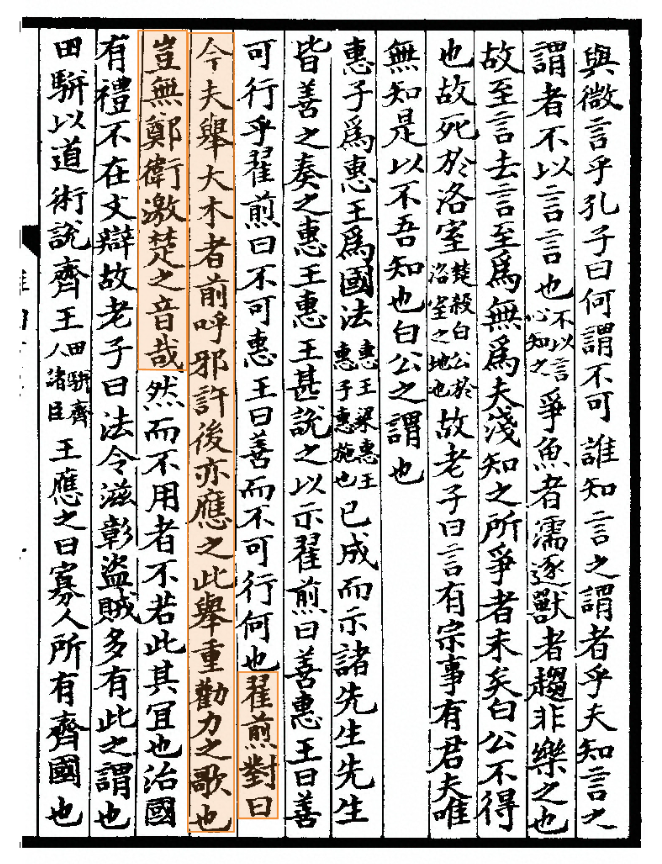
Knowledge Point: Selected Translation from the Huainanzi (Huainan Honglie Jie), Volume 12
[Expand / Collapse]
-
Original text: Zhai Jian replied: “Now when men lift great timbers, the one in front cries ‘ye-hu’ and those behind answer in turn — this is the song of lifting heavy loads and summoning strength. Is it not, then, the stirring music of Zheng and Wei?”Translation: Zhai Jian replied: “Those who carry great timbers today — the one in front shouts the work-cry ‘ye-hu’ and those behind answer in turn. This is the song that urges on strength in lifting heavy loads. Was there not, even so, the impassioned music of Zheng and Wei?”
Knowledge Point: Deciphering the Provenance of Ancient Chinese Book Editions
[Expand / Collapse]
-
Taking the bibliographic note “Sibu Congkan, facsimile of a traced copy of a Northern Song edition held in the Shanghai Hanfen Lou collection” as an example, let me explain how the provenance of ancient Chinese books is recorded.
1. Sibu Congkan (The Four Categories of Books)
- — what is it?: it is an extremely important collectanea of ancient Chinese books (a grand series of works) of the modern era. Led by the renowned scholar and publisher Zhang Yuanji and others, it was brought out in facsimile by the Commercial Press of Shanghai in installments between 1919 and 1936.
- Its purpose: to bring together the most important works among the four categories of Chinese canonical books — classics, histories, masters, and collections — in theirfinest and most authoritative editions(usually precious woodblock prints or manuscripts of the Song, Yuan, or Ming dynasty), reproduced in original form by photographic facsimile, so that copies multiplied into hundreds and thousands, for scholars to study and pass down. It is, in effect, the facsimile counterpart of a “library of rare editions.”
2. Jing (景)
- Here it is影ying (影), meaningphotographic facsimile (yingyin). The Sibu Congkan adopted photographic facsimile to reproduce the original books at full size, preserving the original appearance of the ancient texts to the utmost — including the calligraphy, the layout, and even the marks of damage and staining.
3. Shanghai Hanfen Lou, holding a traced copy of a Northern Song edition
- Shanghai Hanfen Lou: this is the name of the library of the Commercial Press in Shanghai, renowned for its vast collection of precious ancient books. The base editions used for the Sibu Congkan came mainly from the treasures of Hanfen Lou and several other great libraries.
- 藏: to hold in a collection.
- Jingchao Beisong ben — a traced copy of a Northern Song edition: this is the most crucial part, specifying the precise nature of the base edition used.
- Jingchao (景钞): likewise it isyingchao— that is, a “traced facsimile.” It refers to an ancient method of copying: a sheet of thin paper is laid over the original, and every character and stroke is carefully traced, striving to match the original’s calligraphy and format exactly. Before the spread of printing, this was the principal means of reproducing rare copies.
- Beisong ben (Northern Song edition): this refers to theoriginal base edition on which the traced copy was based — an edition printed during the Northern Song period (960–1127). Northern Song woodblock prints are treasured relics of early date and high value among ancient Chinese books.
Reading it all together:
“The content of this book comes from the Sibu Congkan collectanea; and this particular title in the Sibu Congkan is a photographic facsimile of a traced copy collected by the Shanghai Hanfen Lou; and that traced copy was in turn carefully traced, character by character, from a Northern Song woodblock edition.”
The chain of transmission of the edition can be expressed as follows:
Original Northern Song woodblock edition (possibly lost) → traced copy (reproducing the appearance of the Song edition) → Sibu Congkan facsimile (the edition in modern circulation)
The Theory of Shamanistic Sacrifice: Ancient texts repeatedly show the close union of music-dance and sacrifice. For example, the Rites of Zhou, “Grand Director of Music” under the Office of Spring, records the use of “the six lü, the six tong, the five tones, the eight timbres, and the six dances in the grand combined music, to summon the ghosts and spirits.” The “Nine Songs” of the Songs of Chu likewise records: “Qu Yuan, banished, wandered and hid in that region, harboring grief and bitter distress, his sorrowful thoughts seething; going out he saw the rites of the common people’s sacrifices and the music of their songs and dances, and finding the words vulgar and crude, he composed the tunes of the Nine Songs — upward setting forth the reverence due to the gods, and downward revealing his own pent-up grievances, lodging his remonstrance by allegory.” This, too, is a literary recreation of shamanistic ritual music-dance, and all of it shows music’s central function in communicating between the human and the divine and in performing rites.
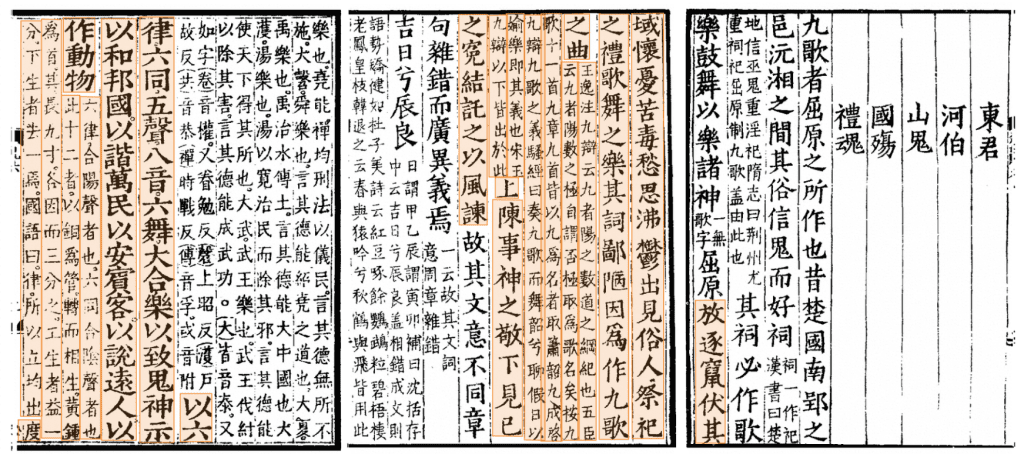
Right, first and second: the Songs of Chu by Qu Yuan [Warring States], Sibu Congkan facsimile of a Ming reprint of a Song edition in the Jiangnan Library collection
Knowledge Point: Selected Translations from the Rites of Zhou and the Songs of Chu
[Expand / Collapse]
-
Excerpted from the Rites of ZhouOriginal text: Using the six lü, the six tong, the five notes, the eight timbres, and the six dances, [the Grand Director] performs the grand combined music, to summon the ghosts and spirits, to bring concord to the states, to harmonize the myriad people, to set the guests at ease, to delight those from afar, and to rouse the animals into action.Translation: The six lü, the six tong, the five notes, the eight timbres, and the six dances were used to perform the grand combined music — to summon the ghosts and spirits, to make the states harmonious, to bring the myriad people into concord, to set the guests at ease, to delight those from afar, and to stir the myriad creatures into vigor.
-
Excerpted from the Songs of ChuOriginal text: The Nine Songs are the work of Qu Yuan. In former days, in the towns of the southern capital of Chu, between the Yuan and the Xiang rivers, the local custom was to believe in ghosts and delight in sacrifice; at every sacrifice, songs and music, drums and dances were sure to be performed, to delight the various gods.After Qu Yuan was banished, he wandered and hid in that region, harboring grief and bitter distress, his sorrowful thoughts seething and congested. Going forth, he saw the rites of the common people’s sacrifices and the music of their songs and dances, and finding the words vulgar and crude, he composed the songs of the Nine Songs for them — setting forth above the reverence owed to the gods, and revealing below his own pent-up grievances, lodging his remonstrance by way of allegory.Translation:The Nine Songs were composed by Qu Yuan. In former times, in the region of the southern capital of Chu, between the Yuan and the Xiang rivers, the local customs believed in ghosts and delighted in shrines, and at their rites they would always sing songs and dance, to delight the various gods.After Qu Yuan was banished, he wandered in exile through the Yuan-Xiang region, his heart weighed down with grief and suffering, his sorrowful thoughts congested and stagnant. Going out, he witnessed the rites of the local people’s sacrifices and the music of their songs and dances; finding the words vulgar and crude, he composed the tunes of the Nine Songs — setting forth above the reverence of serving the gods, and revealing below his own wrongs and grievances, entrusting to them his remonstrance by allegory.
The Theory of Emotional Expression: This theory stands out in the classic texts that expound the origins of poetry and music. The Book of Songs (Mao’s Version) says: “When feeling stirs within, it takes form in words; when words are insufficient, one sighs over it; when sighs are insufficient, one sings it out at length; and when singing at length is still insufficient, unknowingly one’s hands dance and one’s feet stamp.” This clearly traces the process from the natural outpouring of inner emotion to the emergence of song and dance.
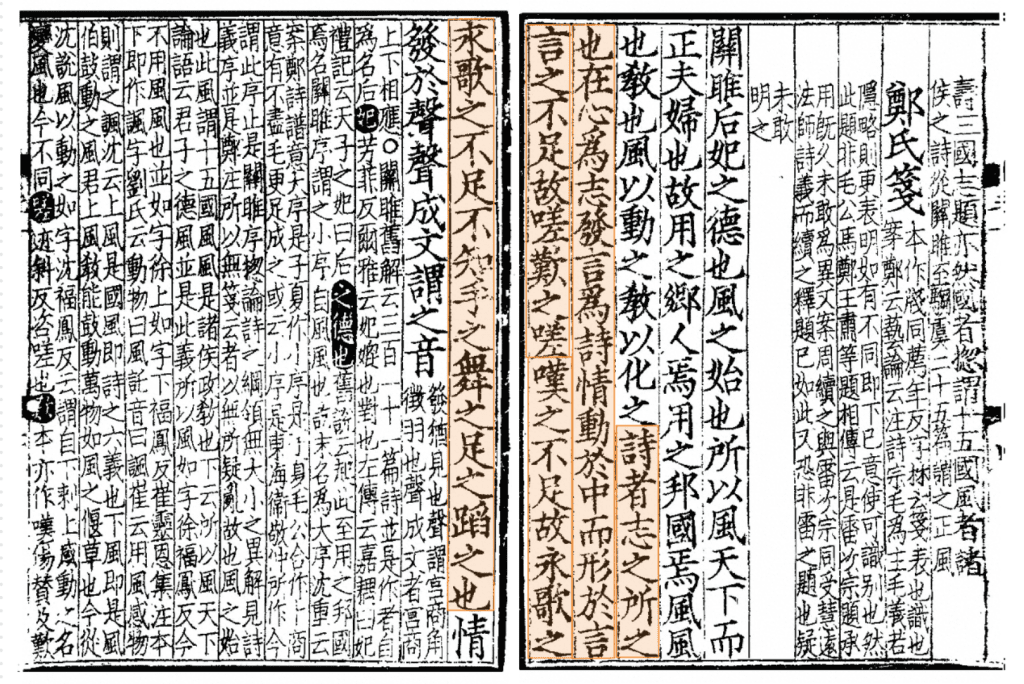
Knowledge Point: Selected Translation from the Book of Songs (Mao’s Version)
[Expand / Collapse]
-
Excerpted from the Book of Songs (Mao’s Version)Original text: Poetry is where the mind’s intent goes. In the heart it is intent; given voice in speech, it becomes poetry. When feeling stirs within, it takes form in words; when words prove insufficient, one sighs over it; when sighs prove insufficient, one sings it out at length; when long singing proves insufficient, one’s hands and feet move in dance without one knowing it.Translation: Poetry is where a person’s aspirations are directed. In the heart it is “intent”; once uttered in speech it becomes “poetry.” When emotion is stirred within, it finds expression in language; when language is not enough, one breaks into sighs; when sighs are not enough, one stretches out the voice in song; and when song stretched out is still not enough, one unknowingly sets hands to dancing and feet to stamping.
Knowledge Point: The Structural System of the Book of Songs
[Expand / Collapse]
-
I. The Structural System of the Book of Songs
The Book of Songs is traditionally divided into:
- 风(the Airs of fifteen states, 160 poems in all) — the Airs of Zheng is one of them
- 雅(the Major and Minor Odes, 105 poems in all)
- 颂(the Zhou Hymns, Lu Hymns, and Shang Hymns, 40 poems in all)
II. The Textual System of Mao’s Version
The most widely circulated edition of the Book of Songs today is the Mao Version (Maoshi), transmitted byMao Heng(the Elder Lord Mao) and annotated byMao Chang(the Younger Lord Mao), later furnished with commentary (jian) in the Eastern Han byZheng Xuan, and with sub-commentary (shu) in the Tang byKong Yingdain his Maoshi Zhengyi (Correct Meaning of the Mao Odes), which became the official orthodox text.
The organizational structure of the Mao Version is:
- Volumes: 20 juan in all (the Airs of the States in 10 juan, the Minor Odes in 7, the Major Odes in 2, and the Zhou Hymns in 1)
- Within each juan, the pieces are arranged in the order of the Airs, or of the Odes and Hymns
- After each piece come the “zhuan” (Mao Heng’s explanation), the “jian” (Zheng Xuan’s supplement), and the “shu” (Kong Yingda’s further elaboration)
The Theory of Signal Transmission: Although direct records are scarce, a line in the Book of Songs such as “the gong-man strikes the drum” in the Lesser Odes, “Gathering the Madder,” which depicts instruments directing advance and retreat in the army, can be seen as an extension of the signal function into the military sphere; and in high antiquity the drum and the war drum were used for alarm and muster, which likewise reflects the practical origin of sound tools in conveying information within communal life.
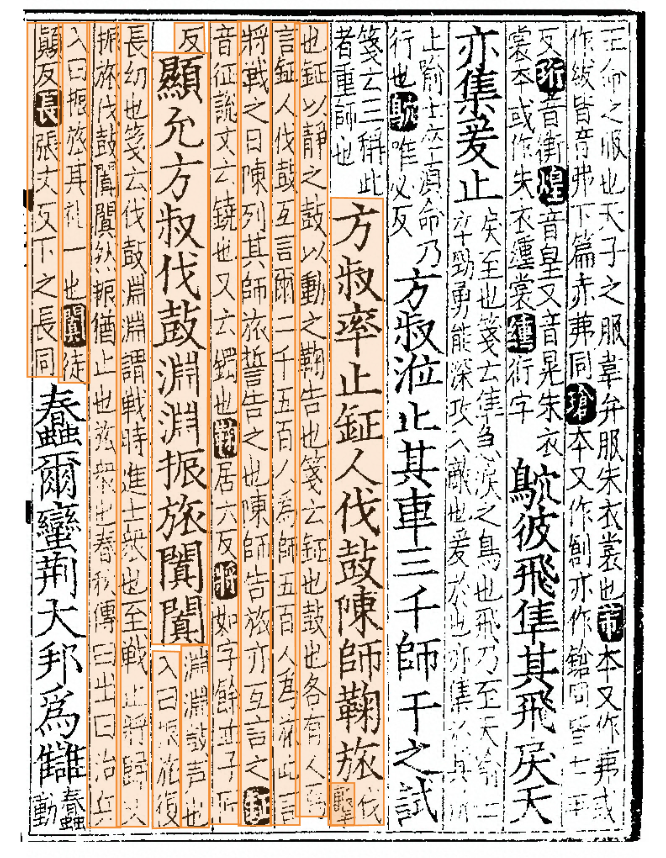
Knowledge Point: Selected Translation from the Book of Songs (Mao’s Version)
[Expand / Collapse]
-
Excerpted from the “Book of Songs (Mao’s Version)》Original text: Swift is that flying falcon; its flight reaches to heaven, and it gathers and alights. Fang Shu has arrived — his chariots number three thousand, and the shields and weapons of his host are well tried. Fang Shu leads on; the bell-man strikes the drum; the host is drawn up and the troops exhorted. Illustrious and sincere Fang Shu — the drum is struck with a deep, resounding beat, and the army is marshalled in mighty array.Translation: The falcon flies swiftly, and flies almost up to heaven, yet it also gathers and alights here. Fang Shu has arrived, with three thousand war chariots, and the shields and weapons of his host are well practiced. Fang Shu leads the army; the gong-man strikes the war drum, the ranks are drawn up, and the order for the march is proclaimed. Illustrious and sincere Fang Shu strikes the war drum with a deep, sonorous sound, and the army is marshalled in magnificent array.
Taken together, these theories depict music’s complex and primal functional web in primitive society — it was at once a tool for organizing labor and transmitting information and a medium for sacrificial communion with the gods and for the expression of emotion, with these multiple roles interwoven in the daily life and spiritual world of the ancestors.
Fortunately, material evidence keeps turning legend into tangible history. The most revolutionary discovery comes from the Jiahu site at Wuyang, Henan. Dozens of bone flutes made from the ulnae of cranes have been unearthed there, dating back roughly 7,800–9,000 years. They are not merely deliberate instrument-making; they possess astonishing musical capability. Most of the bone flutes can play a complete heptatonic (seven-note) scale, and some even contain chromatic semitones, showing that the ancestors already had a highly self-aware grasp of interval relationships — far beyond mere signaling. The sudden emergence of the Jiahu bone flutes pushed the documented history of musical civilization in China — and indeed in all of humanity — dramatically earlier. They prove that at the very dawn of Chinese civilization, the ancestors’ perception and creation of pitch and scale had already reached a considerable height: these were no simple sound-making toys but deliberate tools of spiritual expression.


Echoing the clear piping of the bone flutes is a far more widespread instrument across the sacred land of China: the clay xun ocarina. It developed from the early single-hole xun (as at the Hemudu site in Zhejiang) to the two-hole xun (capable of a three-note sequence), and on to the mature three-hole xun of the Xia and Shang periods (as at Huoshaogou in Gansu and Yinxu in Henan), which could produce a complete pentatonic scale and more. The five-hole xun unearthed from the tomb of Fu Hao at Yinxu shows superb craftsmanship: its range already exceeds a tenth, and its expressiveness is rich. For example, the xun from Fu Hao’s tomb at Yinxu, Anyang, Henan, is made of gray clay pottery, with a smoothly polished surface, a round blow hole at the pointed apex, and five finger holes on the lower belly — three on one side arranged in an inverted “pin” pattern, and two on the other side, left-right symmetrical.

Meanwhile, the tuo drum (a wooden drum covered with crocodile hide) from the Taosi site at Xiangfen, Shanxi, and the stone chime (qing) from the Dongxiafeng site at Xiaxian, Shanxi — an early single stone chime (te qing) — represent the rhythmic and deep-bass register. In particular, the various te qing, in their making from chipped to polished, gradually became more regular in form, prefiguring their transition from practical utensils to great ritual instruments. These archaeological finds scattered across the Yellow River and Yangtze basins together point to one fact: the seeds of music had already sprouted at many points across the vast land of China.
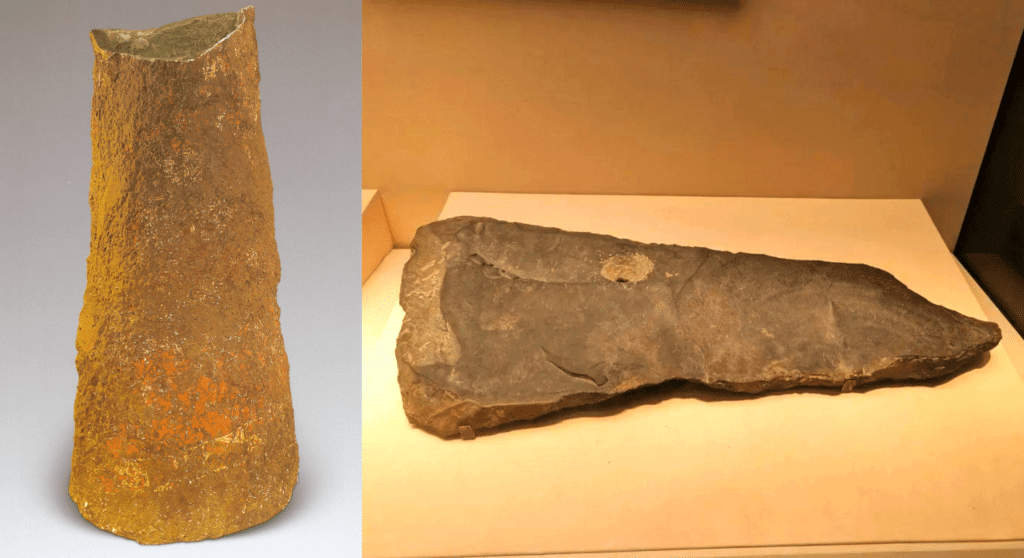
Right: a Xia dynasty stone chime, about 3,500 years old, believed to be the oldest surviving stone chime.
The musical practices of high antiquity and the Three Dynasties (Xia, Shang, and Zhou) injected a decisive auditory gene into Chinese civilization, and its essential spirit finally crystallized in the unique system of the “Eight Timbres” (ba yin) . The classification by material — metal, stone, silk, bamboo, gourd, earth, hide, and wood — was far more than a taxonomy of instruments; it constructed a complete cosmological symbolic system: the solemnity of “metal and stone” laid the authoritative foundation of the ritual-music order; the mellifluence of “silk and bamboo” nourished the soul of melodic art; and the “gourd, earth, hide, and wood” gathered together the manifold sounds ranging from heaven, earth, mountains, and rivers to the rhythms of daily life. This system elevated music from a merely auditory art into an order-framework that bridged Heaven and humankind and regulated ethics, turning “rites and music” from a concept into an operable, performable body of institutions.
Knowledge Point: What Are the Eight Timbres (ba yin)?
[Expand / Collapse]
-
“Ba yin” (the Eight Timbres) is theearliest and most systematicsystem of classifying instruments in Chinese history, recorded in the Confucian classic Rites of Zhou (“Music Master” in the Office of Spring). It does not classify instruments by playing method (blown, bowed, plucked, struck), butby the core material from which they were made, dividing the many instruments into eight categories:
- 金: instruments made of bronze (an alloy of copper and tin). For example, the 钟(in the form of the bianzhong chime), the铙、镈、, and the chunyu (bronze percussion bell). Their timbre is grand and penetrating, and they are the weighty instruments of ritual music.
- 石: instruments made of stone (chiefly limestone and jade). For example, the 磬(in the form of the bianqing chime). Its timbre is clear and piercing, with the famed “sound of metal and stone.”
- 丝: plucked and bowed string instruments strung with silk thread. For example, the 琴、瑟、筝、筑(later instruments such as the huqin and pipa were also classed here, since their strings were of silk).
- 竹: wind instruments made of bamboo pipe. For example, the 箫、管、篪、笛。
- 匏: reed instruments made by inserting bamboo pipes into a gourd (pao) base. For example, the 笙、竽。
- 土: instruments fired from clay. For example, the 埙、缶(the latter sometimes also refers to a clay percussion vessel).
- 革: percussion instruments with a head of stretched hide. For example, the 鼓(drums of various shapes), and the鼗(rattle drum).
- 木: percussion instruments made of wood. For example, the 柷(shaped like a square measure, struck to begin the music), and the敔(shaped like a crouching tiger, scraped to end the music).
Within this system, many of music’s distinctive traits took shape and developed. The ultimate pursuit of the melodic line of “silk and bamboo” established the aesthetic path of Chinese music centered on horizontal unfolding; the precise tuning of “metal and stone” drove a unique tradition of temperament theory, whose impetus always served instrument-making and ritual-music practice. More importantly, the “Eight Timbres” linked the sound of each material to natural elements and philosophical ideas, giving material and ritual support to the Confucian ideal that “great music is in harmony with Heaven and Earth” and to the Daoist realm of “heavenly sounds” (tianlai). From then on, Cathayan music was no longer merely an expression of emotion but the sonorous embodiment of cosmic order, profoundly shaping the three thousand years of ritual-music civilization and artistic spirit that followed.
Second Movement: Shamans Communing with the Gods
Before the birth of writing, music and dance were one undivided whole. The painted pottery basin with a dance pattern unearthed at Sunjiazhai, Datong, Qinghai provides the most vivid pictorial evidence. The inner wall of the basin is painted with three groups of dancers, five in each group, holding hands, moving in step, their head ornaments and trailing tails streaming in the same direction. This is by no means ordinary entertainment; scholars generally believe it depicts a sacrificial or shamanistic rite. In the worldview of the ancestors, ordered rhythm, collective movement, and specific cries or chants possessed great power to bridge Heaven and Earth, summon the spirits, pray for fertility, or drive away evil.
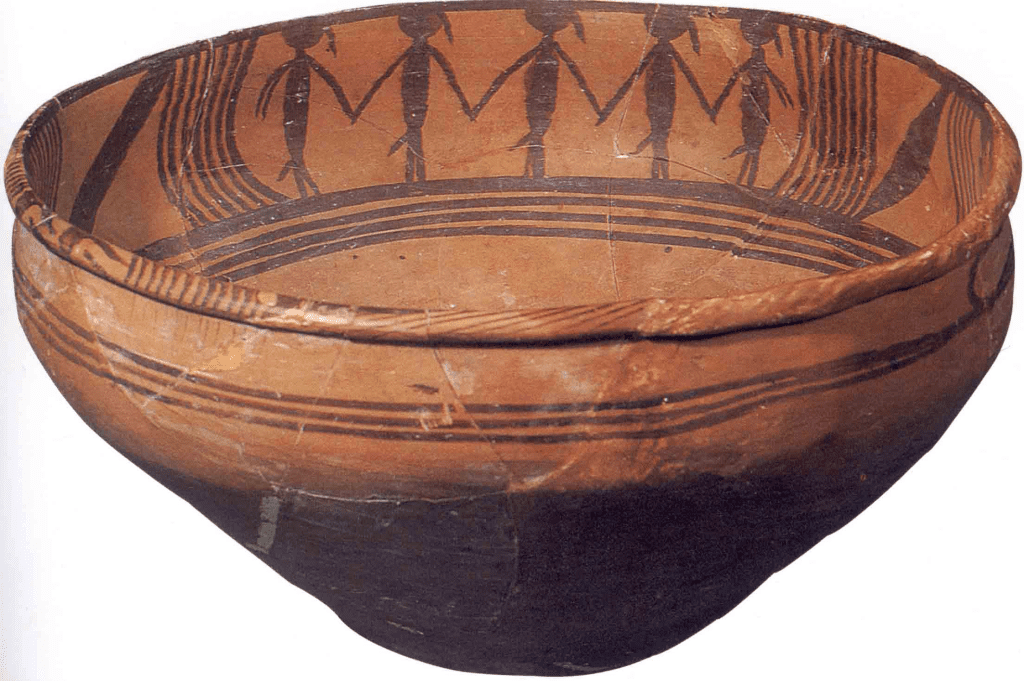
The Correct Meaning of the Spring and Autumn Annals records: “The Emperor said: ‘Kui! I charge you to preside over music, to teach the heirs of the nobles… that spirits and humans may be harmonized.'” Though polished by later hands, this passage precisely captures the core function of early music: “the harmony of spirits and humans”. Music (music-dance) was the medium through which shamans — the early intellectuals and priests — achieved “communion with the gods”; it was the spiritual bond that sustained the cosmic order and the safety of the tribe. One may infer that the earliest “musicians” were very likely the shamans or chieftains of the tribe, who held the “code” for conversing with supernatural forces — specific tones, rhythms, and dances.

Knowledge Point: Selected Translation from the Correct Meaning of the Spring and Autumn Annals
[Expand / Collapse]
-
Excerpted from the Correct Meaning of the Spring and Autumn Annals
Original text: The Correct Meaning says: The Canon of Shun in the Book of Documents records: “The Emperor said: ‘Kui, I charge you to preside over music and to teach the heirs of the nobles.'” This shows that Kui was the officer in charge of music under Shun. “Zheng” (正) means “chief”; “hou” (后) means “ruler.” Hence the text calls him “the chief of the music office.” As a high minister of the royal court, he is spoken of with “hou,” just as Ji is called “Hou Ji.”
Translation:The Correct Meaning explains: The Canon of Shun in the Book of Documents records: “Emperor Shun said: ‘Kui, I appoint you to take charge of music and to instruct the scions of the noble houses.'” This shows that Kui was the official in charge of music under Shun. “Zheng” means “head,” and “hou” means “sovereign.” Hence Kui is called “the chief of the music office.” Because he was a high minister of the royal court, the term “hou” was used to honor him, just as Ji is called “Hou Ji.”
This tradition of the “unity of shamanism and music” profoundly shaped the underlying code of ritual, functionality, and collectivity in the genes of Cathayan music. Music was never merely an auditory art; it was an embodiment of social behavior, cosmology, and structures of power. It laid a far-reaching psychological and cultural foundation for the later Zhou dynasty’s systematic and politicized codification of music.
Third Movement: Kings Extol Their Merits
As tribal confederations evolved toward early statehood, music’s function began to expand from pure “communion with the gods” toward “praising the king.” The legendary Da Xia (celebrating Yu the Great’s taming of the floods) and Da Huo (celebrating Tang of Shang’s overthrow of Jie) — though their actual forms can no longer be known — are hinted at in the literary records as evidence that music had become an important tool for extolling the achievements of leaders and asserting the legitimacy of regimes. The line in the Zhouyi, hexagram Yu (Enthusiasm), “the ancient kings made music to exalt virtue, and offered it in abundance to the Supreme God, that their ancestors and fathers might share in it,” likewise reveals music’s role in sacrificing to ancestors and pleasing God so as to consolidate rule.

Knowledge Point: Selected Translation from the Zhouyi (Book of Changes)
[Expand / Collapse]
-
Excerpted from the Zhouyi, Upper Classic, “Tai” Commentary, Chapter 2Original text: The Symbol says: Thunder bursts forth from the earth, and all things are roused — this is Yu (Enthusiasm). The ancient kings, in accordance with this, made music to exalt virtue, and offered it in abundance to the Supreme God, that their ancestors and forefathers might share in the rites.
Translation: The “Symbol” commentary says: Thunder comes forth from the earth and the myriad things revive — this is the emblem of joy. Observing this hexagram, the ancient kings created music to honor virtue, and with grand ceremonies offered sacrifice to the Supreme God, allowing their own ancestors and fathers to share in the honor.
The material foundation of this shift was the arrival of the Bronze Age. Although the physical evidence for Xia dynasty bronze instruments remains disputed, the glorious bronze culture of the Shang dynasty undoubtedly brought revolutionary change to music. The oracle bone script already clearly contains such characters as “yue” (a pan-pipe-like instrument, now lost), “gu” (drum), and “qing” (stone chime). The bronze nao bells unearthed from the tomb of Fu Hao at Yinxu — in sets of three or five — mark the maturity of melodic bronze percussion instruments. These great vessels were no longer mere sound-making tools but symbols of power, wealth, and sacred order. They laid both the technological and the conceptual foundation for the magnificent bell-and-chime orchestras and the ritual-music institutions of the Western Zhou.


Fourth Movement: The Music Within a Character
The search for the origin of the character “le/yue” (music/joy) is the key to understanding the ancestors’ conception of music. The mainstream interpretations of the oracle bone form of “樂” are two: the first, held by Luo Zhenyu and others, is that the pictograph depicts silk strings suspended from a wooden frame, its original meaning being a musical instrument; the second, held by Guo Moruo and others, is that it depicts ripened grain hanging from its stalks and leaves, from which the feeling of joy is derived. Either way, both point to an auspicious association — whether the delight of qin and se playing in harmony, or the celebration of the five grains in full harvest. As the Record of Music in the Book of Rites says: “Music (yue) is joy (le) — something human feeling cannot do without.” From the very moment of its birth, music was bound up with the most fundamental joys of survival and emotional needs of humankind.

Knowledge Point: A Detailed Explanation of the Character “樂” in Oracle Bone Script
[Expand / Collapse]
-
In oracle bone script, the character pictures strings stretched across a wooden frame; the original meaning is a wooden musical instrument, extended by metaphor to mean music and joy.
The oracle bone form is made up of糸and of木an element not reproducible here — Luo Zhenyu glossed it as: “Silk threads attached to wood — the image of the qin and se.” The character pictures strings attached to a wooden body; its original meaning is a wooden instrument, extended to music and joy. From the mid-Western Zhou, bronze inscriptions additionally take the element白」,「白is the shape of a thumb, and the whole character conveys plucking the strings with a finger (Tian Qianjun). Another view holds that白it was a phonetic element appended later (Liu Zhao). After the Spring and Autumn period,木the form was sometimes written as亦; see the character樂in the bell inscription of Zi Zhang. In the Chu script tradition,木the form was sometimes written as矢appears; see “Rong Cheng Shi” (Shanghai Museum Bamboo Slips, vol. 2), slip 30. Additionally,白the element was perhaps reshaped by analogy with幺; see “Jun Ren Zhe He Bi An Zai,” version A (Shanghai Museum Bamboo Slips, vol. 7), slip 5.
The Shuowen Jiezi says: “Yue (樂) is the general name of the five notes and the eight timbres. Its pictograph depicts a drum. The wood is the stand (ju).” Duan Yucai’s note: “The Record of Music says: ‘Moved by things, [the heart] stirs, and so takes form in sound. Sounds echo one another and so give rise to change; when the change forms a pattern, it is called a tone (yin). Putting tones together and delighting in them — together with shields, axes, feathers, and ox-tails — is called music (yue).’ Under ‘tone’ it says: ‘Gong, shang, jue, zhi, and yu are the notes (sheng); silk, bamboo, metal, stone, gourd, earth, hide, and wood are the timbres (yin).’ The extension of yue (music) is le (joy) — the yue of joy-and-grief.”
In oracle bone inscriptions it is used as a place name: Heji 33153: “At (zai) Yue.” Heji 36501: “Today we march to Yue; there will be no (wu) disaster.”
In bronze inscriptions it refers to playing instruments: the Jing Diao bell: “May his sons and grandsons forever by day strike this bell in music (zi).” It is also used as a verb, meaning to make people happy: the Jing Shi Tian Wang bell: “To use (yi) it to delight the lord.” The Wangsun Yizhe bell: “To use it to delight honored guests.” The Book of Songs, Lesser Odes, “Lu Ming”: “I have honored guests; I play the se and blow the sheng.” The bell inscription’s mention of樂“is just like “playing the se and blowing the sheng,” that is, making music to give people joy. The Linghu Jun hu vessel: “May our house be at ease and joyful” — meaning to keep my family comfortable and healthy. The Records of the Grand Historian, “Treatise on Music”: “And the people are at ease and joyful.” Zhang Shoujie’s Correct Meaning: “Le means peace.” Furthermore, the character樂is also used as a personal name — the “Yue Zuo” ding: “Yue makes (zuo) the travel ding.”
On Warring States bamboo slips, the character樂refers to music: “Cao Mo’s Battle Formation” (Shanghai Museum Bamboo Slips, vol. 4), slips 10–11: “He does not nap by day, does not drink wine, and does not listen (ting) to music.” There is also the term “yue zheng” (music master), meaning the official in charge of music. “Rong Cheng Shi” (Shanghai Museum Bamboo Slips, vol. 2), slip 30: “Shun then wished to gather the qi of Heaven and Earth and listen to (ting) and use it, and so established Zhi as the music master” — meaning that Shun, wishing to join and employ the yin-yang qi of Heaven and Earth, established a man named Zhi as music master. It also means to make people happy: “Discourse on Human Nature” (Shanghai Museum Bamboo Slips, vol. 1), slip 12: “He loves their (qi) countenance (rong) and delights in their (qi) way.”
On Han silk manuscripts, the character樂is read as濼, used as the name of a river — namely the Xiaoqing River north of present-day Jinan. The Mawangdui silk manuscript “Events of the Spring and Autumn Period,” chapter “Duke Huan of Lu and Wen Jiang Meet the Marquis of Qi at Yue,” line 92: “Duke Huan (huan) of Lu and Wen Jiang met the Marquis of Qi at Yue.” The Zuo Tradition, Duke Huan, 18th year: “The duke met the Marquis of Qi at Luo, and then went with Wen Jiang to Qi.” Du Yu’s note: “The Luo River, in the northwest of Licheng county of Jinan, flows into the Ji.” It is also read as藥: the Mawangdui silk manuscript “Sixty-four Hexagrams,” hexagram “Wu Meng”: “An illness of wu mang (recklessness) — do not treat it with medicine (yao); there will be joy.” In the received text of the Changes, the character樂in the received text of the Changes is written as藥; the whole sentence means that the illness does not stem from reckless conduct, and so it heals of itself without medicine (Wang Hui).
Finale: Gazing Across Past and Present
Looking back at the sounds buried by time, what we hear is not silence but the first pulse of the genes of civilization deep in history. The seven clear notes blown from the Jiahu bone flutes long ago carved into the veins of Cathay an eternal longing for melody; the solemn echo of the Taosi tuo drum and stone chime bound music tightly to the order of Heaven and Earth, giving every note the weight of communion between the human and the divine. From the reverence of shamans treading song to commune with the spirits, to the majesty of kings casting bells to inscribe their achievements, those sounds that dissolved amid sacrificial fires and beacon smoke never truly fell silent — they became the genes of ritual music, settling into the philosophical echo of “great music is in harmony with Heaven and Earth,” and, in the bronze vibration of the bianzhong bells of Marquis Yi of Zeng, they reached an astonishing summit of human achievement in tuning theory.
Though the music of high antiquity has gone with the wind, that river of sound-waves carved jointly by bone flutes, clay xun, tuo drums, and stone chimes still surges beneath the strata of civilization. It flows past the tender warmth of “qin and se at hand” in the Book of Songs, past the joys and sorrows of the Han and Wei “xianghe” songs, and at last gathers into an epic written in sound. And today, when we listen to modern singers re-sing the ancient poems of the Book of Songs, the longing, the joy, and the vastness that have crossed three thousand years still stir real ripples in our hearts — and this may be the most moving continuation of the ancient musical soul: the original melodies may be lost, but that longing to settle life with music and to bridge Heaven and humankind has long since become an echo in our spiritual homeland that never fades away.
Afterword
It nearly killed me! Writing this special issue of Classical Diary filled me with unease and guilt. As a child of Cathay, my knowledge of the development of Chinese music is far weaker than my knowledge of Western music. Throughout the entire writing process, confusion and ignorance were my leitmotif — and I believe they are the leitmotif of many of my compatriots as well. As an extension of Classical Diary, this special series focuses on the course of our country’s musical development, and this first installment centers on the period before the Christian era — a history now more than ten thousand years long. The modern interpretation of the Book of Songs recommended at the end is also one of the albums the BLOG owner loves most, and I hope it lets everyone feel the power of music contained in our long history and culture, and the way culture develops, multiplies, and is passed on from voice to voice without cease. (9,677 characters in full)
References
Shidian Guji — Ancient Texts Online Reading Platform
He Nu, former team leader of the Taosi site: on the “observatory platform” and why Yao made his capital at Taosi | Interview_Sina Finance_Sina
Exploring the Stone Chime Instruments at the Site of the Xia Capital
Multi-function Chinese Character Database — Analysis of Oracle Bone Components


You May Also Like

HIFI Diary: The Peak Showdown Between the Luxury & Precision W4 and the iBasso DC-Elite Dongle DACs
HIFI Diary: Moondrop Nice Buds Earbuds Sound Quality Review