Classical Diary: Echoes of an Island — William Byrd (Part 9)
Classical Diary Series
[Expand / Collapse]
-
How to Appreciate Classical Music — Written at the Very Beginning (Part 1)
Follow the BLOG owner’s footsteps and explore the thousand-year story of classical music.
-
The Pope’s Dove and the Millennial Chant — Gregory I (Part 2)
Listen to the development of church chant and grasp the character of religious music.
-
Budding Music, Hidden Epic — Guillaume Dufay (Part 3)
Hear the story of the founding figure in whom technique and sensibility fused in the early Renaissance.
-
Moonlight Knight and Court Poet — Gilles Binchois (Part 4)
Listen to the refined lyricism of the Burgundian School, resonating across a thousand years.
-
A Beacon on the Eve of Change — Johannes Ockeghem (Part 5)
The last master of the Burgundian School, and the founder of the Franco-Flemish School.
-
The King of French Music — Josquin des Prez (Part 6)
The mid-Renaissance turns its most glorious page in both sacred and secular music.
-
The Last Glory of Roman Orthodoxy — Giovanni Pierluigi da Palestrina (Part 7)
Together we open the storm-tossed, blood-soaked gate of the late Renaissance.
-
Orlando di Lasso of Europe, Orlando di Lasso of the World (Part 8)
The Renaissance welcomes its last master of music.
-
Echoes of an Island — William Byrd (Part 9)
England rends apart the Renaissance era’s final master of music.
Prologue — England’s Century of Change
I. The Rose and the Tudor
In the late Renaissance, as the sixteenth century drew to a close, we already know from earlier installments of the Classical Diary series that the fire ignited by the Reformation had burned its way from the pages of doctrinal debate deep into the daily life and souls of every European. On the Continent, upon the shattered map of ‘cuius regio, eius religio’, a dynamic but armed equilibrium was barely maintained. Yet beyond the Continent, the island kingdom of England, adrift offshore, had forged itself into a unique laboratory of faith, whose inner tensions and rifts were deeper and more painful than any confrontation on a battlefield.

In 1453, at the tail end of the Hundred Years’ War, England finally lost all its continental territories save Calais, and the cloud of defeat hung over the kingdom. Yet this seemingly catastrophic loss tore open a crack for a far deeper transformation, both internal and external. England was forced to awaken from the old dream of continental dominance, and its internal contradictions — the military nobles swollen and then frustrated by the war, the empty treasury, the powerful lords estranged from the crown — erupted violently, dragging the country into the even bloodier Wars of the Roses (1455–1487).
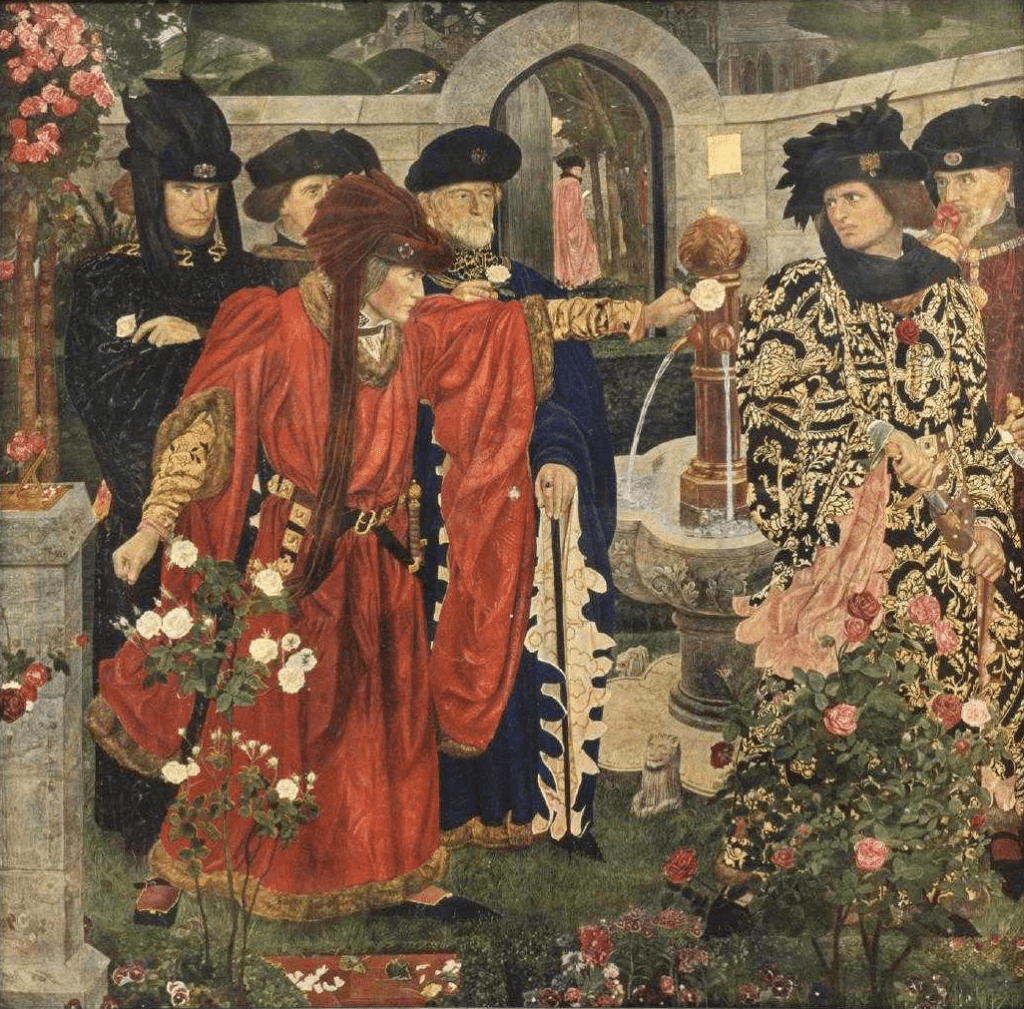
The House of Lancaster’s rule (1399–1461) had, under Henry VI, lost all legitimacy through the king’s weakness, misrule and military defeats (especially in the Hundred Years’ War). This gave the House of York, which held a claim to the throne, reason to take up arms. As war broke out, the two great camps — the Lancastrians, marked by the red rose (with major allies such as the Beauforts, parts of the Percy family, and the Cliffords), and the Yorkists, marked by the white rose (with powerful allies such as the Nevilles) — together with their retainers, were drawn into a zero-sum game aimed at completely erasing the other’s political existence.

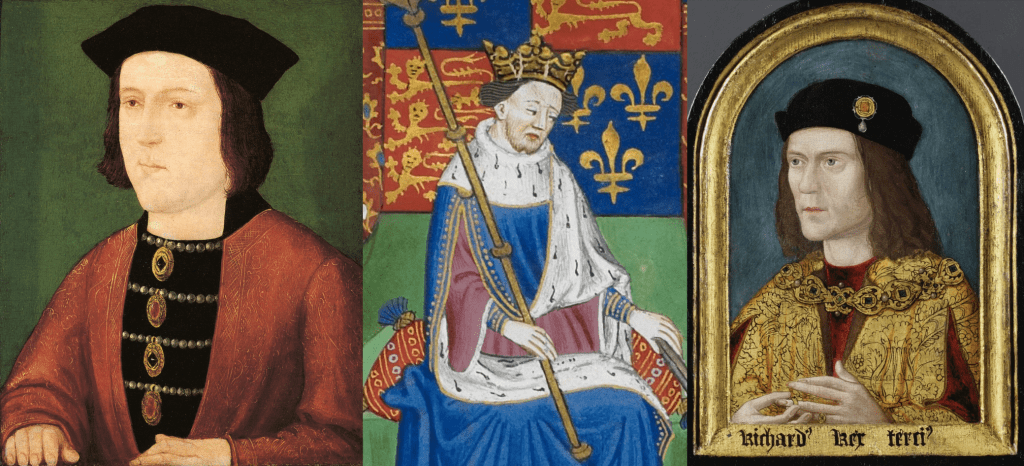
The House of York’s rule (1461–1485): Edward IV (son of the Duke of York) took the throne in 1461, inaugurating the Yorkist dynasty. Yet internal divisions (his break with the Earl of Warwick, Richard Neville) and stubborn Lancastrian resistance led to his brief overthrow in 1470, when Henry VI was temporarily restored (1470–1471). Edward IV quickly regained the throne in 1471 and consolidated his rule; in the end the male line of Lancaster was almost entirely wiped out. In 1483, after Edward IV’s death, the twelve-year-old Edward V was usurped by his uncle Richard III and suspected murdered (the ‘Princes in the Tower‘), plunging the realm into yet another crisis of legitimacy.
Knowledge Point: The Princes in the Tower
[Expand / Collapse]
-
‘The Princes in the Tower’ is one of the most famous and most mysterious royal enigmas in English history, referring toEdward Vand his younger brotherRichard, Duke of Yorkand their disappearance.
Core facts:
The figures:
- Edward V: After his father Edward IV (King of the House of York) died suddenly in 1483, the twelve-year-old became king.
- Richard: Edward V’s nine-year-old brother, Duke of York.
The events:
- Their uncle, the Lord Protector,Richard, Duke of Gloucester, placed the two brothers in the Tower of London (at the time a royal palace and fortress, not a dedicated prison) to await the coronation.
- Richard then declared the two princes illegitimate (on the grounds that their father’s marriage was invalid) and thus barred from the throne.
- In July 1483, Richard had himself crownedRichard III。
- After that, within the Tower of London the two princeswere seen in public less and less, until they vanished completely, their fate unknown.
Historical impact:
- The princes’ disappearance destroyed Richard III’s reputation; he was widely suspected of murdering his own nephews to secure the throne. This gravely undermined the legitimacy of his reign.
- This providedHenry Tudor(the future Henry VII) with an excellent moral pretext to take up arms against Richard III. After defeating and killing Richard III at the Battle of Bosworth Field, Henry foundedthe Tudor dynasty。
- To further consolidate his legitimacy, Henry VII also pushed an Act of Parliament throughformally declaring the two princes dead(without accusing Richard III), and married their elder sister — Elizabeth of York — uniting the two houses.
The mystery and later discoveries:
- The truth remains a mystery: Rumours abounded at the time, but there was no firm evidence. In ‘Richard III’, Shakespeare portrayed Richard as the classic villain who had his confidants murder the princes, embedding this version deep in the popular imagination.
- Key discovery: In 1674, during renovations of the Tower of London, workmen found beneath a staircase a wooden chest containing the bones of two youths matching the princes’ ages. Charles II had them solemnly interred in Westminster Abbey as the princes’ remains.
- Modern examination: The examination of 1933 concluded that the bones’ ages matched the princes and showed signs of kinship, but it could not be confirmed with absolute certainty.The British royal family has to this day refused to allow DNA testing, so this remains an unresolved historical case.
In short, the affair of the ‘Princes in the Tower’ isthe ultimate symbol of the House of York’s bloody internecine strife, which directly led to the collapse of the dynasty’s legitimacy, paved the way for the rise of the Tudor dynasty, and became an eternal metaphor in literature and history for power corroding kinship and darkness swallowing innocence. Within the context of the Wars of the Roses you recount, this is the summit of the old order’s double collapse — morally and in bloodline alike.
Decades of the Wars of the Roses brought the pillars of the old feudal order crashing down in self-destructive slaughter. Both the commoners worn down by war and the surviving but diminished lesser nobility desperately yearned for a strong central authority that could offer stability, order and peace. The land and its hearts awaited a new monarch to reunite them, and Henry VII of the Tudor house — himself a distant Lancastrian heir — through his marriage to Elizabeth of York, united the red and white roses, created the Tudor Rose emblem, and opened a brand-new chapter upon the ruins of history.
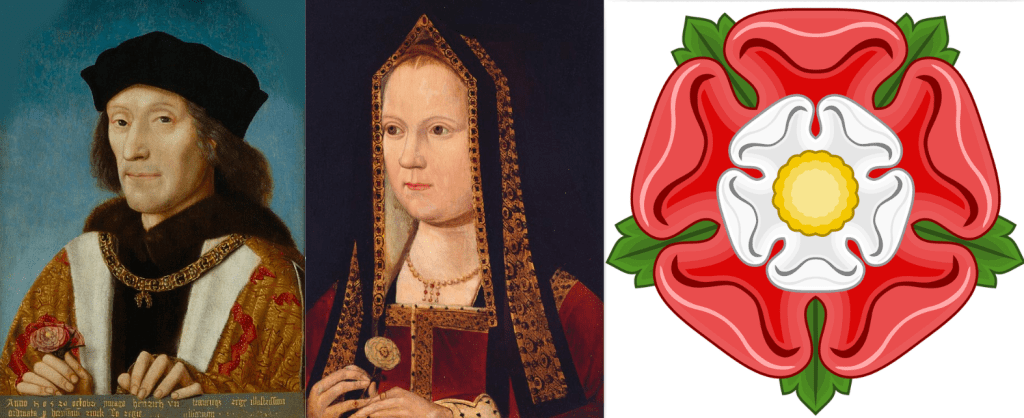
The Tudor dynasty’s rule (1485–1603): In 1485, Henry Tudor (Henry VII) defeated Richard III at Bosworth Field, bringing the House of York to its end. Henry Tudor’s success came not from his own overwhelming military strength or the support of powerful hereditary nobles; rather, he won through his tenuous blood claim, the luck of an exile, international aid, and the last-minute betrayal of his foes on the battlefield.
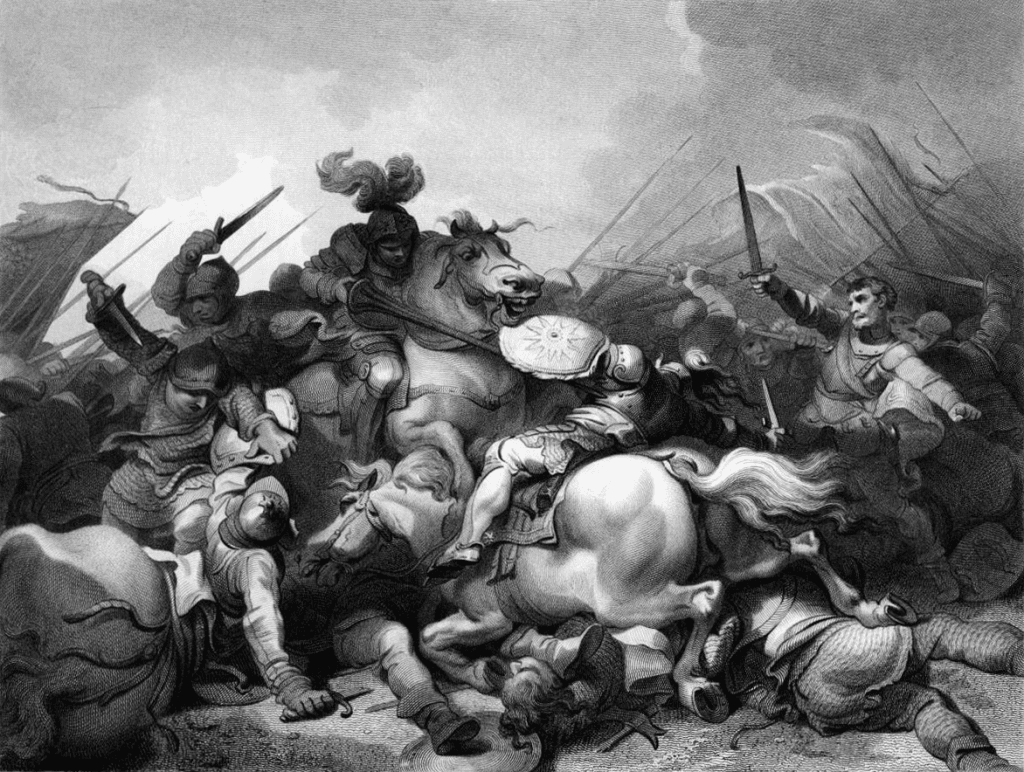
Knowledge Point: The Battle of Bosworth Field and the End of the Old Order
[Expand / Collapse]
-
In 1483, Edward IV of the House of York died, and his son Edward V succeeded him. But soon after, their uncleRichard, Duke of Gloucester, declared the late king’s marriage invalid (claiming he had secretly contracted a marriage, rendering the children illegitimate), thereby usurping the throneRichard III. The two young princes (the ‘Princes in the Tower’) mysteriously disappeared and were widely believed to have been murdered. This act shocked the nation, utterly shattered Richard III’s already fragile legitimacy, and alienated many Yorkist nobles.
At this time, the chief challenger for the throne was the man exiled in BrittanyHenry Tudor. He was the last surviving male heir of the House of Lancaster (his mother, Margaret Beaufort, belonged to a cadet branch of the Lancastrians), but his claim was remote and he had no great strength of his own. His capital lay in this: he became a‘banner’ for the various forces opposed to Richard III.。
Key turning point: defection and alliance
- The defection of key figures: One of Richard III’s most important allies,the Stanley family(especially Thomas, Lord Stanley, and his brother William) began secretly corresponding with Henry. The Stanleys were powerful in the north-west of England, and their stance carried enormous weight. At the same time, the man of high standing in Richard III’s court,Henry Percy, Earl of Northumberland,was also ambiguous in attitude and passive in battle. These defections came not from loyalty to Henry, but from discontent with Richard’s rule and the calculations of personal interest.
- An alliance crossing red and white: With the backing of the King of France, Henry landed in Wales in August 1485 with a mixed army of about two thousand French and English exiles. He marched eastward to little response — until a heavyweight figure joined him with his troops:John de Vere, Earl of Oxford. The Earl of Oxford was an experienced old Lancastrian commander, and his arrival brought badly needed military professionalism. More importantly, Henry promised to marry the eldest daughter of Edward IV,Elizabeth, thereby binding the core demand of the House of York (the right to the succession) to his own cause. This attracted Yorkist nobles and knights discontented with Richard, and brought about the political union of the ‘red rose’ and the ‘white rose’.
The Battle of Bosworth Field: the last act of the old order
On 22 August 1485, the two armies faced each other at Bosworth Field.
- Richard III’s army: superior in numbers, with an elite vanguard commanded by the Duke of Norfolk.
- Henry Tudor’s army: its core was the experienced infantry under the Earl of Oxford, but it was smaller.
The outcome of the battle embodied the collapse of the ‘old order’ in every respect:
- The ‘passivity’ of the Earl of Northumberland: Richard III ordered the Earl of Northumberland, on his left wing, to attack, but the earlheld his ground and would not move, perhaps on the pretext of unfavourable ground, but in reality looking on with arms folded.
- The Stanleys’ fatal stroke: The troops of Thomas, Lord Stanley, and his brother William had been watching from the edge of the field. When the battle reached a stalemate, Richard III saw his chance to stake everything: leading his elite bodyguard in person, he launched a stunning cavalry charge straight at Henry himself, and nearly succeeded. At that critical instant,William Stanley suddenly intervened with his men and struck hard at Richard’s flank. Thomas Stanley then joined the battle as well.
- The death of the king in battle: Richard III was surrounded. He refused the advice to retreat, cried ‘Treason! Treason!’, and fought on amid the press until he was killed. He was the last English king to die on the battlefield. His crown was found on the field, and it is said that Lord Stanley placed it upon Henry’s head.
Symbolic significance: why this was ‘the end of the old order’
- The end of decision by force of arms: The death of Richard III wasthe last time the fate of the English crown was decided by sheer force of arms on a battlefield. His death drew a close to the violent cycle of the Wars of the Roses.
- The bankruptcy of aristocratic loyalty: The outcome was decided not by the relative strength of the armies, but bythe last-minute betrayal and opportunism of key nobles. The Stanleys’ defection was the greatest variable, laying bare the truth that old-style feudal loyalty had given way to the cold calculus of family survival and personal interest.
- The victory of an ‘outsider’: Henry VII was an ‘outsider’ who had spent long years in exile, with almost no roots or estates in the country. His victory rested not on his own vast feudal following, but oninternational backing (France), an opportunistic alliance of disaffected nobles, and a marriage promise that bound the succession of the other house (York). This marked a new era: the source of royal legitimacy began to shift from inherited lands and military vassals toward political alliances, diplomacy, and the universal domestic longing for peace.
- The birth of a new symbol: After the war, Henry VII quickly married Elizabeth. Combining the red rose of Lancaster with the white rose of York, he created the ‘Tudor Rose’ emblem. This was not merely a propaganda symbol but acore state policy: through the fusion of bloodlines and strong royal power, to resolve dynastic division permanently and proclaim the beginning of a new age that transcended family feuds.
Thus the Battle of Bosworth Field was not only the beginning of the Tudor dynasty, but alsothe funeral of medieval England’s feudal political order. In the most dramatic way, it proved that the age in which supreme power was decided by the private armies of hereditary nobles had collapsed, paving the way for a state led by central royal authority that needed new methods of governance. Henry VII’s task was to build a new system upon the ruins where trust and loyalty had been destroyed.
The Tudor monarchs, especially Henry VII and Henry VIII, used the void created by the Wars of the Roses to systematically forge a brand-new state machine: a powerful central monarchy. Through the Star Chamber they awed the remnants of the aristocracy, ruled the localities directly through justices of the peace drawn from the gentry, and forged a firm alliance with the rising forces that had survived and grown stronger in the wars — the gentry, the lawyers and the merchants. The core demand of this alliance was order, rule of law and national prosperity, and its strength flowed from domestic land management, maritime trade and professional expertise, not from feudal domains on the Continent.
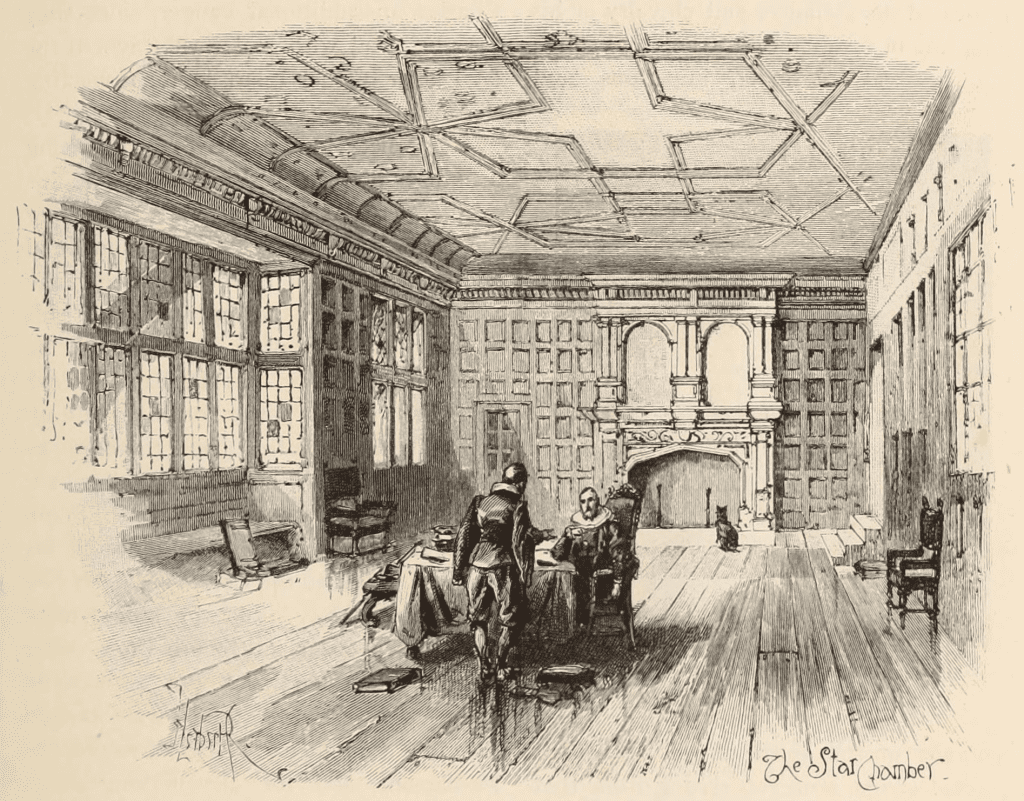
Knowledge Point: The Star Chamber
[Expand / Collapse]
-
The Star Chamberwas a special court in England during the Tudor period (1487–1641), renowned for its efficiency, severity and direct service to the Crown, and was a key instrument by which the Tudor monarchs strengthened central authority and struck at the power of the nobility.
Origin of the name
Its name derives from a room in the Palace of Westminster, where the court originally sat, whose ceiling was decorated with star motifs (the “Star Chamber”). The name has nothing to do with astrology, but comes from the room’s architectural decoration.
Establishment and nature
- Formal establishment: It is generally held to have been formally established by Henry VII by an Act of Parliament in 1487, but its origins can be traced back to the judicial functions exercised by the medieval king’s council.
- Core nature: It was aprerogative court, outside the common law system, directly representing and executing the king’s will. Its procedure was swift and flexible, unconstrained by the cumbersome processes of the common law or by the jury system.
Functions and characteristics
- Jurisdiction over major cases: It chiefly heard major cases that the common-law courts found hard to handle, especially:
- violent, corrupt and disorderly conduct by nobles and magnates(such as keeping private armed forces, rigging juries, and intimidating witnesses).
- crimes against public order and national security(such as rebellion, seditious speech, and forgery).
- abuse of power by officials。
- Procedural characteristics:
- No jury: A bench of judges made up of the Lord Chancellor, the Lord Treasurer, bishops and royal councillors tried the cases.
- Decision on evidence: It emphasized documentary evidence and witness testimony, and could resort to torture to extract confessions.
- Swift and efficient: The procedure was concise, avoiding the delays of common-law litigation.
- Harsh penalties: It could impose heavy fines, imprisonment, and corporal punishment (such as whipping, cropping of ears, and branding), butcould not impose the death penalty. Its fines were an important source of revenue for the Crown.
Historical role and evolution
- The Tudor period (its heyday): Henry VII and Henry VIII used itto forcefully suppress the surviving power of the nobility, maintain order after the wars, and consolidate royal power. It effectively curbed private warfare among the nobility and was praised as ‘the poor man’s court’ (because commoners could sue the mighty there).
- The Stuart period (abuse and abolition): In the seventeenth century, the Stuart kings (especially Charles I) turned it intoa tool abused to suppress political dissent (such as the Puritans) and to impose autocratic rule, and it became a ‘symbol of tyranny’. It was finally abolished by the Long Parliament during the English Revolution of 1641.
Its relation to the Wars of the Roses and Tudor centralization
The establishment of the Star Chamber arose directly fromthe lessons of the Wars of the Roses:
- The wars had exposed the fatal problem of great nobles using their regional power, private armies and manipulation of the law to defy the Crown.
- Henry VII created this court precisely topossess a weapon that could directly and efficiently deter and punish the unlawful acts of the great nobles, thereby uprooting the soil of civil war at its source.
- It was a model of the Tudor dynasty’s ‘achieving political centralization through legal means’; through judicial centralization it ensured that royal commands reached the localities directly, laying the foundation of domestic political control for Henry VIII’s later Reformation.
In short, the Star Chamber was the key judicial lever with which the Tudor dynasty built a new order out of the ruins of the Wars of the Roses — in its early days a sharp instrument for restoring the rule of law and royal power, in its later days degenerated into a symbol of despotism. Its rise and fall bore full witness to England’s tortuous journey from feudal fragmentation toward the modern sovereign state.
II. Marriage and Royal Supremacy
Henry VIII (r. 1509–1547), at the start of his reign, had been a staunch defender of the papacy and was granted the title ‘Defender of the Faith’. Yet his desperate need for a male heir to secure the Tudor dynasty eventually collided irreconcilably with Rome’s canon law. His marriage to Catherine of Aragon (originally the widow of his elder brother) had been sanctioned by papal dispensation, but after years it had produced only a daughter and no male heir. Henry read this as God’s punishment upon the marriage and demanded that it be declared invalid, so that he could marry Anne Boleyn.
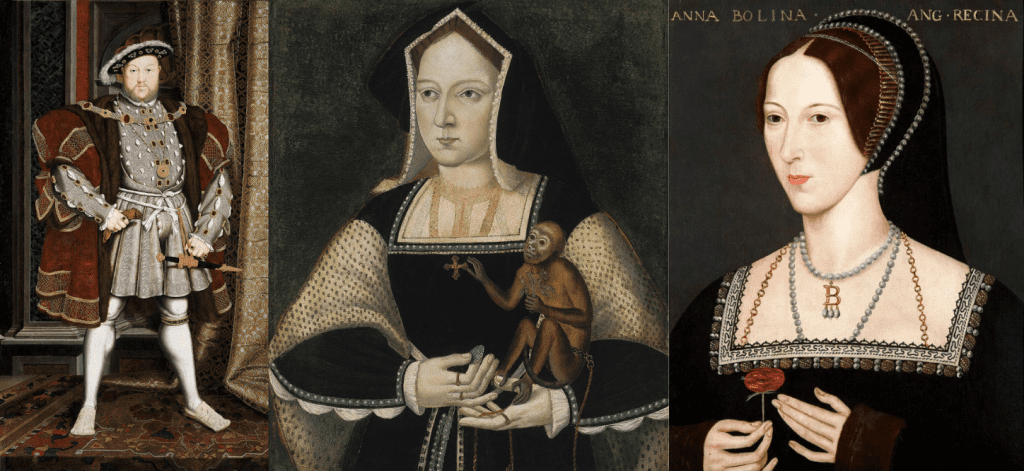
Knowledge Point: Henry VIII’s Queens
[Expand / Collapse]
-
Catherine of Aragonwas the first queen consort of King Henry VIII of England; her status and her marriage were the immediate fuse of the English Reformation.
- Birth and lineage: She was the youngest daughter of Spain’sCatholic Monarchs— Ferdinand II of Aragon and Isabella I of Castile. Of illustrious birth, she was a princess of the most powerful Catholic dynasty in Europe.
- First marriage: She was first married to Henry VIII’s elder brother —Arthur Tudor(Prince of Wales). They wed in 1501, but Arthur died of illness within a few months of the marriage.
- Marriage to Henry VIII: To secure the Anglo-Spanish alliance, and with the dispensation of PopeJulius II, she married the newly enthroned Henry VIII in 1509 (Arthur’s younger brother). The basis of the papal dispensation was Catherine’s insistence that her marriage to Arthurhad never been consummated, and therefore did not fall under the brother’s-wife union forbidden in the Book of Leviticus.
- Offspring and crisis: Catherine was married to Henry VIII for many years and conceived repeatedly, but only one child survived — the futureMary I(‘Bloody Mary’). Henry VIII desperately wanted a male heir, believed that the lack of one was God’s punishment upon the marriage, and began to question the validity of the papal dispensation, holding that the marriage had been void from the start.
-
Anne Boleynwas Henry VIII’s second queen consort and the mother of Elizabeth I; she was the pivotal figure who drove the English Reformation forward.
- Birth and rise: She was no continental princess, but the daughter ofan ambitious English courtier, Sir Thomas Boleyn. Educated at the French court, she was charming in manner, quick-witted and decisive.
- Her entanglement with the king: When Henry VIII pursued her, Anne refused to become the king’s mistress, insisting on the status of queen. This forced Henry tofirst dissolve his marriage to Catherine。
- The catalyst of the Reformation: To marry Anne, Henry VIII waged a legal and political struggle with Rome that lasted years. When Pope Clement VII (constrained by Catherine’s nephew, the Holy Roman Emperor Charles V) refused to declare the marriage invalid, Henry turned to radical measures:declaring the Church of England independent of Rome, with himself as its head。
- Outcome: Anne was crowned queen in 1533 and gave birth to Elizabeth (the future Elizabeth I). But she too failed to produce a male heir, and, entangled in court intrigue, was accused of adultery and treason and in 1536 wasbeheaded。
-
The prohibition in Leviticus
The specific text Henry VIII cited comes from the Old Testament book ofLeviticus, chapter 20, verse 21:
‘If a man takes his brother’s wife, it is an unclean thing; he has uncovered his brother’s nakedness; they shall be childless.’
The logic of the argument put forward by Henry VIII and his supporters (such as the theologian Cranmer) was:
- Catherine had first married his elder brother Arthur, and was therefore his ‘brother’s wife’.
- Even though the pope had granted a dispensation, the marriage violated the law of God (Leviticus).
- Their being ‘childless’ (meaning specifically that there was no survivingmaleheir) was clear proof of God’s punishment; therefore the marriage was void in the sight of God.
This ‘King’s Great Matter’ quickly escalated into a showdown of sovereignty. Under political pressure from the Holy Roman Emperor Charles V (Catherine’s nephew), Pope Clement VII could not bring himself to grant Henry VIII‘s request for an annulment. To marry Anne, Henry VIII waged years of legal and political struggle with the papacy. In the end Henry was driven to the most radical course: declaring the English Church independent of Rome, with himself at its head.
- The Legal and Propaganda Offensive (1529–1533): He summoned the ‘Reformation Parliament’ and pushed through a series of acts that progressively severed ties with Rome. Meanwhile he had scholars (such as Cranmer) argue that the king holds supreme jurisdiction within his realm, and the pope has no right to interfere.
- The Key Breakthrough (1533): The new Archbishop of Canterbury, Thomas Cranmer (who had already secretly acknowledged Henry and Anne’s marriage), formally declared Henry’s marriage to Catherine invalid. Anne was crowned queen.
- The Declaration of Sovereignty (1534): Parliament passed the Act of Supremacy, declaring in statutory form: ‘the king’s majesty is the only supreme head on earth of the Church of England‘. To refuse to swear to it was treason. This was not a reform of religious doctrine but the ultimate assertion of political sovereignty — in England, all authority, including jurisdiction over faith, must rest in the Crown.
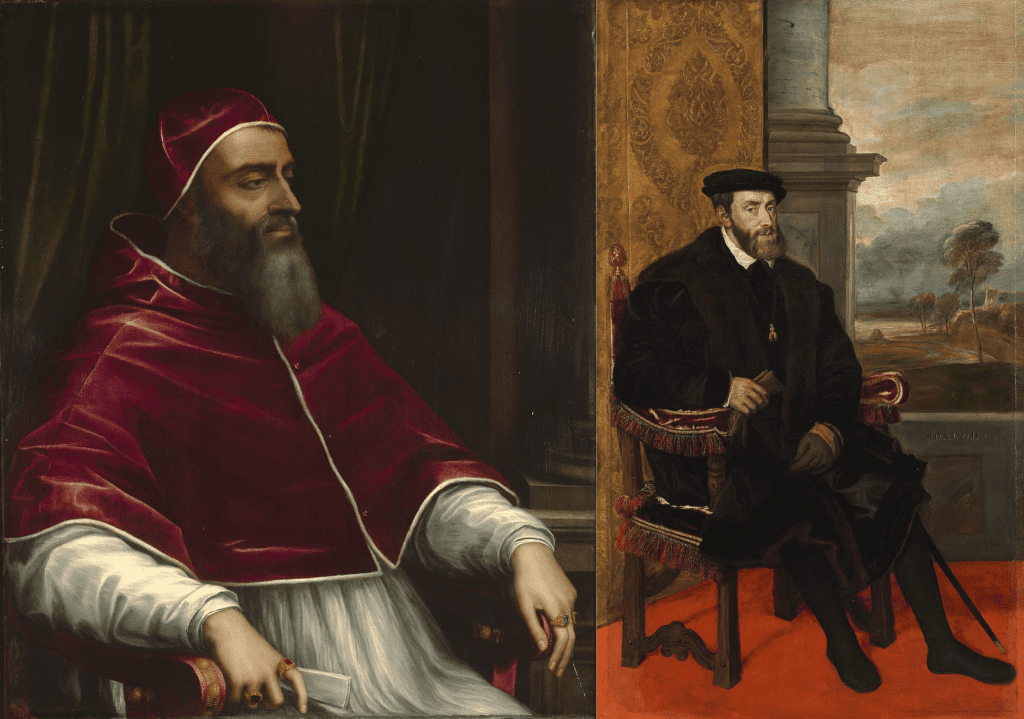
Knowledge Point: The Act of Supremacy in Full and Its Translation
[Expand / Collapse]
-
Henry VIII ‘s Act of Supremacy (1534)
Albeit the king’s Majesty justly and rightfully is and ought to be the supreme head of the Church of England, and so is recognized by the clergy of this realm in their convocations, yet nevertheless, for corroboration and confirmation thereof, and for increase of virtue in Christ’s religion within this realm of England, and to repress and extirpate all errors, heresies, and other enormities and abuses heretofore used in the same, be it enacted, by authority of this present Parliament, that the king, our sovereign lord, his heirs and successors, kings of this realm, shall be taken, accepted, and reputed the only supreme head in earth of the Church of England, called Anglicana Ecclesia; and shall have and enjoy, annexed and united to the imperial crown of this realm, as well the title and style thereof, as all honors, dignities, preeminences, jurisdictions, privileges, authorities, immunities, profits, and commodities to the said dignity of the supreme head of the same Church belonging and appertaining; and that our said sovereign lord, his heirs and successors, kings of this realm, shall have full power and authority from time to time to visit, repress, redress, record, order, correct, restrain, and amend all such errors, heresies, abuses, offenses, contempts and enormities, whatsoever they be, which by any manner of spiritual authority or jurisdiction ought or may lawfully be reformed, repressed, ordered, redressed, corrected, restrained, or amended, most to the pleasure of Almighty God, the increase of virtue in Christ’s religion, and for the conservation of the peace, unity, and tranquility of this realm; any usage, foreign land, foreign authority, prescription, or any other thing or things to the contrary hereof notwithstanding.
Henry VIII’s Act of Supremacy (1534)
Although the king’s majesty justly and lawfully is, and ought to be, the supreme head of the Church of England, and is so recognized by the clergy of this realm in their convocations, yet nevertheless, for the corroboration and confirmation thereof, and for the increase of virtue in Christ’s religion within this realm of England, and to repress and extirpate all errors, heresies, and other enormities and abuses heretofore used in the same, be it enacted by the authority of this present Parliament that the king, our sovereign lord, his heirs and successors, kings of this realm, shall be taken, accepted and reputed the only supreme head on earth of the Church of England, called Anglicana Ecclesia; and shall have and enjoy, annexed and united to the imperial crown of this realm, as well the title and style thereof as all honours, dignities, pre-eminences, jurisdictions, privileges, authorities, immunities, profits and commodities to the said dignity of supreme head of the said Church belonging and appertaining; and that our said sovereign lord, his heirs and successors, kings of this realm, shall have full power and authority from time to time to visit, repress, redress, record, order, correct, restrain and amend all such errors, heresies, abuses, offences, contempts and enormities, whatsoever they be, which by any manner of spiritual authority or jurisdiction ought or may lawfully be reformed, repressed, ordered, redressed, corrected, restrained or amended, most to the pleasure of Almighty God, the increase of virtue in Christ’s religion, and for the conservation of the peace, unity and tranquillity of this realm; any usage, foreign land, foreign authority, prescription, or any other thing or things to the contrary hereof notwithstanding.
The ‘solution’ to the marriage question was in fact accomplished as a thoroughgoing national revolution. Henry VIII not only achieved his aim of divorce and remarriage, but more importantly seized the opportunity to nationalize the wealth and power of the Church. In 1535 and 1539 Henry VIII issued the First and Second Suppression Acts, and immediately launched the Dissolution of the Monasteries (1536–1541), systematically confiscating the vast lands and property of the monasteries. Most of these assets were sold or granted to the gentry, officials and merchants, creating a new vested-interest class firmly bound to the fate of the Reformation.
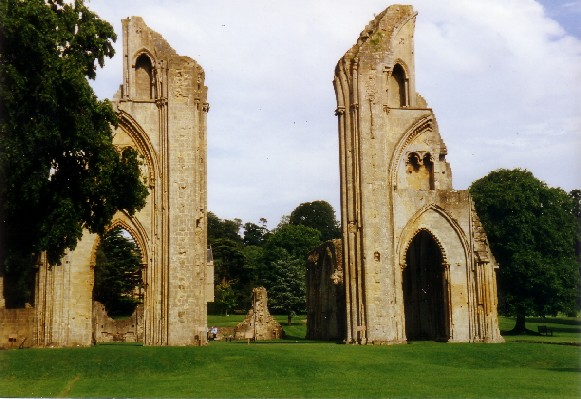
Knowledge Point: The Dissolution of the Monasteries
[Expand / Collapse]
-
The Dissolution of the Monasteries, sometimes called the Suppression of the Monasteries, refers to the process between 1536 and 1541 by which Henry VIII, through a series of administrative and legal measures, dissolved all Catholic monasteries, priories, nunneries and mendicant houses in England, Wales and Ireland, confiscated their property, disposed of their assets, destroyed their buildings and relics, dispersed or destroyed their libraries, and made arrangements for their former personnel and functions.At the time England had nearly nine hundred religious houses, including about 260 monasteries for men, 300 houses of regular canons, 142 nunneries and 183 mendicant houses; in total roughly 12,000 people, of whom 4,000 were monks, 3,000 regular canons, 3,000 friars and 2,000 nuns. If the adult male population was half a million, this meant that one in every fifty adult men belonged to a religious order. The movement has therefore alsobeen described as “the most violent disturbance of population, property and daily life in England since the Norman Conquest”.
III. Blood and Religion
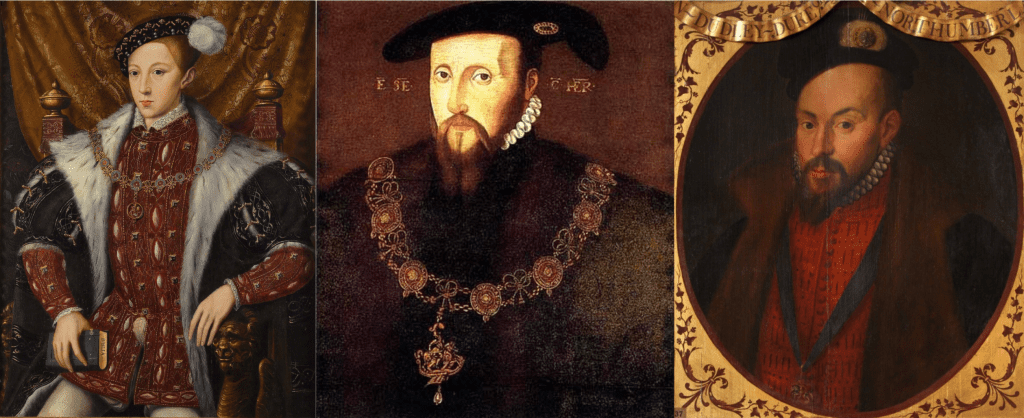
Over the following two decades or so, England was plunged into fierce conflict and upheaval over whether royal or divine authority was the supreme power in the land. In 1547 Henry VIII died, and his nine-year-old son Edward VI succeeded him (r. 1547–1553). As the king was a child, power passed successively to two regents: first the Duke of Somerset, then the Duke of Northumberland. Under their forceful direction, the English Church underwent a radical Calvinist reform: doctrine, liturgy and even church furnishings were thoroughly Protestantized, deepening the rupture with the traditions of Roman Catholicism.
Knowledge Point: Calvinism
[Expand / Collapse]
-
John Calvinwas one of the most important theologians and leaders of the sixteenth-century European Reformation, ranked with Martin Luther as one of the two founding fathers of the Protestant Reformation. His system of thought —Calvinism— not only shaped the theological foundations of Reformed Protestantism, but exerted a profound influence on modern Western politics, economics, society and culture.
His theology is often summed up by theTULIP(‘tulip’) — five points (codified by later generations):
- Total depravity: Humanity is utterly fallen through original sin and cannot, of its own will, choose God.
- Unconditional election: Before creation God unconditionally chose certain people for salvation, independent of personal conduct.
- Limited atonement: Christ’s atonement was made only for the elect.
- Irresistible grace: The elect cannot resist God’s saving grace.
- Perseverance of the saints: Once elected, one will never lose salvation.
Under Edward VI, Calvinism directly influenced England through the following means:
- The destruction of images: Removing or destroying within the churchesthe icons, stained-glass windows, crosses and altar-pieces, deeming them ‘idolatry’ that hindered believers from communicating directly with God.
- The simplification of worship:
- 用Englishto entirely replace Latin in worship.
- Splendid vestments were abolished, and clergy wore plain black gowns instead.
- The altar was removed from the east end of the church, or replaced by aplain wooden table, emphasizing that the Eucharist is a shared feast of the faithful, not a priestly sacrifice.
- Masses for the dead, the doctrine of purgatory, and its related rites were abolished.
- The fixing of the Book of Common Prayer: The second Book of Common Prayer, issued in 1552, entirely purged from its communion liturgy any wording that might suggest Christ’s ‘real presence’, fully embodying the Calvinist doctrine of commemoration.
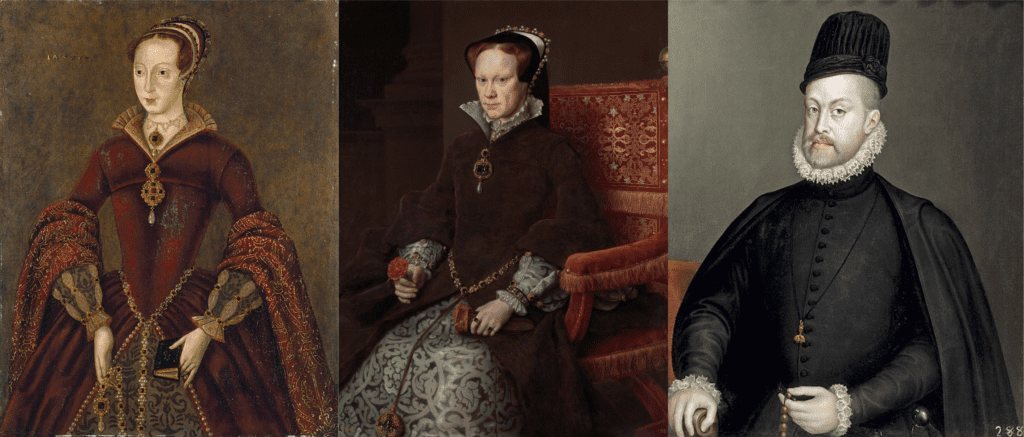
On 6 July 1553, the sickly Edward VI died of tuberculosis. On his deathbed, manipulated and influenced by the Duke of Northumberland, he contravened the provisions of his father Henry VIII’s Act of Succession, and on the grounds that his two sisters (Mary and Elizabeth) were ‘illegitimate’, deprived them of the succession and instead designated his cousin, the devout Protestant Lady Jane Grey, as his heir. The aim was to prevent the Catholic Mary from taking the throne, so as to preserve the achievements of the Protestant Reformation.
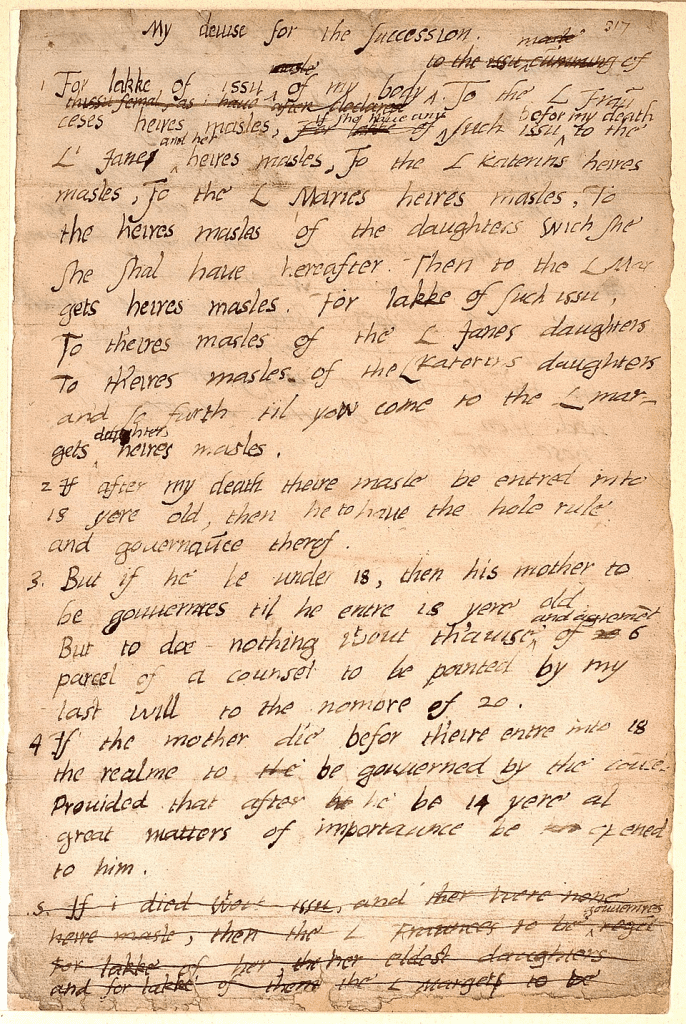
Knowledge Point: Interpreting the Device for the Succession
[Expand / Collapse]
-
- Nature: This was the ‘device’ draft personally composed and amended by Edward VI in June 1553 (about a month before his death), ‘will’, legally called the ‘Device for the Succession’. Its purpose was to bypass the order laid down in his father Henry VIII’s Act of Succession (Mary → Elizabeth), deprive his two sisters of the succession, and pass the throne to the Protestant Jane Grey.
- Content: The document laid down a new order of succession. The crucial point lay in the details that Edwardaltered in his own hand:
- Originally it read ‘Lady Jane’s male heirs’(“L[ady] Janes heires masles”).
- Later it was amended to ‘Lady Jane and her male heirs’(“L[ady] Jane and her heires masles”).
- This amendment was crucial: It meant the throne would pass first directly to Jane Grey herself, rather than to her (future) son. This ensured Jane couldascend the throne immediately, avoiding the power vacuum that would arise from waiting for a male heir to be born, and so preventing Mary from seizing her opportunity.
Why does this matter so much?
- It demonstrates Edward’s autonomy and resolve: The autograph amendments show that this document was not entirely a puppet text manipulated by the Duke of Northumberland. Edward VI himself — a devout and radical Protestant — was deeply involved, genuinely believing that the Catholic Mary had to be kept from the throne to save the Protestant cause in England.
- It reveals the urgency of the coup and its legal packaging: The amendments show the plotters’ consideration ofthe urgency of time. They needed Jane crowned at once, to consolidate power by military and legal means. The document was then submitted to the Privy Council, and judges and nobles were compelled to swear to obey it, becomingan amendment to the Act of Succession of 1536, in an attempt to clothe the coup in the garb of legality.
- It highlights the essence of the Tudor succession crisis: This document is anextreme instance of religious position overriding bloodline and legal tradition. To preserve the Protestant regime, the king and the magnates did not scruple to break the established law of succession with their own hands — which in itself shook the foundation of legitimacy and gave Mary’s counter-strike a moral justification.
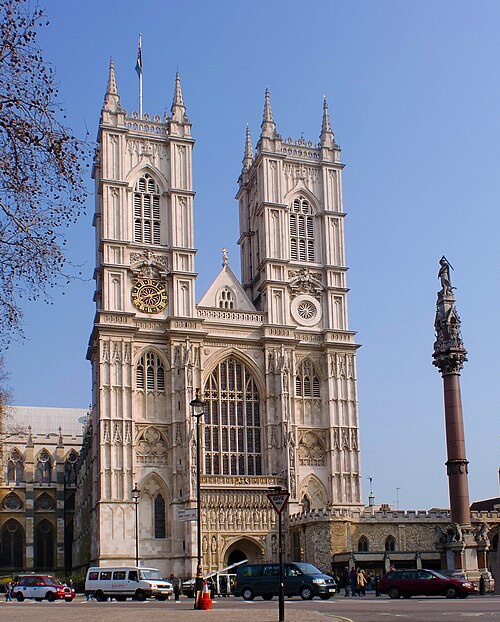
On 10 July 1553, Jane Grey was proclaimed queen. However, Mary swiftly gathered the support of Catholics and conservative forces in East Anglia and marched on London. Faced with overwhelming public opinion and the defection of the nobility, the Duke of Northumberland’s scheme rapidly collapsed. On 19 July, Mary entered London without bloodshed, and Jane Grey was forced to abdicate after a ‘reign’ of just nine days. On 1 October 1553, Mary was formally crowned at Westminster Abbey, becoming Mary I. She at once launched a fierce counter-reformation aimed at returning England wholly to Roman Catholicism, and her reign has been remembered ever since for that reason.
Mary’s foremost aim was to systematically destroy the Protestant establishment built up by her younger brother Edward VI. She had Parliament repeal all of Edward’s religious legislation, and restored the Latin Mass, clerical celibacy and full communion with Rome. In 1554, her marriage to the Spanish prince Philip (later King Philip II of Spain), a fanatical Catholic, provoked enormous fear in England that Protestantism would be strangled by a foreign power — yet it made her believe she had secured the backing of Europe’s mightiest Catholic dynasty.
The true terror followed. From 1555, Mary began to persecute on a massive scale all who refused to abandon their Protestant faith. Nearly three hundred ‘heretics’ — bishops, scholars, artisans and ordinary believers — were publicly burned at the stake. The most famous was Archbishop of Canterbury Thomas Cranmer, the very man who had supplied the theological justification for Henry VIII’s divorce and presided over Edward VI’s reforms: in the flames he thrust first into the fire the hand that had signed his recantation, crying out: ‘This hand hath offended!’ This persecution, lasting nearly four years, earned Mary the infamy of ‘Bloody Mary’ and etched into the English national memory a lasting dread of Catholic rule and foreign interference.
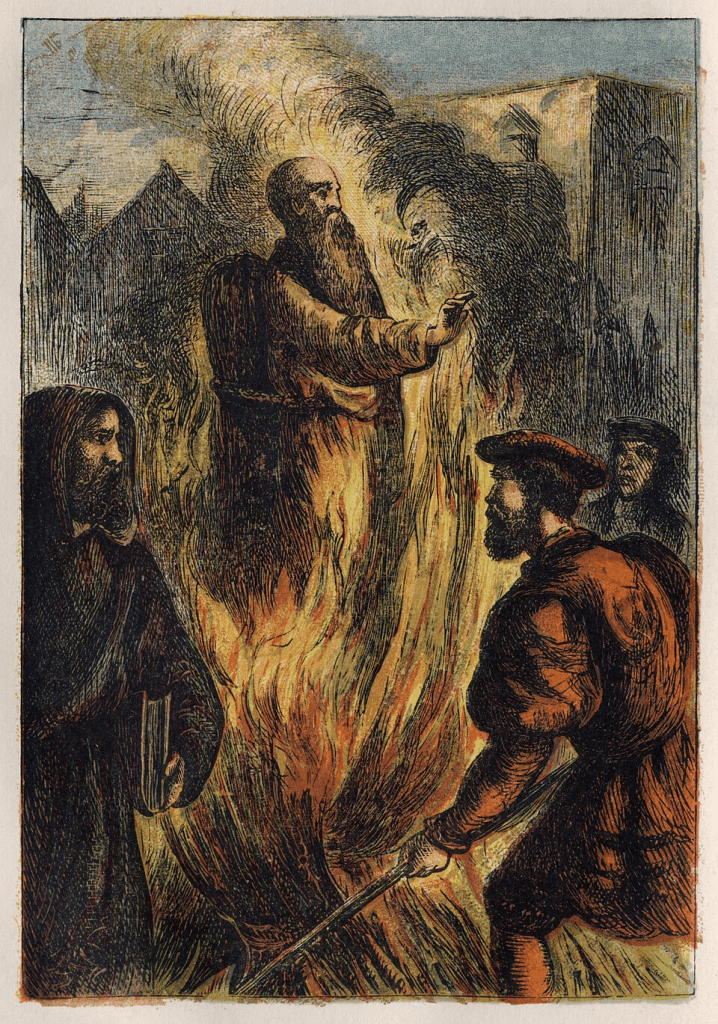
Mary’s religious zeal and diplomatic choices ultimately led to disastrous political consequences. To support her husband Philip II against France, England was drawn in 1557 into war with France. The following year, England’s last foothold on the Continent — the port of Calais — fell to the French. Held since 1347, Calais was not only a vital trading hub but a symbol of England’s national glory and continental ambition. Its permanent loss was widely seen as a mark of Mary’s incompetent rule, unleashing national humiliation and fury that greatly undermined the queen’s prestige.

Mary’s personal tragedy deepened the dynastic crisis. She desperately longed for a child to continue the Catholic cause, but in the end it was not to be. Her health deteriorated rapidly amid disappointment, illness and the strains of rule. On 17 November 1558, Mary I died at St James’s Palace in London. She left no children, and under Henry VIII’s will and the acts of Parliament, the legitimate and sole heir was none other than her half-sister — the Protestant Elizabeth, whom she had once imprisoned in the Tower of London. When the messenger rode from London to Hatfield House to bring the news to the twenty-five-year-old Elizabeth, the future queen was sitting under an oak tree reading. It is said that, upon hearing the tidings, she fell to her knees and murmured in Latin: ‘This is the Lord’s doing, and it is marvellous in our eyes.‘
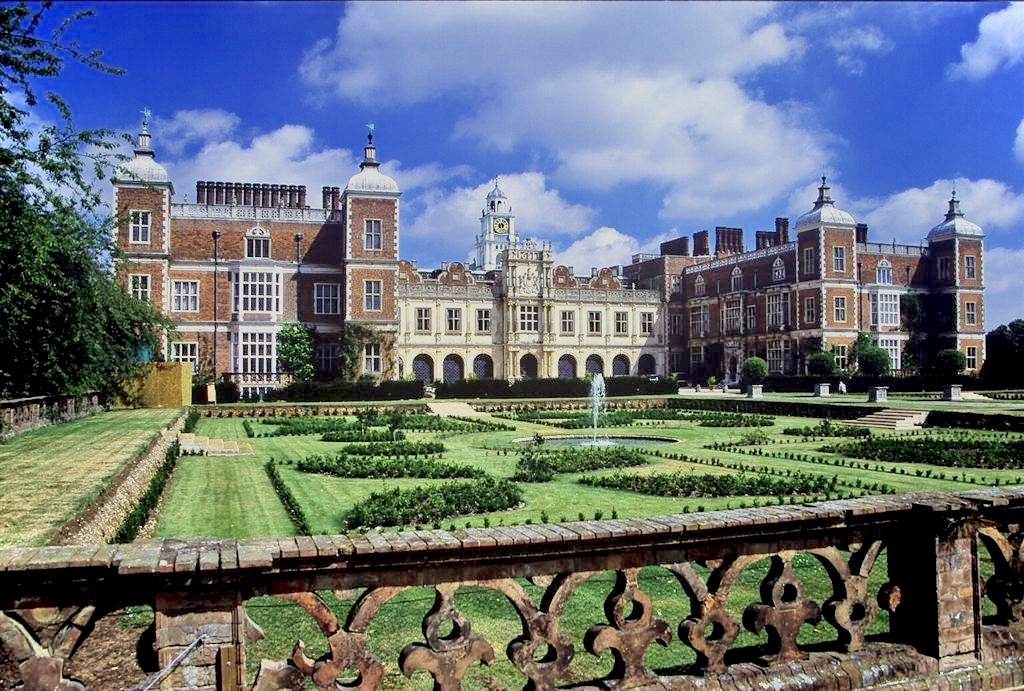

IV. The Established Church and the Settlement
When Queen Elizabeth I came to the throne in 1558, what she inherited was a country torn by religious hatred, with an empty treasury and international prestige at rock bottom, left behind by her father, sister and brother. Her reign was, from the very outset, a precisely engineered project aimed at rescuing the nation from division and remaking its greatness. The core of this project was what later generations called the ‘Religious Settlement‘. Through the Act of Supremacy and the Act of Uniformity of 1559, she deftly re-established the monarch’s supreme governance over the Church while issuing a Book of Common Prayer whose careful wording left key doctrines in ‘strategic ambiguity’. The prayer book allowed conservatives to see echoes of the traditional rites, and reformers to find interpretations in keeping with Protestant doctrine. Its fundamental purpose was forcibly to mark out a middle path called ‘the Church of England’ between radical Puritans and stubborn Catholics, and to make obedience to this unified liturgy the touchstone of national identity and political loyalty.
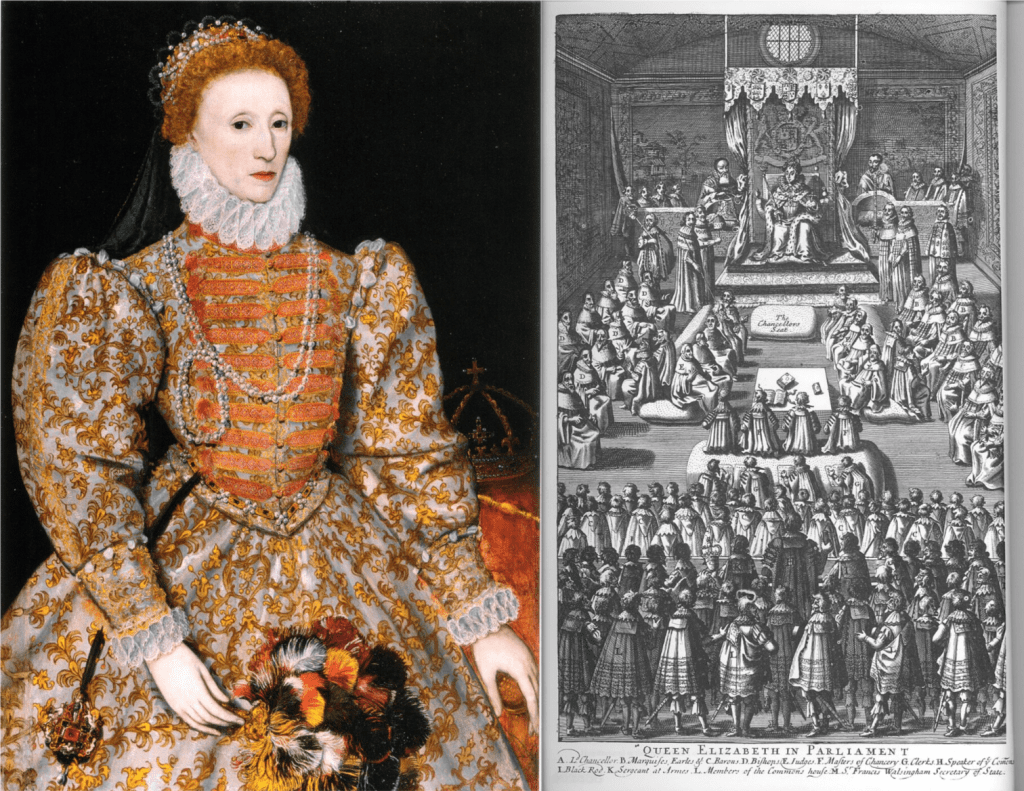
Knowledge Point: The New Acts
[Expand / Collapse]
-
The Act of Supremacy:
- Content: Re-established the king (or queen) as ‘the supreme governor of the Church of England in earth’ . Note that Elizabeth prudently adopted ‘Supreme Governor’ rather than her father’s ‘Supreme Head’ , to appease the Calvinists (Puritans) who held that only Christ is the head of the Church.
- Substance: This wasa reaffirmation of political sovereignty. It severed the juridical and financial ties with Rome and secured the integrity of national sovereignty, but it made no radical doctrinal definitions.
The Act of Uniformity:
- Content: It compelled the whole nation to usethe uniformly revised Book of Common Prayer(based on Edward VI’s second Book of Common Prayer of 1552, but with crucial modifications).
- Substance: This wasThe core instrument for shaping a unified national liturgy and identity. Every word of the liturgy was carefully honed to accommodate differing theological understandings.
Knowledge Point: The Essential Significance of the Book of Common Prayer
[Expand / Collapse]
-
Concessions to Catholics:
- The episcopate, church buildings, vestments and other traditional outward forms were retained.
- In the wording of the communion service, an eclectic formula was adopted. It took in the 1552 version’s Protestant-leaning ‘take and eat this bread, in remembrance that Christ’s body was broken for you’ , while also restoring some wording from the 1549 version closer to the Catholic doctrine of ‘transubstantiation’, such as retaining the term ‘the Body of our Lord Jesus Christ’. This allowed traditionalists to understand it in the old way.
- As to clerical eligibility, theological conformity was not strictly demanded at first, and many Catholic clergy from Mary’s reign were allowed to remain in their posts.
Satisfactions for Protestants (Puritans):
- Worship usedEnglish, not Latin.
- Papal authority was explicitly denied.
- The importance of preaching and of reading the Bible was stressed.
- In the communion service, the laity could receive both the bread and the cup (unlike the Catholic practice of giving the bread alone).
Within this grand design, music was assigned an unprecedented national function. The magnificent Great Service and the dynasty-glorifying anthems were no longer expressions of private devotion, but were transformed into auditory symbols that forged a unified national identity. Beneath the dome of the Chapel Royal in London, the polyphony thundered out by organ and choir built an acoustic emblem of an orderly, God-favoured England. Every note took part in celebrating the queen as supreme governor of the Church, turning religious worship into a political spectacle that reinforced the authority of the state and the sense of a shared national destiny.
- These are two canticles (the Magnificat and the Nunc Dimittis) from Byrd’s monumental Great Service, the crowning works he composed for the Church of England.
- ‘Purge me, O Lord’
This is one of Thomas Tallis‘s most representative short English anthems, a finely wrought polyphonic piece for four to five voices, hailed as the perfect exemplar of ‘piety and clarity’ in the Church of England anthem. It distils the core function of Elizabethan sacred music: turning the words of the Book of Common Prayer into a shared emotional experience that binds the community of faith.
Knowledge Point: The Essential Significance of the Great Service and the Anthem
[Expand / Collapse]
-
- The transformation of function: Music was elevated from a medium of private devotion intothe grand acoustic architecture of national ceremony. In the royal churches (such as St Paul’s Cathedral and the royal chapels), the polyphony rendered by organ and professional choirs, through itspower to fill space, its harmony of order and its power to elevate the emotions, gave audible form to the national image of ‘a united, orderly, blessed England’.
- The symbolism of the content: Composers such asThomas Tallis和William Byrdcreated English church music that united the exquisite polyphonic technique of the Renaissance with English texts. The music was grand and complex enough to satisfy the longing for traditional ritual beauty (soothing those with Catholic leanings), while ensuring that the words praising God and the queen remained clearly audible (meeting the Protestant demand for ‘intelligibility’). The anthems, often written for royal celebrations, directly depicted the queen as a ruler under divine providence.
- A unifying experience: Whatever their personal theological stance, when the people — at least those who entered the churches — were surrounded by the same magnificent sound and sang the same hymns, theyshared a common emotional experience that transcended doctrinal divisions. Here music played the role ofemotional integration and social cohesion.
Yet Elizabeth’s statesmanship went far beyond religion. She knew that the realm’s stability demanded wealth and prestige. She therefore encouraged maritime adventure and privateering: the voyages of Drake and others, and their raids on Spanish treasure fleets, though controversial, injected the kingdom with much-needed capital and kindled the nation’s oceanic ambition. In foreign policy she deployed superb marriage diplomacy and a balance-of-power strategy, long keeping her unmarried status as a political bargaining chip while manoeuvring among the Catholic powers of France and Spain, winning England precious time for development. And when Philip II of Spain at last sent the ‘Invincible Armada’ to conquer this heretical island kingdom, the glorious victory of 1588 was not merely a stroke of military fortune — it was shaped by her propaganda machine into the providential myth of Protestant England, divinely protected, triumphing over a tyrannical Catholic empire, and it immensely rallied the nation’s heart.
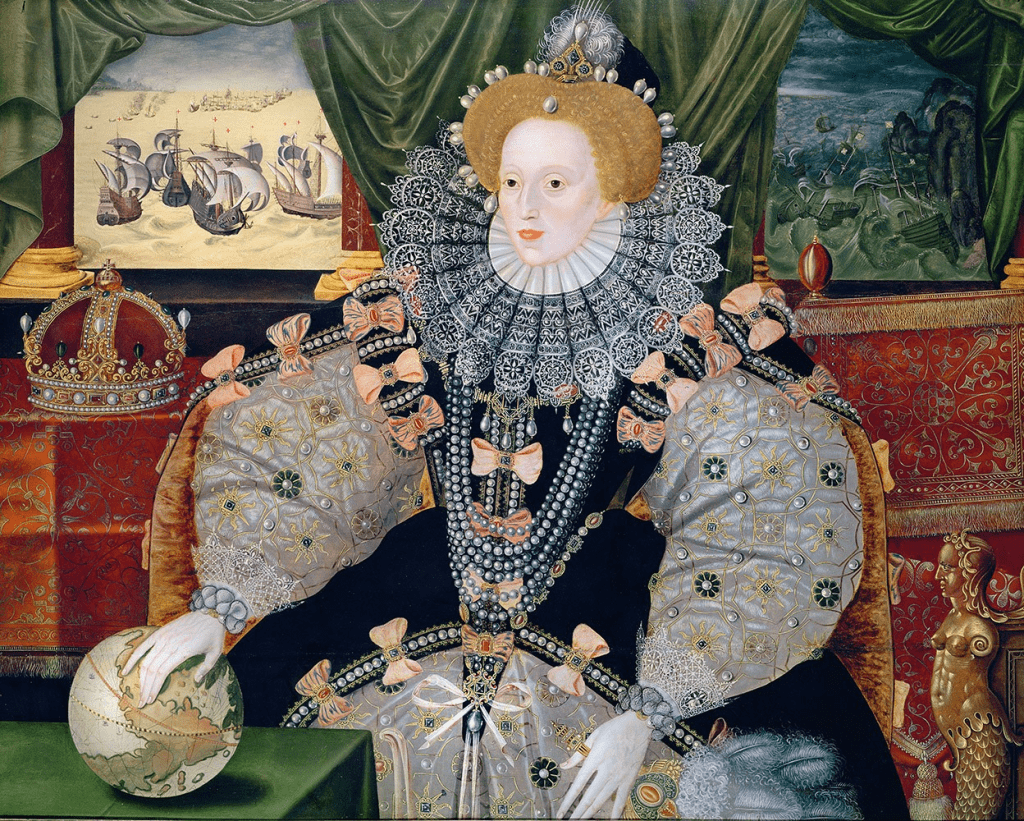
Knowledge Point: The Succession of Maritime Hegemony
[Expand / Collapse]
-
I. Background: the escalation of the Anglo-Spanish conflict
- The fundamental contradiction: Religious opposition (Protestant England vs. Catholic Spain), geopolitical rivalry (England challenging Spain’s maritime hegemony and American colonial interests), and England’s support for the Dutch Revolt against Spanish rule.
- The immediate trigger: In 1585 Elizabeth openly supported the Dutch rebels, and England and Spain entered a state of war.Francis Drakeand other ‘sea dogs’ and privateers began systematically raiding Spanish ports in the Caribbean (1585) and at home (such as the surprise attack on Cadiz in 1587 that destroyed much of the fleet in preparation), infuriating King Philip II of Spain.
II. Climax: the rout of the Armada in 1588
- The Spanish plan: In 1588, Philip II sent the great ‘Invincible Armada’ into the English Channel, planning to rendezvous with the Duke of Parma’s army in the Netherlands and invade England.
- The English response: The Royal Navy, underDrake和and Howard, exploiting the advantages of nimbler ships and longer-range guns, fought a harassing campaign.
- The decisive blow: In the Battle of Gravelines, the English usedfireshipsin a night attack, throwing the Spanish formation into confusion; then storms (the ‘Protestant wind’) drove the broken fleet northward. The Spanish fleet suffered heavy losses while sailing home around Scotland and Ireland.
- A political and propaganda victory: Although the enemy was not wholly annihilated militarily, the threat of invasion was lifted. Elizabeth, at theTilbury reviewof her troops, delivered her famous speech, immensely raising morale. The campaign was fashioned into ‘God protecting Protestant England and the Virgin Queen’ — a national myth, becoming a symbol of Elizabethan glory.
III. Turn and stalemate: the war becomes protracted (1589–1604)
The failure of the Armada was not the end of the war; on the contrary, it opened a far longer naval war of attrition:
- England’s counter-attack is repulsed (1589): Elizabeth sent a ‘counter-Armada’ to invade Spain itself, which met withcatastrophic failure (losing over ten thousand men and forty ships), and Spanish naval power quickly recovered.
- The economic warfare of ‘sea dog’ privateering: Alongside the standoff of the official navies,Drake, Hawkins and Raleighand other privateering captains, funded by the Crown and by merchants, kept plundering Spanish treasure fleets and colonies. This wasstate-sponsored, systematic piracy, bringing England enormous profits (such as the capture of the great Portuguese ship ‘Madre de Deus’ in 1592) and severely draining Spain’s strength.
- Later military clashes:
- 1596: England, allied with the Dutch, capturedCadiz, a major tactical victory, but the commander-in-chief, the Earl of Essex, fell out with the queen as a result.
- 1597–1601: Spain organized three further large fleets (the second, third and fourth ‘Armadas’), but all failed to achieve their strategic goals because ofbad weather, command errors or tactical failure, most notably the final failure of the expedition to support rebels in Ireland (the Battle of Kinsale, 1601).
IV. Denouement: the peace of exhaustion
- Nearly two decades of war exhausted both sides financially (Spain went bankrupt several times; England’s finances were strained).
- The key figures died in succession: Drake and Hawkins (1595), Philip II (1598), Elizabeth I (1603).
- In 1604, the newly succeeded James I signed with the new King of Spain, Philip III, the Treaty of London , formally ending the war. The treaty restored peace and trade and in effect acknowledged England’s status as an emerging maritime power; Spain’s absolute hegemony was broken.
Core summary
- Nature: This was acomposite conflict mixing religious war, national rivalry, the contest for sea power and economic plunder.
- The key point: The victory of 1588 was more aturning point in spirit and politics than a military end. The real contest lay in the longnaval war of attrition and economic warfare。
- that followed.:
- For England: It established national self-confidence and the identity of a maritime power; privateering accumulated primitive capital that laid the groundwork for later colonial expansion.
- For Spain: Its hegemony was challenged, vast wealth was plundered, and its power turned from strength to decline.
- For history: It marked the beginning of the shift of Europe’s centre of power from the traditional land-based empire (the Spanish Habsburgs) toward the emerging sea powers (England and the Netherlands).
The whole of Elizabeth I’s life work can be summed up as the transformation, with a flexible yet resolute hand, of England from a weak kingdom riven by internal strife and beset by external peril into a sovereign state with a strong national identity and the first glimmer of imperial ambition. Her Religious Settlement provided the framework for internal stability, her economic and diplomatic policies accumulated strength, and the final naval victory founded the myth of national self-confidence. Although religious persecution under her rule remained cruel and social contradictions never disappeared, she nonetheless succeeded in riding the towering waves of her age, infusing the very concept of ‘England’ with lasting strength and a distinctive character, and her legacy far outlived her dynasty, directly shaping the future trajectory of British history.
Knowledge Point: The Cost of the Settlement
[Expand / Collapse]
-
- Legal coercion: Failure to attend the services of the Established Church was punished by fines (‘recusancy fines’), and publicly opposing its doctrine could lead to imprisonment. Conformity was compulsory.
- It created new ‘nonconformists’:
- Radical Puritans: Believing the reform incomplete, they demanded the removal of every Catholic remnant (a ‘purification’), and became a major force in the later constitutional revolutions.
- Devout Catholics: Refusing to acknowledge the queen’s religious authority, they faced persecution, and some went underground or into exile.
- Pragmatism over doctrinal purity: Elizabeth once famously said: ‘I do not wish to make windows into men’s souls.‘ This reveals the essence of the Settlement — what it pursued wasoutward uniformity and obedience, not inward unity of belief. This was atriumph of reason of state.
First Movement: The Apprentice Amid the Undercurrents
William Byrd was born around 1540. At that moment England’s religious landscape was on the verge of a millennial upheaval — amid the raging waves of Henry VIII’s radical Reformation. What this future composer beheld when he opened his eyes was a kingdom that had broken with Rome, whose monasteries were being dissolved, yet where the after-echoes of the Latin Mass had not entirely faded. His entire youth happened to fall within the most violent pendulum swings of Tudor religious politics. Through his childhood he successively lived through the bloody Catholic restoration of Mary I (1553–1558) and then the final establishment of the Protestant Elizabeth I (after 1558). His artistic initiation and early career unfolded in the unease of these ceaselessly switching regimes of faith and power.
There is little recorded about Byrd’s precise early education, but two threads outline its probable course. He came from a gentleman family with a musical background, and two of his elder brothers had served in the choir of St Paul’s Cathedral. More crucially, he is generally regarded as the pupil of Thomas Tallis. Tallis was at least thirty-five years Byrd’s senior, and had served through the reigns of Henry VIII, Edward VI and Mary I; his career itself was a symbol of how England’s musical tradition survived amid religious rupture. If Byrd indeed studied under him at the Chapel Royal, then what he inherited was a native polyphonic craft, rooted in the soil of England and transcending the boundaries of any creed. Its foundations predated the Established Church and outlasted the brief Catholic restoration, becoming the ultimate capital with which he would meet every later upheaval.
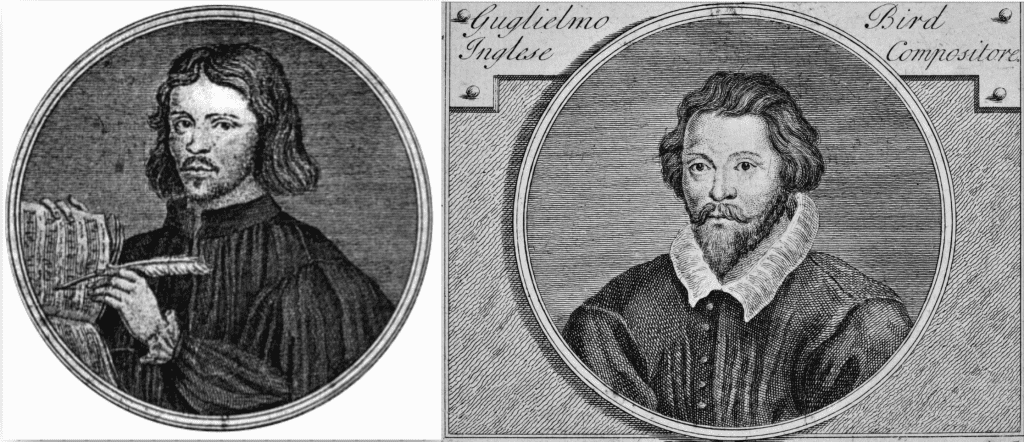
Knowledge Point: Thomas Tallis
[Expand / Collapse]
-
Thomas Tallis (c. 1505 – 1585)
Thomas Tallis was one of the most pioneering and influential composers of the English Renaissance, often hailed as ‘the father of English music’. His long career spanned the most turbulent period of the Tudor Reformation, serving four monarchs — Henry VIII, Edward VI, Mary I and Elizabeth I — and his output profoundly reflects the transformations of the age.
Key biography and historical role
Witness and adapter of his age
Tallis’s life witnessed the fundamental transformation of England from Roman Catholicism to the Church of England. As organist and composer of the Chapel Royal, he had to write music for the ever-changing official liturgy: from the Latin Catholic Mass, to the austere English church music of Edward VI’s reign, to the brief restoration of the Latin rite under Mary I, and finally works for the Church of England as established by Elizabeth I. His musical career is itself a history of survival through political and religious upheaval.Teacher and partner of William Byrd
Tallis was the mentor of the younger composer William Byrd and had a decisive influence on the formation of Byrd’s technique and style. In 1575 the two together received from Elizabeth Ithe monopoly for music printing and publishing, the first patent of its kind in English history. To commemorate the occasion they jointly published the landmark collection ‘Cantiones quae ab argumento sacrae vocantur‘ (Cantiones which by their subject are called sacred), each contributing seventeen motets, dedicated to the queen.
His early works, such as the consort pieces ‘Sermone Blando’ and ‘Miserere’, already show a solid polyphonic craft. More importantly, in the last years of Queen Mary’s reign (before 1558), this youth very likely encountered — perhaps even participated in — the music written for the restored Catholic Sarum Rite. His piece ‘Christus resurgens’ (Christ rising again), an Easter responsory, is deeply rooted in that tradition in its musical idiom. Yet Elizabeth’s accession in 1558 brought not continuity but yet another complete volte-face. Before he was twenty, Byrd had witnessed a second great upheaval in the official musical context: public music had once more to turn, this time to serve the newly established liturgy of the Church of England. His apprenticeship was, in essence, a matter of learning a craft while watching its social function and legitimacy be repeatedly redefined by regime change.
Knowledge Point: The Catholic Sarum Rite
[Expand / Collapse]
-
The term ‘Catholic Sarum Rite’ needs to be unpacked and understood in its historical context, because it points to ahistorical phenomenon of a particular time and place.。
1. Unpacking the core concept
The Sarum Rite: Its more accurate name is the ‘Sarum Use’ 或 the ‘Use of Sarum’. It is not a rite separate from Catholicism, buta distinctive body of Latin liturgical practice used by the medieval Catholic Church in England.. Its name derives from its centre of codification and standardization —Salisbury Cathedral. In the Middle Ages, although the papacy in Rome was the centre, the great dioceses of Europe (such as Toledo in Spain and Lyon in France) each had their own local traditions in the details of the Mass and the Divine Office, the arrangement of feasts, and the music used (the chant melodies); these were called ‘rites’ or ‘uses’. The Sarum Rite is the most influential local rite that developed on English soil.
Catholic: This is the crucial qualifier. Beforethe English Reformation of 1534, the Sarum Rite wasthe standard liturgy used by the Catholic Church in England. That is, before Henry VIII’s break with Rome, an English Catholic going to church experienced the Mass and the Divine Office of the Sarum Rite.
2. Historical evolution: from ‘Catholic’ to ‘Church of England’
The fate of the Sarum Rite was tightly bound to England’s religious politics:
- Before the Reformation: Asthe native rite of English Catholicism, the Sarum Rite had been in use for centuries, with a rich body of proper music (chant) and complex, exquisite ceremonial. Thomas Tallis’s early works were written to serve this rite.
- During the Reformation:
- After Henry VIII established the Church of England, the liturgy at first changed little; the Sarum Rite continued in use, but references to the pope began to be removed.
- 在Edward VI‘s radical Protestant reforms, the two Books of Common Prayer of 1549 and 1552 replaced Latin with English, fundamentallysuperseding the Sarum Rite. Liturgical music was likewise reformed in the direction of simplicity and of making the words intelligible.
- Mary IDuring the Catholic restoration (1553–1558),the Sarum Rite was briefly restored. It was precisely in this period that the young William Byrd likely encountered and studied the Latin polyphony written for this rite.
- Elizabeth I, upon her accession, re-established the national liturgy based on the English Book of Common Prayer. As an open, complete Catholic rite, the Sarum Rite’s legal status in England came to an end.
3. The direct connection to music
For composers such as Tallis and Byrd, the importance of the ‘Sarum Rite’ lay in:
- It was a vehicle of musical tradition: It was a complete system of texts and music. Many ancient chant melodies (plainsong) and the polyphony built upon them (such as Masses and motets) were written for the specific feasts and ritual moments of the Sarum Rite (such as the Gradual and the Alleluia).
- It was a source and framework for composition: Even after Catholicism was proscribed, composers (especially those with Catholic leanings, like Byrd) continued privately to set the texts of the Sarum Rite. Byrd’s early work ‘Christus resurgens’, for instance, sets the text of the responsory used in the Sarum Easter liturgy. These works arean artistic nostalgia for, and a steadfast clinging to, a vanished tradition.。
- The contrast after the Council of Trent: Even as England underwent its Reformation, the Roman Catholic Church convened theCouncil of Trent, to reform and regulate itself. After the Council, Rome vigorously promoteda uniform Roman Rite, to eliminate local differences. Thus when English Catholics gradually resumed their activities after the seventeenth century, what they generally adopted was the reformedRoman Rite, not the ancientSarum Rite. From this point the Sarum Rite truly became a relic of history.
-
The following table compares the Sarum Rite with the other major local rites of the same era (before about the sixteenth century) along key dimensions:
Dimension of comparison Sarum Rite Roman Rite (before reform) Ambrosian Rite (Milan) Mozarabic Rite (Spain) 1. Core character and spirit A model of administration and education. Renowned for rigorous logic and ease of uniform administration and teaching, it is a ‘carefully arranged manual of worship’. Papal tradition and flexibility. The core is the papal liturgy, but in practice it varied enormously from church to church and order to order (such as the Benedictines and Franciscans), with many variants. A living fossil of an ancient tradition. Deliberately preserving ancient traditions distinct from Rome (such as the length of the liturgy and certain prayers), it is a symbol of Milan’sidentity. The guardian of the Visigothic heritage. It preserves the Latin liturgy of the Visigothic kingdom from before Arab rule, and is a symbol ofnational and religious resistance, extremely conservative. 2. Systematic character of text and structure Extremely high. It possesses the earliest and most complete written service-books, with a highly standardized structure. The ‘Common Sunday’ system is the summit of its ordering. Relatively low. Before Trent, Rome had no compulsory uniform service-book. Each order and diocese had its own traditions, resulting in ‘multiple rites in a single city’. High, but different. Its own tradition is firm and its structure complete, but its aim is not administrative efficiency so much as the preservation of distinctiveness. High, but isolated. It has its own complete service-books and calendar, but its structure is utterly different from other rites, forming a closed system of its own. 3. Musical (chant) tradition The Sarum chant. The melodies are beautiful and fluent, highly integrated with the liturgical texts, andprovided clear nodal points for polyphonic composition (such as particular responsories). Gregorian chant. Though the name is uniform, its actual transmission produced many local variants (for instance, France and Germany sang the same chant very differently). Ambrosian chant. The melodies are more ornate and decorative, the rhythm freer, audibly distinct from Roman Gregorian chant. Mozarabic chant. Its melodies have a distinctive oriental colouring, with an archaic sense of rhythm and mode, one of the most distinctive branches of European Christian music. 4. The development of polyphony An ideal breeding ground. Its clear structure allowed composers (such as Fayrfax, Taverner, and the early Byrd) to systematically write ‘cantus firmus’ works , such as settings for the ‘third Easter responsory’ or the Lady Mass. Central but diverse. It was the centre in which masters such as Dufay, Josquin and Palestrina worked, but the works served theparticular traditions of Rome or of the composer’s own order, so their universality was relatively limited. Limited influence. Polyphony developed relatively little; the emphasis was on its distinctive tradition of monophonic chant. Almost no polyphonic tradition. The rite itself forbade the use of the organ and of polyphony, holding fast to the most ancient monophonic singing. 5. Transmission and influence Exported as a ‘management model’. Its service-books were used by continental universities (such as Paris and Louvain) and new religious orders asmodels for compiling their own local service-books, an influence both scholarly and structural. Radiating as ‘papal authority’. It exerted influence through pilgrimage, papal documents and the cardinal system, but its assimilative power over actual liturgical practice was weak before the Council of Trent. Strictly regional. Confined to the diocese of Milan, it is a touchstone of local loyalty and exported little. Extremely endangered, later restricted. After the Reconquista, and after several controversies, it was restricted to a few churches in Toledo, with almost no external influence.
In 1563, not long after Elizabeth I had come to the throne, Byrd in his early twenties won his first important post: organist and master of the choristers at Lincoln Cathedral. This great church was not only the starting point of his career, but became a testing ground for how he could compose within the constraints of the new age.
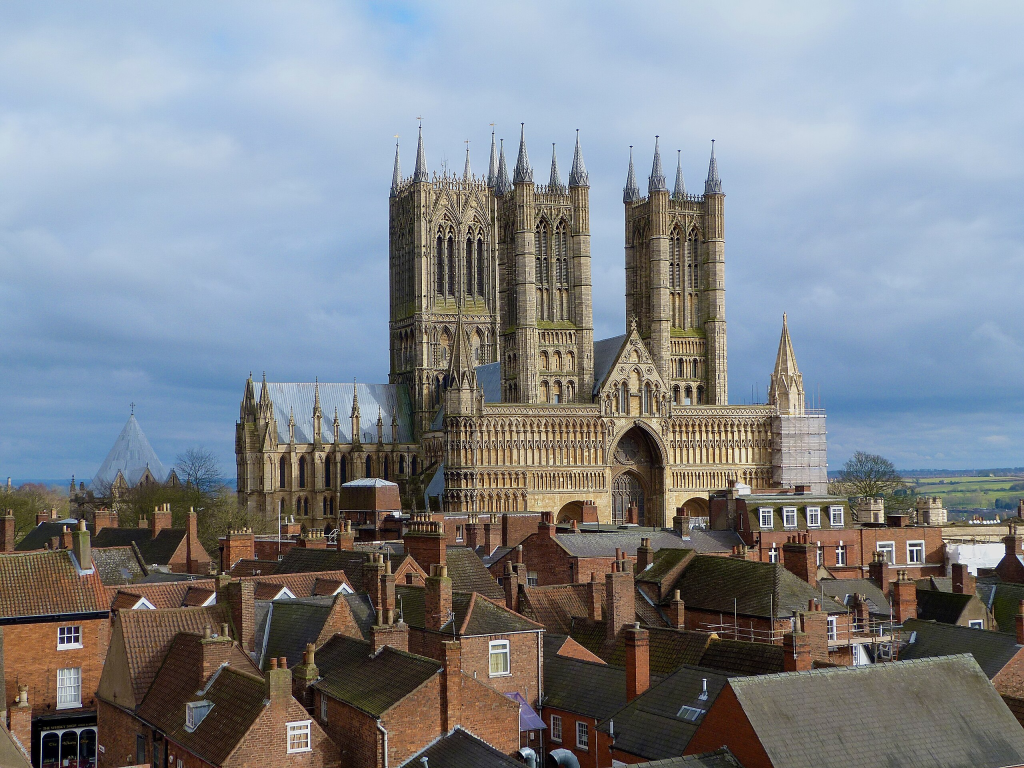
At Lincoln Cathedral, where Byrd served, the increasingly powerful Puritan reformist tendency within the Church of England exerted strong pressure. This school of thought regarded the ritual heritage retained by the Established Church as ‘Catholic remnants’ to be purged, and was especially hostile to any element of worship that might blur the clarity of the words or stimulate the senses. As cathedral organist and master of the choristers, Byrd’s professional domain — complex polyphony and expressive organ playing — lay precisely at the storm centre of this internal struggle over direction. In 1569, Byrd was summoned by the dean and chapter and had his stipend withheld over ‘certain matters objected against him’. Although the specific charges have not survived, a directive issued in November of that year, strictly circumscribing his use of the organ, provides a clear footnote to the conflict. This document came not from an external hostile confession but from within the very Established Church he served, marking the moment when Puritan ideas translated directly into administrative power, regulating liturgical practice in fine detail.
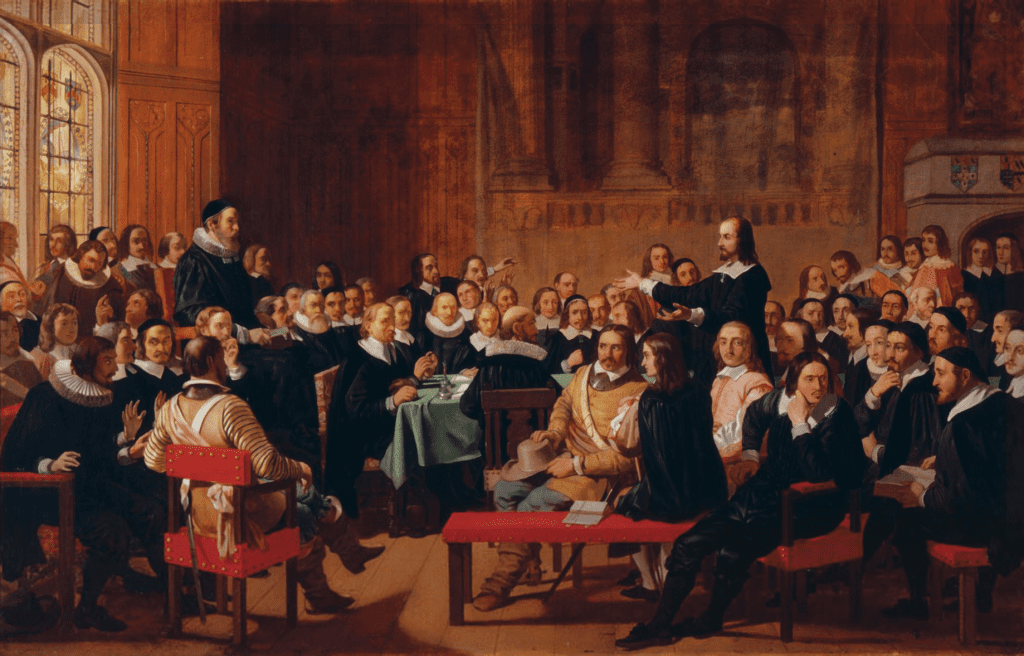
Knowledge Point: Puritanism and the Call of the Baroque
[Expand / Collapse]
-
As a transitional period from the Renaissance to the Baroque, the opposition between Puritanism (Protestantism) and Catholicism was in fact one of the crucial openings from which the Baroque age began. In truth,the ‘Baroque’ is not a single unified style but a ‘great divergence’ in which different camps of faith led to different artistic paths. Andthe re-embrace and extreme development of ‘sensuous experience’ is precisely one of the key marks distinguishing the Baroque from the Renaissance. The hostility of English Puritanism to the senses formed precisely the backdrop of ‘counter-force’ against which this historical turn took place.
1. A direct contrast: from ‘clear text’ to ‘stirring the emotions’
- The Puritan / radical-reform position: Art (music and painting) should serve to conveyrational doctrine; sensual pleasure is a dangerous distraction that must be suppressed. The ideal is a ‘pure’ text stripped of ornament.
- Baroque aesthetics (especially in Catholic regions): Art should serve to conveyfiery emotion; sensory experience is the necessary road to faith and must be intensified. The ideal is to employ every means (grandeur, contrast, virtuosity, light and shadow) todirectly and powerfully conquer the viewer’s heart and senses, proving the glory and truth of Catholicism.
2. Historical logic: this was the strategic weapon of the ‘Counter-Reformation’
The sensuousness of Baroque art did not arise from nothing; it was preciselythe Catholic Church’s ‘strategic response’, after the Council of Trent, to Protestant (especially Puritan-style) criticism.。
- The Protestant challenge: Protestantism (including Puritanism) accused Catholic worship of luxury, idolatry, and of using music and art to bewitch the mind.
- The Catholic counter-attack: The Catholic Church did not abandon art, butsystematized and theorized it, upgrading it into an even more powerful instrument of propaganda. Its reasoning was: ‘You say art interferes with reason? No — art can awaken a conversion of feeling that is direct and beyond reason. You pursue plainness? We shall prove, with incomparable splendour, emotion and drama, who truly possesses divine truth and grace.’
- Concrete manifestations:
- In music: Basso continuo brought rich harmony; opera was born, dramatizing emotion through music; the concerto created contrast and surprise; Monteverdi’s ‘stile concitato’ (agitated style) directly sought to simulate the tremors of human emotion through pitch and dissonance.
- In architecture and painting: Churches became feasts of light and shadow, colour, curve and golden cloud, designed to make the faithful feel as if they were in heaven, producing a dizzying sense of devotion.
-
It is very interesting: from the Classical age to the Renaissance, Catholicism was the reactionary force of its time, but by this moment it had instead become a force driving the age forward.
1. The Renaissance: Catholicism as ‘traditional framework’ and ‘reactionary force’
- Core features: Much of the humanist thought and artistic innovation of the Renaissance (especially in its birthplace, Italy) first arose under the patronage ofwealthy secular nobles, bankers (such as the Medici) and city-republics. It pursued the revival of antiquity, the discovery of humanity, and the beauty of this world.
- The role of the Church: At this time the papacy was both one of the greatest patrons of art (hence it gave rise to Michelangelo and Raphael) and at the same timethe guardian of traditional theology and moral order. When humanist currents (such as Erasmus’s criticisms) or new science (such as Copernicanism) touched the fundamentals of doctrine, the Church instinctively defended tradition, becoming abrake or reactionary force restraining certain ‘premature’ ideas. The Church itself did not initiate this cultural movement; it exploited and tried to steer it.
2. The Reformation: Catholicism as ‘the challenged’ and ‘the incumbent in crisis’
- The core shock: The Reformation launched by Martin Luther, Calvin and others fundamentally challenged the authority, doctrine and ritual system of the Catholic Church. It represented adestructive, subversive new force。
- The Church’s reaction: At this moment the Catholic Church’s primary identity wasa vast existing system and a vested interest; its first reaction was shock, repression (the Counter-Reformation) and defence of what it held. In the regions where the reform wave was fiercest, it truly wasa conservative fortress blocking the ‘new direction’ of history.。
3. The Baroque age: Catholicism as ‘driver of innovation’
- The crucial turn — the Council of Trent: To meet the crisis, the Catholic Church convened the Council of Trent (1545–1563). This council was not merely self-defence but aprofound strategic transformation. It decided:‘Since Protestantism attacks our liturgy as elaborate, sensual and opaque, let us carry these very qualities to their extreme, elevating them into an irrefutable, sacred aesthetic system.’
- From ‘defending what is held’ to ‘creating increment’:
- Actively embracing the senses: No longer defending sensory experience, but declaring the senses to be thesacred channel to faith。
- Systematic innovation: It patronized and drove a new, highly emotional, dramatic and synthetic artistic language — this isthe Baroque. It employed every means — architecture, painting, music, theatre (the birth of opera was inseparable from Church support) — to create an all-encompassing ‘experience of faith’, aimed at utterly conquering the faithful emotionally.
- The result: Far from retreating in art, Catholicism became the principal engine and patron of the most radical, most innovative artistic style of seventeenth-century Europe.At this point it turned from a passive guardian of tradition into an active, highly productive cultural creator.
Conclusion: the essence of the driving force is ‘competition’ and ‘survival strategy’
This change of role reveals a core principle:What drives an age forward is often the fierce competition and survival pressure within the system itself.
- The Renaissance ‘s driving force came partly from the ‘competition/symbiosis’。
- The Reformation ‘s driving force came from Protestantism’s ‘subversive competition’。
- Baroque art ‘s splendour, in turn, came directly from the ‘asymmetric innovation strategy’。
Perhaps it was precisely this environmental pressure that gave birth to one of Byrd’s earliest major contributions — the Short Service. This setting for the Anglican morning prayer, communion and evening prayer, with its clear harmonic progressions, lean contrapuntal texture and evident concern for projecting the words, perfectly met the functional requirements that the reformers placed upon liturgical music. It is not an impassioned personal expression, but a finely crafted liturgical tool that meets the rules. When Byrd left in 1572, Lincoln Cathedral even agreed to pay part of his salary on condition of continuing to receive his new works — proof that what he produced within the constraints of the framework had already won recognition for its practical value from the Protestant authorities of the day.
Alongside the public, supervised music of worship, instrumental composition became a semi-private domain in which Byrd explored a broader musical imagination. During his Lincoln years he composed several In Nomine settings and fantasias, as well as consort works, honing his ability to build pure musical structures. More significant was the beginning of his keyboard music, including the ‘Ground in Gamut’, the introspective ‘A minor Fantasia’ (Byrd Fantasia MB 13), and early pavans and galliards likely derived from instrumental consort arrangements. These works served private entertainment and the display of skill, were freer from the constraints of public rite, and allowed him, in a relatively unguarded space, to explore harmonic colour, contrapuntal logic and variation technique — laying the foundation for the splendid virginal music to come.
Knowledge Point: Consort, In Nomine, and Fantasia Explained
[Expand / Collapse]
-
1. The Consort
- Literal meaning: it meansensemble、band或ensemble music。
- What it actually denotes: In Byrd’s day it referred specifically toa chamber-ensemble form made up of instruments of one family or of different families, usually led by theviolfamily, sometimes joined by wind or keyboard instruments. The music played is ‘consort music’ 。
- Characteristics: It is apurely instrumentalform, without words, serving the entertainment and contemplation of private houses, courts, or high society. During the Renaissance it was an important marker ofinstrumental music gaining independence from vocal music and coming to maturity.。
2. The In Nomine
- Origins: This is aunique instrumental genre with a strongly English character. Its source is a vocal work:John Taverner ‘s Mass ‘Gloria tibi Trinitas’ (Gloria tibi Trinitas) composed in the early sixteenth century — one passage from it. In the ‘Sanctus’ of this Mass, one voice sings the words ‘In nomine Domini’ (in the name of the Lord), and the melody above it is extraordinarily beautiful and moving.
- Development: Later English composers (from Christopher Tye to Byrd and his successors)took this particular melody (and its corresponding harmonic progression) as a fixed ‘cantus firmus’, extracted it, and wrote specifically for itpurely instrumental variations or fantasias. This practice, like the way the melody of the ancient Chinese piece ‘Three Variations on the Plum Blossom’ (‘Meihua San Nong’) has been continually reworked and varied by later generations, created a unique compositional tradition.
- Its significance for Byrd: Writing an In Nomine was a ‘required course’ and an arena for English composers of the time. Byrd wrote several In Nomines (for different numbers of voices), proving that he:
- was deeply rooted inthe native English musical tradition。
- possessedoutstanding contrapuntal skill in making infinite variation within a fixed framework。
- and was conducting serious, scholarly exploration in the purely instrumental domain.
3. The Fantasia
- Definition: It is one of the most importantpurely instrumental genresof the Renaissance and Baroque periods, held in especially high regard in the consort repertory. It imitates thepolyphonic style and structure of the vocal motet, but is written entirely for instruments.
- Characteristics:
- Imitative counterpoint: The voices, as if in conversation, imitate and pursue a thematic motif in turn.
- Sectional structure: It usually consists of several contrasting sections, each developed from a different theme or motif.
- Freedom and contemplation: The very name ‘fantasia’ impliesimagination and free expression. It is bound by neither dance rhythm nor a fixed melody, and is one of the highest forms in which a composer can display polyphonic invention and abstract musical thought.
- Its significance for Byrd: Byrd’s fantasias (especially those written for four-, five- and six-part consorts) are the most profound and most complex part of his instrumental output. They show how he transplanted the rigorous logic of vocal polyphony perfectly onto instruments, exploring pure musical structure and emotional tension. These works are hisproof of the most advanced and most personal artistic expression carried out in the private sphere.。
In 1572 a crucial turn occurred in Byrd’s path: he left Lincoln and was appointed a Gentleman of the Chapel Royal in London. This carried him from being music director of a provincial church into the core institution representing the highest musical authority in the land. He was no longer an apprentice: he had mastered a deep traditional craft, knew how to compose seemly music for the new Established Church, had shown brilliance in instrumental music, and — perhaps in a recess of his heart that no one could see — had already formed a complex and intimate attachment to that old rite which had been banned politically yet still haunted the culture and the spirit. Carrying the consummate craft acquired in his Lincoln years, the ability to work under constraint, and an artistic personality in which a ‘duality‘ was just beginning to show, he stepped formally into the fiercest arena of Elizabethan political and religious struggle. What awaited him were higher honours, more complex patron relationships, and a trial that would ultimately tear apart his public identity and his private faith. His early career, like the introduction to a great symphony, steadily sounded, amid the variations of a turbulent age, the opening motifs that foreshadowed all the complex themes to come.
Knowledge Point: Gentleman of the Chapel Royal
[Expand / Collapse]
-
Literal meaning and nature:
- The Chapel Royal: It does not mean a fixed church building, butthe exclusive institution that provided the daily liturgy and musical service for the English monarch. It was amobile musical institution attached to the Crown。
- Gentleman: Here it does not mean the aristocratic class, buta title of formal office, meaning he was an ‘established member’ or ‘officer’ of the institution. The title indicates he was aprofessional musician-cleric.。
Core duties:
- Daily worship: As a member of the choir, taking part in the daily Morning Prayer, Evening Prayer and Communion held in the palace where the monarch was in residence. This was the primary duty.
- Composition and rehearsal: Writing new music for the various ceremonial occasions of the royal household (including feasts, weddings, funerals and state celebrations), and responsible for teaching the choirboys of the chapel and conducting rehearsals.
- Organ playing: Although ‘organist’ was not a separate office, a member as technically gifted as Byrd would naturally have been responsible for playing the organ.
Status and privileges:
- The highest musical institution: This was thehighest honour and most prestigious post an English musician could attain, representing the nationally recognized authority in music.
- Royal protection: Members were employed directly by the monarch, with a stable salary, allowances and livery. More importantly, they stoodunder the direct protection of the Crown. For a man like Byrd, who would later openly maintain the Catholic faith, this was a crucial ‘umbrella’. The Crown (especially Elizabeth I) valued his genius and therefore showed a degree of tolerance toward his religious nonconformity, sparing him the harsh persecution an ordinary Catholic might have faced.
- Creative freedom and resources: He had access to the finest singers and players and to the most advanced musical currents, providing an ideal environment for his composition.
In short, Byrd’s post was the equivalent of ‘lifetime principal composer and singer/instrumentalist of England’s national court ensemble’, enjoying special political protection.
Second Movement: Before the Throne, and the Rift
In 1572, William Byrd’s path was lifted to its summit by a royal command. He left the provincial Lincoln Cathedral and was formally appointed a Gentleman of the Chapel Royal in London. This meant that he leapt from being an important local music director to a core member of the national institution that served the queen herself and represented the highest musical standard of England. The post was not only a lifelong honour but carried a handsome salary. In the Chapel Royal records he is often called ‘organist’ — not a separate office but a description of the core duties he actually performed, a post any capable member of the Chapel could fill. Yet stepping into this gilded hall did not mean entering a pure artists’ paradise; on the contrary, he entered a more complex field of power, where glory, favour, commercial ambition and ideological risk were interwoven.
Byrd’s career in the Chapel Royal was soon bound up with a still more august patron — Queen Elizabeth I herself. In 1575, he and his teacher Thomas Tallis received an unprecedented honour: the queen granted them a joint monopoly over the printing of music and music paper for twenty-one years. It was one of the first patents of its kind in England, intended to encourage native music publishing. The two quickly collaborated with the French Huguenot (Protestant) printer Thomas Vautrollier to publish a lavishly planned dedicatory masterwork: the ‘Cantiones quae ab argumento sacrae vocantur‘ (Cantiones which by their subject are called sacred).
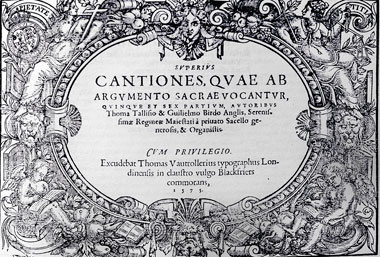
This was an ambitious venture. The collection contained thirty-four Latin motets, seventeen each by Byrd and Tallis, corresponding to the seventeenth year of the queen’s reign. It was furnished with a splendid preface and Latin verses, and dedicated directly to Queen Elizabeth herself. On the surface it was a perfect union: two of the finest composers, in the most consummate polyphonic art, paying homage to the queen as supreme governor of the Church. Yet commercially this great work met with failure. In 1577 Byrd and Tallis were forced to petition the queen jointly, stating that the publication had caused them ‘great losses’ and mentioning Tallis’s advanced age. As compensation they received twenty-one-year leases on certain lands in East Anglia and the south-west. The setback exposed a harsh reality: even with a royal patent and the highest artistic standard, one could not guarantee in the England of that day a stable and sizeable market of Latin-music consumers sufficient to support so sumptuous a publication. The royal halo and the market’s coldness formed the first resistance in Byrd’s mid-career.
Knowledge Point: Why the ‘Cantiones’ Failed
[Expand / Collapse]
-
The commercial failure of Byrd and Tallis’s ‘Cantiones’ was not because the music was of poor quality, but because, as acultural commodity, it was seriously out of step with the distinctive social, religious and market soil of England at the time. Compared with successful precedents in France and elsewhere, England lacked several key supporting elements:
1. The market foundation was utterly destroyed by the Reformation
In Catholic regions such as France and Italy, printed music had a clear and stable body of consumers:
- Institutional buyers: Catholic churches, cathedrals and monasteries scattered across the land had a continuous liturgical need to purchase new collections of Masses and motets.
- A stable system of patronage: Nobles and courts, as cultural patrons, bought lavish music publications both as an act of religious devotion and as a display of refinement.
In Elizabethan England, by contrast:
- The demand from official institutions vanished: The liturgical core of the Church of England was the Book of Common Prayer and the English anthem. Latin motets hadno place left in the official, public services of the Established Church. Although cathedrals and the Chapel Royal still sang Latin music, the volume and frequency of demand could not compare with Catholic countries.
- The secret Catholic market could not come out into the open: Those who truly needed Latin motets were the underground Catholic community. But theydared not openly buy, keep or circulateso splendid, conspicuous and queen-dedicated a monument of Latin music. Simply possessing it could itself be evidence of being a ‘papist’, inviting surveillance, fines or worse. The market demand existed, but it was crushed by political fear and could not form effective purchasing power.
2. Product positioning and consumer mismatch
This ‘Cantiones’ was in essence a ‘tribute project’ , not a commodity oriented by market demand.
- Its content was too ‘lofty and austere’: All of it serious, lengthy, technically demanding Latin polyphonic motets serving a particular Catholic liturgical tradition or high-level spiritual contemplation. It lacked the more easily popularsecular genres (such as the chanson or madrigal), or the more practicalliturgical sets。
- Its format was too lavish: Its publication format (fine printing, Latin verses) made it expensive, aimed at the top nobility or institutions. But in England, the top nobles willing and able to pay for it were precisely those who needed to hide their Catholic leanings, making the act of purchase fraught with risk.
- It missed the ‘practical’ market: At the same time, the emergingmarket for Church of England music (needing English anthems and service music) and themiddle-class urban entertainment market (needing madrigals, lute songs and instrumental dances) was entirely ignored. Tallis and Byrd wrote no marketable products for them.
3. Different social structure and cultural ecology
The continental success rested on a relatively complete and diverse musical ecology. In England:
- There was no mature music-publishing industry chain: This was England’s first large-scale music-printing venture; from the printer Vautrollier (a French Protestant refugee) to the sales network, everything was still at an experimental stage, far less mature than Paris or Venice.
- A break in the system of patronage: The Tudor dynasty strengthened the central monarchy, weakening the independence of the great nobles and their local cultural power. The continental situation in which several independent courts supported a plural music-publishing scene no longer existed in England. Everything ultimately pointed to the Crown, and the taste and policy of the Crown (the queen herself) determined that this single centre’s preference was practical and political, not pure Latin art.
In sum, this failure was a classic case of ‘acclimatization failure’:
: Byrd and Tallis tried to transplant a publishing model that had succeeded inthe Catholic, polycentric, market-mature Continent (the lavish Latin polyphonic collection) directly intoan England ruled by the Established Church, centralized, with a nascent market and suffused with political fear. They possessed the most advanced ‘production technology’ (compositional skill) and the ‘operating licence’ (royal patent), yet badly misjudged the real composition and purchasing psychology of the ‘consumer market’.
Just as Byrd was enjoying royal favour and devoting himself to the official musical cause, a profound and dangerous personal transformation was taking place in the depths of his soul. From the 1570s on, he became ever more visibly enmeshed in the Catholic network. The trajectory of this change left clear marks in the historical record:
- Early connections: Around 1573 he wrote a petition letter on behalf of a friend to the known Catholic nobleman Thomas, Lord Paget. ‘Mr Byrd’s and Mr Tallis’s songs’ were frequently sung at Paget’s household musical gatherings, showing that Byrd’s ties to this Catholic family circle had grown quite deep.
- Family witness: His wife Julian first appears in the records in 1577, cited at Harlington in Middlesex (where the Byrds then lived) for ‘recusancy’ — refusing to attend the services of the Established Church. This was a clear sign of the family’s turn in faith.
- Personal record: Byrd himself formally appeared on the official lists of recusants from 1584 onward, meaning he publicly refused to attend the statutory services of the Church of England and would face heavy, recurring fines.
Knowledge Point: The Catholic Network
[Expand / Collapse]
-
In sixteenth-century England, the ‘Catholic network’ was not a formal organization in the modern sense, but referred toan informal, clandestine web of connection and support, formed under the suppression of the official Established Church, among aristocratic families secretly keeping the Catholic faith, underground clergy, ordinary believers, and supporting institutions on the European continent.。
The core elements of this ‘network’ included:
Aristocratic patron families: These were the pillars of the network. Certain powerful families (such as thePetre family, to which Byrd later attached himself, and theLord Paget whom he had earlier approached) set up secret chapels in their country houses, sheltered illegally smuggled-in Catholic priests, and provided them with the venue and protection for secret Masses. Their houses became ‘safe houses’ for underground religious activity.
Underground clergy: Chiefly the Jesuits and seminary priests who, after training in the English colleges on the Continent (such as those at Douai in France and in Rome), secretly returned to England. They were the soul of the network, administering the sacraments, spreading doctrine and sustaining the faith of believers. Like secret agents, they moved between the houses of the nobility, as did Henry Garnet, whom Byrd had contact with.
Communities of the faithful: Ordinary Catholic believers such as Byrd and his family, who refused to attend the services of the Established Church (that is, ‘recusants’), regularly attended secret Masses, and were bound together by marriage, neighbourhood and service relationships, forming a hidden community of mutual recognition and support.
Support bases on the Continent: The English colleges at Douai, Rome and elsewhere not only trained priests but also printed and smuggled Catholic books, prayer-books and music (including Byrd’s works) back into England, providing spiritual sustenance for the underground Church.
Why was it ‘dangerous’?
Because under Elizabethan law, every activity of this network constituted a felony:- Harbouring a priest = treason (punishable by death)
- Attending a Latin Mass = a crime (heavy fines, imprisonment)
- Refusing to attend the services of the Established Church = recorded, with continuing fines
In the England of the 1580s this change of faith was by no means a private matter but a highly sensitive political issue. Ever since Pope Pius V issued his bull of 1570 releasing English subjects from their allegiance to Queen Elizabeth, the Catholic faith had been dangerously associated with the charge of ‘treason’. As trained Jesuits and seminary priests slipped secretly into England from Douai, Rome and elsewhere, the authorities’ suppression grew harsher. In 1583 Byrd got into serious trouble for his close relations with Lord Paget, who was implicated in the ‘Throckmorton Plot‘. His membership in the Chapel Royal was temporarily suspended, his movements restricted, and his home placed on search lists. In 1586 he was found to have attended secret gatherings at which were present the Jesuit Henry Garnet (later executed for his involvement in the Gunpowder Plot) and the Catholic poet Robert Southwell. Byrd’s life had split into two irreconcilable identities: the public master of the queen’s music, and a secret, watched Catholic believer.
It was precisely this growing crisis of faith and split of identity that gave Byrd’s Latin-texted music of the late 1570s to early 1590s its peculiar urgency and emotional depth. Though composing music for the public Catholic liturgy was by then illegal, a music that offered spiritual consolation to a persecuted community of faith began to pour from his pen.
Emotion and symbol: The scholar Joseph Kerman observed that the texts of the motets Byrd composed in the 1580s changed profoundly from what had come before. Recurring themes are ‘captivity’ (as in ‘Domine tu iurasti’), ‘persecution’ (as in ‘Domine praestolamur’ a5), and ‘hope of redemption’ (as in ‘Laetentur caeli’, ‘Circumspice Jerusalem’). These works have been read as musical prayers spoken on behalf of the suffering Catholic community of England. ‘Deus venerunt gentes’ (published 1589), for example, is generally regarded as a lament for the Jesuit Edmund Campion, brutally executed in 1581.
Knowledge Point: Translation of ‘Deus, Venerunt Gentes’
[Expand / Collapse]
-
This is a passage from Psalm 79 (according to the Vulgate numbering), which Byrd used as compositional material.
Part One
O God, the heathen have come into your inheritance,
they have defiled your holy temple,
and made Jerusalem a place to keep fruit.Part Two
They have given the dead bodies of your servants
as food to the birds of the sky,
the flesh of your saints
to the beasts of the earth.Part Three
They have poured out their blood like water all around Jerusalem,
and there was none to bury them.Part Four
We have become a reproach to our neighbours,
a mockery and derision to those around us.
Musical dialogue: The most telling example is Byrd’s covert dialogue with the Catholic world of the Continent. In 1583, the composer Philippe de Monte, in the service of the Holy Roman Emperor Rudolf II, sent Byrd from Prague his motet on Psalm 137 (‘By the rivers of Babylon we sat down’), whose text contains the pointed question: ‘How shall we sing the Lord’s song in a strange land?’ The next year Byrd replied with a motet, ‘Quomodo cantabimus’ (How shall we sing), setting the subsequent, defiant verses of that psalm. This exchange of music across Europe, founded on a shared faith, transcended artistic communication and became a statement of identity maintained under persecution.
Knowledge Point: Translation of ‘Quomodo cantabimus’
[Expand / Collapse]
-
First strophe
How shall we sing the LORD’s song in a foreign land?
If I forget you, O Jerusalem,
may my right hand forget its skill.
If I do not remember you,
if I do not set Jerusalem above my highest joy,
May my tongue cling to my throat.Second strophe
Remember, O LORD, the Edomites
in the day of Jerusalem’s calamity.
Publication and patronage: In the crucial four years from 1588 to 1591, William Byrd accomplished an astonishing artistic outpouring, laying out in four collections of very different genres the full map of his divided, parallel double world. In 1588 he published ‘Psalmes, Sonets and Songs of Sadnes and Pietie‘, and the following year ‘Songs of Sundrie Natures‘. These two English songbooks established his public image as a master of English secular music. Among them, ‘Lullaby‘ enjoyed wide circulation, fusing the tender comfort of a cradle song with a profound lament for the fragility of life; popular at both court and street, it displayed Byrd’s remarkable gift for capturing universal emotion in his native tongue.
Almost simultaneously, in 1589 and 1591, he gathered those dangerous Latin motets written for the persecuted Catholic community into the two volumes of the ‘Cantiones Sacrae‘. Unlike the earlier collection dedicated to the queen, these two were dedicated to the powerful Edward Somerset and John, Baron Lumley — both to seek protection in the wake of the crisis of faith, and as a mark of the full maturity of his artistic personality.
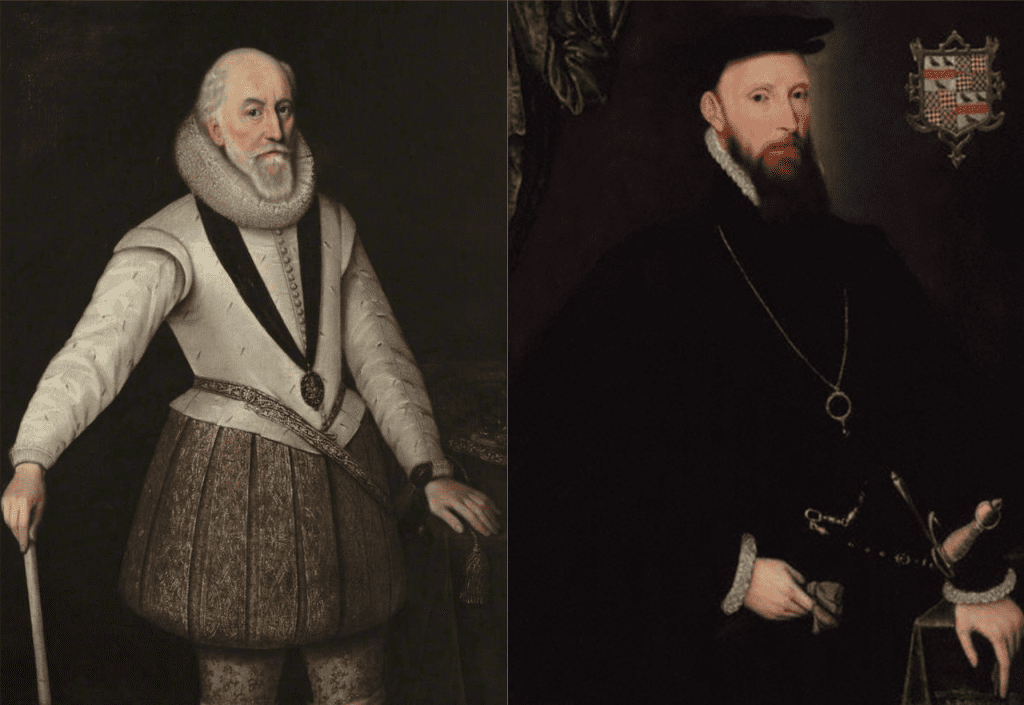
In this period Byrd studied deeply and absorbed the novel style of the Italian composer Alfonso Ferrabosco, active at the English court — a manner of dramatizing the emotion of a text through supple melody, keen harmony and compact structure. He internalized this idiom completely and used it to cast his own most intimate experience of faith. In the Latin sphere, ‘Domine praestolamur‘ (O Lord, we await) is a model of this style. The piece builds its themes on plaintive minor seconds and yearning minor sixths, and by tearing the musical ideas apart and passing fragments between the voices, it mimics a collective, restless prayer, turning the pain and longing of a captive community into suffocating polyphonic sound. In the English sphere, by contrast, ‘Christ Rising Again‘ from ‘Songs of Sundrie Natures‘ shows another kind of grandeur. Set to an Easter prose and yet in English, it serves the public liturgy of the Established Church with majestic sectional contrasts and glorious full passages — a grand public statement of his official identity. These four collections appearing in succession, like parallel rivers, clearly mirror the complete portrait of Byrd at the end of the 1580s and the beginning of the 1590s: a contradictory genius who simultaneously commanded public glory and private suffering, reaching the summit of both.
Knowledge Point: Translation of ‘Domine praestolamur’
[Expand / Collapse]
-
O Lord, we await your coming;
come quickly, break the yoke of our captivity.O Lord, come, tarry no longer;
forgive the sins of your people, and save your people.
Knowledge Point: Translation of ‘Christ Rising Again’
[Expand / Collapse]
-
Christ, being raised from the dead, dies no more;
death no longer has dominion over him.
For the death he died, he died to sin once for all;
but the life he lives, he lives to God.
through our Lord Jesus Christ.Christ is risen,
the firstfruits of those who have fallen asleep.
For since death came through a man,
the resurrection of the dead also comes through a man.
For as in Adam all die,
so in Christ all will be made alive. Amen.
Almost in step with the vocal works above, Byrd carried a more intimate domain to unprecedented heights: music for the virginals. In 1591, a handsome manuscript called the ‘My Ladye Nevells Booke’ was completed, containing forty-two of Byrd’s keyboard works in systematic order. This compilation, comparable to a ‘complete works’, was likely made for Lady Elizabeth Nevell, and displays Byrd’s all-round mastery as an instrumental composer.
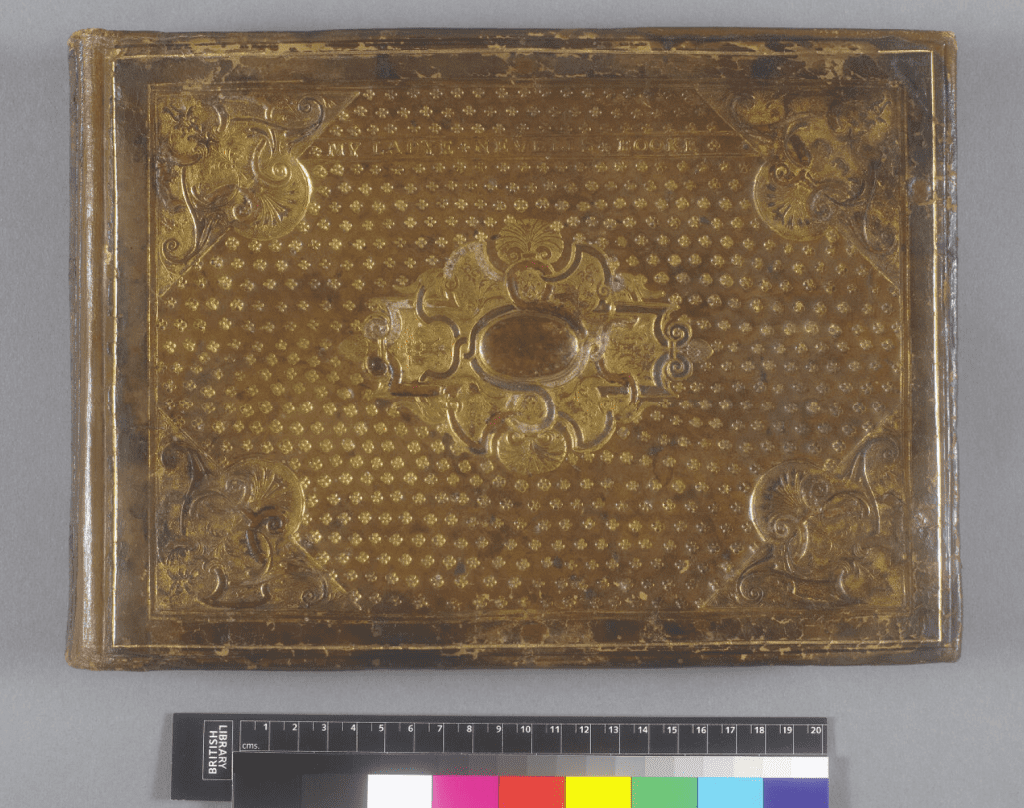
Here he shed the constraints of words and liturgy and built worlds purely from notes. The genres in this manuscript are refined and profound:
Consummate fantasias and free movements: The manuscript also includes several fantasias, such as ‘A Fancie’, and free, improvisatory movements such as ‘A Voluntarie: For My Ladie Nevell’, which fully display his brilliant gift for pure musical thought.
Solemn dances: A series of pavans and galliards forms the core. From ‘The Firste Pavan’ to ‘The Eighte Pavan’, together with their paired galliards, such as ‘The Galliarde to the Firste Pavan’, he elevates this three-section form of courtly origin into an abstract poem that expresses profound feeling or displays exquisite contrapuntal skill.
Grand variations: The most striking of all is ‘Have With Yow to Walsingham’. This is the famous ‘Walsingham Variations’: Byrd turns the tune into a set of variations containing elaborate ornamentation, rhythmic shifts and contrasts of texture, building an awe-inspiring edifice of sound that displays to the full his incomparable power of improvisatory fantasy and large-scale structural control.
Programmatic and dramatic: The manuscript also contains vivid descriptive pieces, such as ‘The Marche Before the Battell’, ‘The Battell’ and ‘The Galliarde for the Victorie’. By imitating fanfares, drumbeats and battle scenes, this group forms a miniature ‘symphonic’ narrative — a masterpiece of early English programme music. In addition, ‘The Barley Breake’ is a light, lively imitation of a rustic game, revealing his wit and gift for depiction.
Profound grounds: No. 1, ‘My Lady Nevells Grownde‘, and No. 29, ‘The Second Grownde‘, are both polyphonic variations built over an ostinato bass melody — rigorous in structure and rich in meditative feeling.
These works are not accompaniments to public worship, but pieces for the private entertainment, contemplation and artistic appreciation of gentlefolk in their homes. They form the third pole of Byrd’s middle-period output: neither wholly the public anthem of the Established Church nor wholly the dangerous cipher of the Catholic underground, but a relatively neutral artistic space in which pure musical intelligence and emotion could roam free. Yet their technical complexity, emotional depth and structural grandeur mark, no less than his vocal masterpieces, the full maturity of his artistic personality. The same hands that wrote plaintive motets in a hidden chamber could also build upon the keys a solid and glorious kingdom belonging to sound alone.
Third Movement: The Hidden Chamber and the Monument
Entering the 1590s, William Byrd, now past fifty, was in a state of semi-retirement, and at that point he made a decisive choice. He left Harlington near London with his family and moved to a small Essex village called Stondon Massey. On the surface this move was a ‘semi-retirement’; in reality it was the last and most thoroughgoing strategic relocation of his life. He was not withdrawing from the world but plunging more deeply into a hidden yet stable system of patronage — the underground network of Catholic nobles. The manor of Stondon Massey adjoined the two grand houses of his most important patron Sir John Petre (created Baron Petre in 1603): Ingatestone Hall and Thorndon Hall.
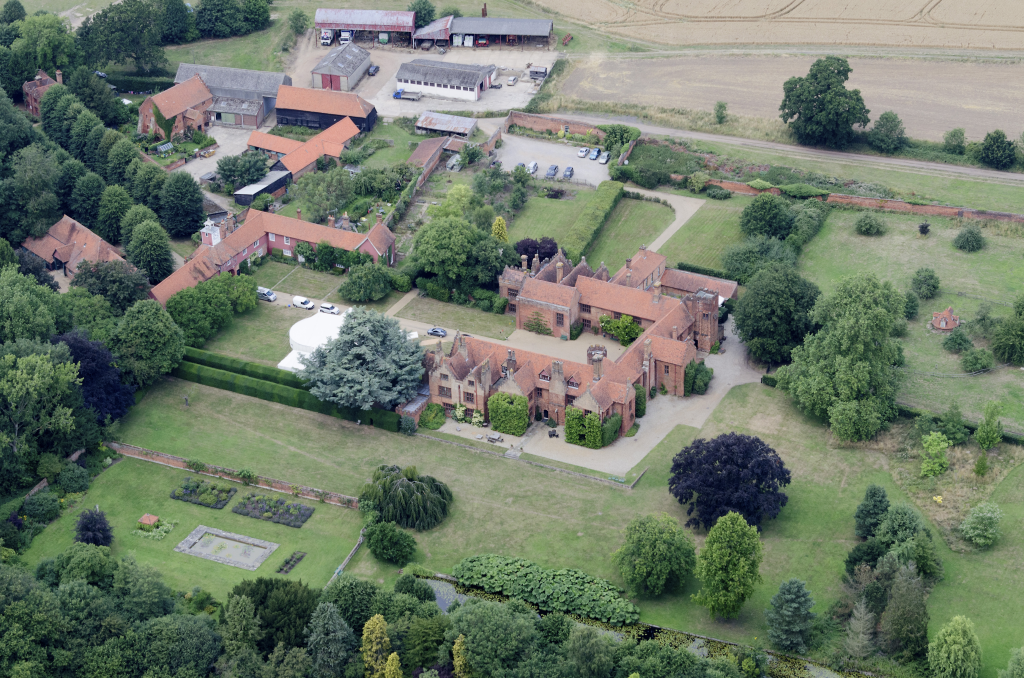

This choice marked a new phase in his career. He was no longer merely a Gentleman of the Chapel Royal, though he nominally retained that honorary post. He became the private musician of the Petre family and its Catholic circle. Here religious worship moved in secret into the hidden chambers of country houses or into underground ‘priest holes’. Byrd’s task was to supply, for these highly dangerous secret Masses held under the shadow of spies and informers, music that was at once solemn and discreet. This was not merely an artistic commission but an act of conspiratorial faith.
Knowledge Point: Priest Holes
[Expand / Collapse]
-
‘Priest holes’ (priest hole) were, during the reign of Elizabeth I (1558–1603) and after, secretly built within the houses of English Catholic families ashidden spaces or secret chambers, specifically to hide Catholic priests (clergymen), so as to evade the sudden searches and arrests of government officers.
Its core features and historical background are as follows:
Direct cause: Elizabethan law treated Catholic priests (especially the Jesuits who secretly entered from the Continent) as ‘enemies of the state’. Harbouring a priest was a felony punishable by death. Therefore, nobles and gentry of the Catholic faith, to protect the priests who came to celebrate secret Masses, devised ingenious hiding places within their houses.
Design and construction:
- They were usually located in wall cavities, beneath floors, behind chimneys, in stairwells, or behind heavy oak panelling.
- The design was extremely secret, with entrances often blended into the joinery and masonry so as to be nearly impossible to detect.
- The interior space was usuallyextremely cramped, dark and airless, allowing only one person to curl up in hiding, under very harsh conditions. A priest might need to remain hidden for hours or even days.
The famous builder: The most famous builder of priest holes wasNicholas Owen, a Jesuit lay brother and a carpenter of consummate skill. He travelled among the Catholic aristocratic families, designing and building these hiding places for them; in the end he was captured, died under torture in the Tower of London, and was later canonized as a saint.
Symbolic significance: The priest hole is not merely a curiosity of architecture, butthe ultimate symbol of the underground survival of English Catholicism. It represents how faith was forced into absolute privacy and hiding, and embodies the enormous risk believers took to hold fast to their creed.
Not long after settling at Stondon Massey, Byrd embarked on the most central and most daring project of his late period: writing a complete set of Masses for the ordinary of the Catholic Mass. These are the Masses for three, four and five voices, secretly published between about 1592 and 1595. The publications themselves are witnesses to their age: they bear no date, name no printer, and each voice-part is printed on a single folded sheet, easily hidden or carried. Merely possessing such books was at the time a serious crime.

These works are not simple liturgical settings but highly personal and cohesive declarations of faith. Stylistically they deftly fuse the heritage of the earlier Tudor polyphonic masters (such as Taverner) with new influences from the Continent. Byrd deliberately included a Kyrie in each Mass — uncommon in the suppressed Sarum Rite — as if insisting on the ‘purity’ and universality of his liturgy. Yet the most affecting strokes come at the close of each Mass. The ‘dona nobis pacem’ (grant us peace) of the Agnus Dei is set in the four-voice Mass as a long, aching suspension, and in the five-voice Mass as urgent block harmony. This is far more than routine setting of a standard text: it is the double cry of an entire persecuted English Catholic community for inner peace and outward peace alike. These Masses are sturdy, secret sanctuaries of sound built for believers who dared not pray aloud in their own homes.
If the three Masses are the sturdy foundation stones, then the two volumes of the ‘Gradualia’ that followed are the great dome Byrd built for his hidden faith. This monumental work appeared in 1605 and 1607, dedicated respectively to Henry Howard, 1st Earl of Northampton, another Catholic nobleman, and to his patron John Petre.
The ‘Gradualia’ is a systematic encyclopedia of liturgical music, aiming to provide complete proper music for all the principal feasts of the Catholic calendar (including the Virgin Mary, All Saints, and the core festivals of Christmas and Easter), covering the Introit, Gradual, Alleluia, Offertory and Communion. Byrd even devised a clever system of ‘cross-references’ so that the same piece could be used flexibly for different liturgical occasions — practical in intent, but also resembling an artistic disguise against raids.
Knowledge Point: The Proper of the Mass Explained & The Role of Artistic Disguise
[Expand / Collapse]
-
The Proper of the Mass explained in detail
In the Roman Catholic Mass (in the form standardized after the Council of Trent), the Mass is divided into the ‘Ordinary’ and the ‘Proper’.
- The Ordinary: The Kyrie, Gloria, Credo, Sanctus and Agnus Dei. Their texts are fixed and unchanging, and Byrd’s three Masses were written for these parts.
- The Proper: Its textschange from day to day with the church calendar and feasts. Byrd’s ‘Gradualia’ is precisely the great work that sets these parts to music. They form the skeleton of the Mass liturgy and echo the readings and theme of the day.
The Introit: The song at the beginning of the Mass. As the priest approaches the altar, the choir sings it. Its text is usually a biblical psalm, used to announce the theme of the day’s feast and tocreate the initial atmosphere of entering the sacred rite. For example, the Introit for Christmas has the text: ‘Today the true Light has come down to earth”。
The Gradual: The song between the first reading and the second reading (or the Epistle). Its name comes from being sung in antiquity on the steps of the ambo. It is usuallya longer, contemplative psalm, serving to connect and meditate on the first reading. In penitential seasons (such as Lent), the joyful ‘Alleluia’ is replaced by the more plaintive ‘Tract‘.
The Alleluia: It stands before the second reading and isa short, jubilant phrase. The choir first sings ‘Alleluia’ (meaning ‘praise the Lord’), then follows with a ‘Alleluia verse‘ drawn from a psalm, ending finally with the ‘Alleluia’ again. It is a symbol of joy and of the gospel about to come.
The Offertory: It is sung whilethe bread and wine are being prepared as offerings. Its text is short, often concerned with imagery of offering and sacrifice. This moment is a small climax of the rite, and the music accompanies the preparation of the material offerings.
The Communion: It is sung whileAs the faithful come forward to receive the Blessed Sacrament (the Eucharist),it is sung. Its text usually expresses the joy of union with Christ, of thanksgiving and communion. The music accompanies the whole communion rite.
-
The ‘cross-referencing’ system: artistic disguise and a survival strategy
Now let us look at the ingenious ‘cross-referencing’ system Byrd designed, and how it became a kind of ‘artistic disguise’.
1. How the system worked:
In the ‘Gradualia’, Byrd did not rigidly make ‘one piece correspond to one feast’. Instead, he composed many pieces that couldbe used flexibly for several different feasts. For example, an Introit written for the feast of All Saints, because its text has a universal, praise-like character, might also be directed to be used for the feasts of the Blessed Virgin or of the Apostles. The score might carry a simple note or marking telling the user the piece’s several possible occasions.2. How it helped evade searches:
Reducing physical evidence: This is the most direct benefit. If every feast required entirely separate sets of music, a complete year’s ‘Gradualia’ would be a bulky, conspicuous and undeniable ‘criminal evidence’. Through cross-referencing,the number of scores that actually had to be printed, copied and hidden was greatly reduced. A single small, cleverly designed booklet could meet most of the liturgical needs of the whole year, and was easier to hide and carry.
Room for confusion and defence: If the authorities found a score in a search, it might bear the text of the feast of ‘All Saints’. The holder could plead: ‘This is merelyan old musical document kept for scholarly study, or a work of art, not something used for the current unlawful activity.’ Because the piece could also suit other, less sensitive or more generic occasions, such a defence gained a little more plausibility. It blurred thedirect and exclusive link between the score and a particular, currently ongoing illegal Catholic rite.
Greater efficiency and safety in use: For the underground Church, safety and mobility were vital. Priests and choir members might need to move between different houses, or to relocate in an emergency. Carrying alight, multi-purposescore was far safer and more practical than hauling a box of heavy specialized volumes. This was essentially a ‘portable solution for liturgical music’ designed for underground activity.。
Musically, the ‘Gradualia’ marks the final maturity of Byrd’s style. Compared with the emotionally exposed, structurally grand motets of earlier years, these works are more concise and concentrated. Melodies often flow in light quavers, catching the emotional colour of the text in subtle harmonic changes, and some festive passages even display a madrigalian vividness of depiction. Among them, ‘Ave verum corpus’ (Hail, true Body), a short piece for the feast of Corpus Christi, with its simple and infinitely devout harmonic progressions, has become one of the most moving pearls from his pen. In his dedication Byrd called these works ‘flowers from your own garden’, openly revealing their direct link to the Petre family’s secret religious life.
Knowledge Point: Translation of ‘Ave verum corpus’
[Expand / Collapse]
-
Hail, true Body,
born of the Virgin Mary:
You truly suffered, and were offered as a sacrifice
on the cross for mankind;
Your side was pierced,
from which flowed water and blood:
Grant that we may, in the test of death,
foretaste (of your grace).
O sweet Jesus, O merciful Jesus,
O Jesus, Son of Mary,
have mercy on me. Amen.
O sweet, O merciful,
O Jesus, Son of Mary,
have mercy on me.
Yet the cruelty of reality never stayed far away. The Gunpowder Plot of 1605 made the situation of Catholics worse again. The 1607 ‘Gradualia’ had to delete some sensitive texts. Records show that a young Frenchman named Charles de Ligny was arrested on suspicion of carrying a copy of the 1605 ‘Gradualia’. This monument of art was always accompanied by danger.
Knowledge Point: James I & The Gunpowder Plot
[Expand / Collapse]
-
James I (r. 1603–1625): from dashed hopes to full-scale repression
- Signals of leniency at the start of his reign (the stage of hope):
- James was the son of Mary, Queen of Scots (a Catholic martyr in Protestant eyes), and came from the relatively tolerant Scottish Presbyterian background. Before his accession he sent ambiguous signals to English Catholics, hinting that the persecution might ease.
- This raised enormous hopes among the Catholic community, including Byrd. It was in precisely this mood of optimism that Byrd ambitiously planned and published the first volume of his monumental ‘Gradualia’.
- The turn and escalation of policy (the stage of disillusionment and repression):
- Pressure from domestic Protestant forces: The English Parliament and the powerful Puritan forces firmly opposed any concession to Catholicism. To consolidate his power, James had to rely on them.
- The disastrous impact of the Gunpowder Plot (1605): This was the decisive turning point. A plot to blow up the king and Parliament, planned by a handful of Catholic extremists,confirmed the Protestant camp’s most fearful imaginings. Although most Catholic leaders condemned it, the whole community was stigmatized as a body.
- Legislation tightened across the board: After the Gunpowder Plot, James approved anti-Catholic lawsfar harsher than those of the Elizabethan era::
- the Oath of Allegiance Act of 1606 required every subject to swear that the pope had no power to depose the king. Those who refused — that is, all devout Catholics — would incur all the penalties of the law.
- Severer penalties: The punishments for attending Mass and harbouring priests were increased.
- Deprivation of civil rights: Catholics were barred from public office and the legal profession, and from free movement (such as being forbidden to enter London).
- Supporting Protestantism: James stood firmly with the Established Church and tried to mediate the Calvinist (Puritan) tendency within it, but his chief energy went into suppressing Catholicism and consolidating a Protestant national identity.
- Signals of leniency at the start of his reign (the stage of hope):
-
The Gunpowder Plotwas a famous attempt in England in 1605 by Catholic extremists to assassinate the king and overthrow the government. Its core plan was to blow upthe Palace of Westminster, that is, during the State Opening of Parliament , to kill at one blow the king,James I, his family, most of the Protestant nobility, and the entire membership of both Houses of Parliament.
The course of events:
- Background: In the early days of James I’s reign, some English Catholics had placed hopes in him, expecting him to relax the laws persecuting their religion. But the hopes were dashed; the legislation grew harsher instead, sharpening the conflict.
- The plot: Led byRobert Catesby, a small group of English Catholic gentry planned the conspiracy. They leased a cellar adjoining the basement of the Houses of Parliament and brought in thirty-six barrels (about 2.5 tonnes) of gunpowder.
- The key figure:Guy Fawkeswas a Catholic soldier who had fought abroad, assigned to carry out the task of igniting the powder, and so became the very symbol of the whole conspiracy.
- The discovery: Before the action, one of the conspirators, out of concern for certain Catholic nobles who would be present, sent an anonymous warning letter. The letter was laid before the king, and the authorities then, on the night of4–5 November 1605, searched the cellar and seized Guy Fawkes, who was keeping watch.
- Trial and execution: Fawkes and his accomplices were tortured in interrogation after their arrest, and were then publicly executed byhanging, drawing and quartering.
Immediate consequences and far-reaching impact:
- A devastating blow to the Catholic community: The plot, planned by Catholics, confirmed the authorities’ long-standing propaganda that equated ‘the Catholic faith’ with ‘treason’ . Although the pope and most Jesuits condemned the action, the entire English Catholic community was still stigmatized as a body and suffered crueler suppression.
- Legislative persecution intensified: Subsequently, even harsher anti-Catholic statutes were passed, including:
- Forcing Catholics to take an oath of allegiance, acknowledging the king’s authority as above the pope’s.
- Restricting their freedom of movement (such as forbidding them to enter London).
- Increasing the penalties for attending Mass and harbouring priests.
- Cultural impact: The event gave rise to the annual 5 November ‘Bonfire Night’ tradition of celebration, burning effigies of Guy Fawkes — a tradition sustained for centuries that reinforced the anti-Catholic collective memory of English Protestantism.
Even while devoting his chief energy to the Catholic faith, Byrd never entirely severed his connection with the Church of England and the secular musical world. His late works show a comprehensive character, fusing a lifetime’s experience into one alloy. In 1611, past seventy, Byrd published his last English songbook, ‘Psalms, songs and sonnets’. Like a miniature universe, it embraced everything from devout settings of biblical texts — such as the magnificent six-voice ‘Praise our Lord, all ye Gentiles‘ — to light secular songs, and on to complex instrumental fantasias. It proved that even in rural retirement in Essex, he remained the all-round master who could command any genre.
Knowledge Point: Translation of ‘Psalms, songs and sonnets’
[Expand / Collapse]
-
Praise the Lord,all you nations;oh, praise him, all you peoples!
For his steadfast love has been firmly upon us, and his faithfulness endures forever. Amen.
Meanwhile he continued to contribute his gifts to court festivities. In the keyboard anthology ‘Parthenia’, published in 1612–1613 to celebrate the wedding of Princess Elizabeth, daughter of James VI and I, eight works by Byrd were included, among them the famous ‘Earle of Salisbury Pavan’, a grave and elegiac masterpiece commemorating the recently deceased statesman Robert Cecil.
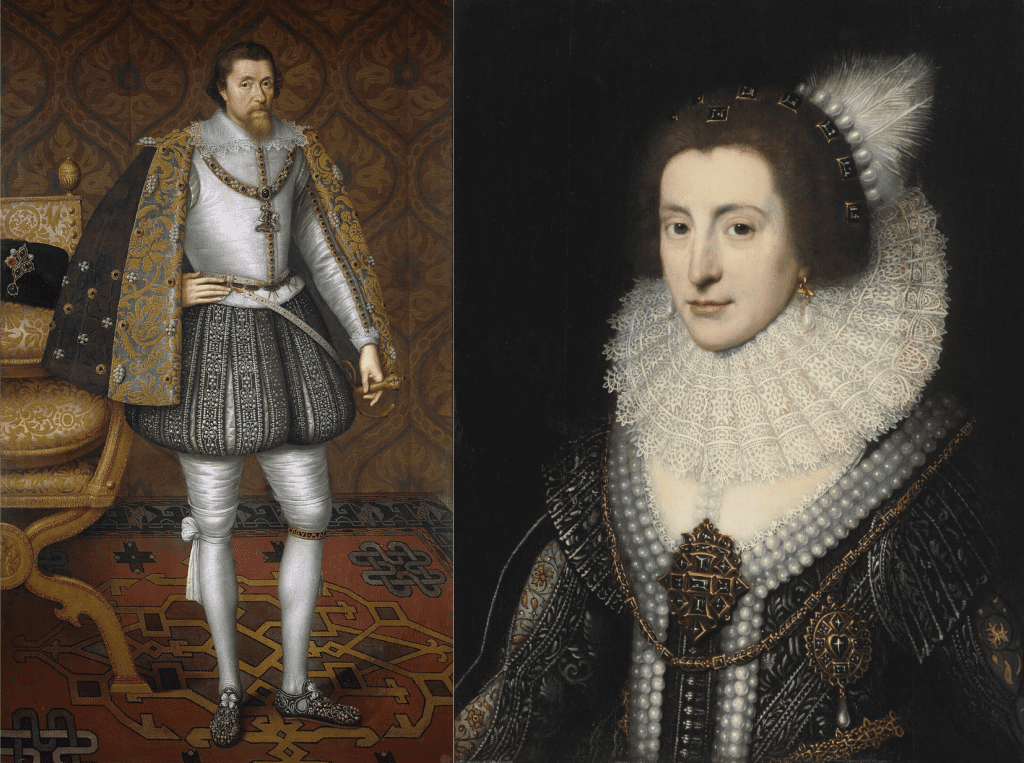
Yet worldly glory could not conceal the hardship of his life of faith. Even into his old age he continued to be repeatedly accused and fined for refusing to attend the Established Church’s services. Nevertheless, when he died of heart failure at Stondon Massey on 4 July 1623, he was by no means a destitute recluse but a wealthy, respected old man. The records of the Chapel Royal noted his death in a distinctive and reverent manner, calling him ‘a father of music’.
Finale: The Unifier of a Divided Age
After the BLOG owner has written about so many great musicians of the Renaissance, we take William Byrd as the terminus of this long era. He is not merely the ‘last’ in time, but the embodiment in a single person of all the contradictions that had their roots in the whole age.
He inherited the precise structure of Franco-Flemish polyphony that Dufay had inaugurated, absorbed Josquin’s emotional expression and word-painting, and mastered Palestrina’s pure counterpoint and grand architectural sense. His Great Service may be called the last great monument of English Renaissance polyphony. Compared with Lasso’s free wanderings among the courts of Europe, Byrd was confined in the most violently contested laboratory of the Reformation — England. His personal predicament bound Renaissance music to the fierce conflicts of politics, religion and national identity more tightly than ever before. His music thereby became a historical archive recording the spiritual schizophrenia of an age. He was at once the last great guardian of the medieval Catholic tradition of liturgical music, and a pioneer exploring a strongly individual style and a national idiom in the English anthem and the keyboard variation. In him, the collective liturgical tradition and the expressive impulse of the individual artist held their final and most tensile dialogue.
Byrd is not a full stop to an era but a dash pointing toward the future. In his music the seeds of much that would flower in the Baroque are already clearly present. The extreme portrayal of pain, longing and consolation in the ‘Cantiones Sacrae’ and the Masses reaches an emotional intensity far beyond the Renaissance ideal of ‘moderate affect’, pressing directly toward the heart of the Baroque ‘doctrine of the affections’. The pleading quality created by suspended harmony in the Agnus Dei foreshadows Monteverdi‘s ‘stile concitato’. His virginal works, especially the dances and variations in ‘Parthenia’, are no longer an appendage to vocal music but an independent domain exploring pure instrumental logic, keyboard technique and homophonic tonal interest. This paved the way for the vast keyboard music of the Baroque era (above all the English virginal school and the later French school of the harpsichord).
Looking back, then, we can at last make a historical summary for this final great master of Renaissance music: he was the completer and closer of Renaissance polyphonic art in England, and at the same time the first crucial prophet of English music’s advance into the Baroque age. His greatness lies not in healing the rift, but in holding fast, with incomparable artistic integrity, to both poles of that rift, and in converting the enormous tension thereby generated entirely into creative musical power. The year of his death (1623) fell precisely on the eve of a violent turn in European musical style. The great edifice of polyphony was still admired, but people had already begun to hunger for more direct emotional impact, sharper dramatic contrasts, and a more euphonious harmonic language — the age of the Baroque was about to arrive.
Afterword: The Close of a Great Age
With the end of the chapter on William Byrd, the Renaissance — a great age fondly spoken of by countless later generations — also draws to its close. On the soil of Europe, this age gave birth to the most glorious music humanity had yet produced, accompanied by some of its most turbulent history. Behind almost every note, blood is steeped. As those who came after, we study and come to understand this history; we listen to and savour this music. But we must always remember that the reason we can savour life in our leisure and wander through a sea of music is that we are now born in a mighty homeland — a place more powerful than all of Europe combined, and a greater age than the Renaissance itself.
In 2025, after much hesitation, the BLOG owner finally took up the pen to begin writing the ‘Classical Diary’ series — a special feature that had existed only in the BLOG owner’s dreams in earlier years. And now, at the close of the year, I find that I have written nine installments without quite realizing it. I still remember many years ago, when on a whim I first stepped into Xinghai Concert Hall and heard my first classical music concert — that was my first step into the classical world. Now, at last, I have emerged from my green years, and can take the hand of those who come after as one who has trod the path before, guiding you to listen to the echoes of this history. I am honoured and proud to do so. I look forward to continuing to explore music with all of you next year, to listening together to the melancholy of the Baroque and the ardour of the Classical. (The full text is 38,688 characters.)
Digital Image Archive of Medieval Music (primary reference database)
Digital Bodleian (primary reference database)
ChoralWiki (primary reference database)
Wikipedia (drawing on a large number of articles in Chinese, English, Italian, French, etc.; cited in the original text)
World Historical Atlas (map screenshots used in this article)
QQ Music (some of the audio referenced in this article)
Tudor Printed Music at the New York Public Library | New York Public Library
International Music Score Library Project
The National Archives
UK travel and heritage – Britain Express UK travel guide
Purge Me O Lord – Tallis | PDF
Thomas Tallis – Purge me, O Lord Lyrics | Genius Lyrics
William Byrd: Gentleman of the Chapel Royal – John Harley – Google Books
“Cantiones quae ab argumento sacrae vocantur 1575”
Oxford Academic
Genius | Song Lyrics & Knowledge

You May Also Like

Personal Recommendations: Ten Songs That Moved Me in 2024
Classical Diary: Orlando di Lasso of Europe, Orlando di Lasso of the World (Part 8)