England rends apart the Renaissance era’s final master of music.
Open the score of history: fifteenth-century Europe was a polyphonic movement in many voices. The various parts—political, religious, economic—marched independently, yet interwove into one vast, ever-shifting whole. In the middle of this grand movement, when the stable bass of the old order had not yet faded and the bright theme of a new melody had already burst in, the birth of Josquin des Prez was like a long-awaited note, about to sound in the right voice, with the right timbre.
Prologue: The Voice of the Age — Converging in the World
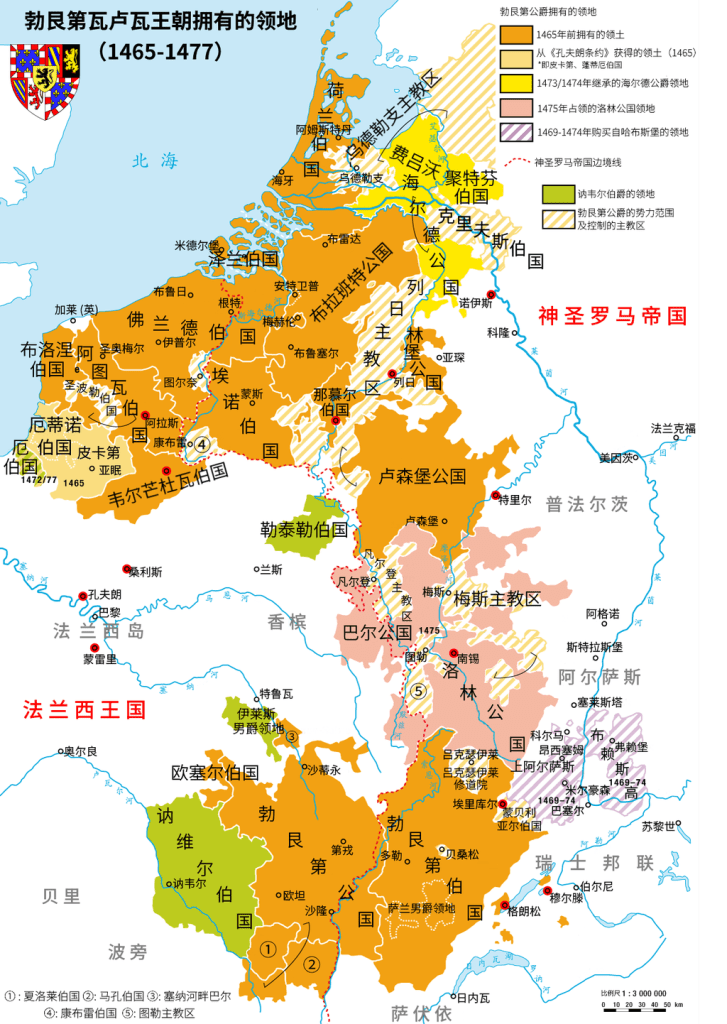
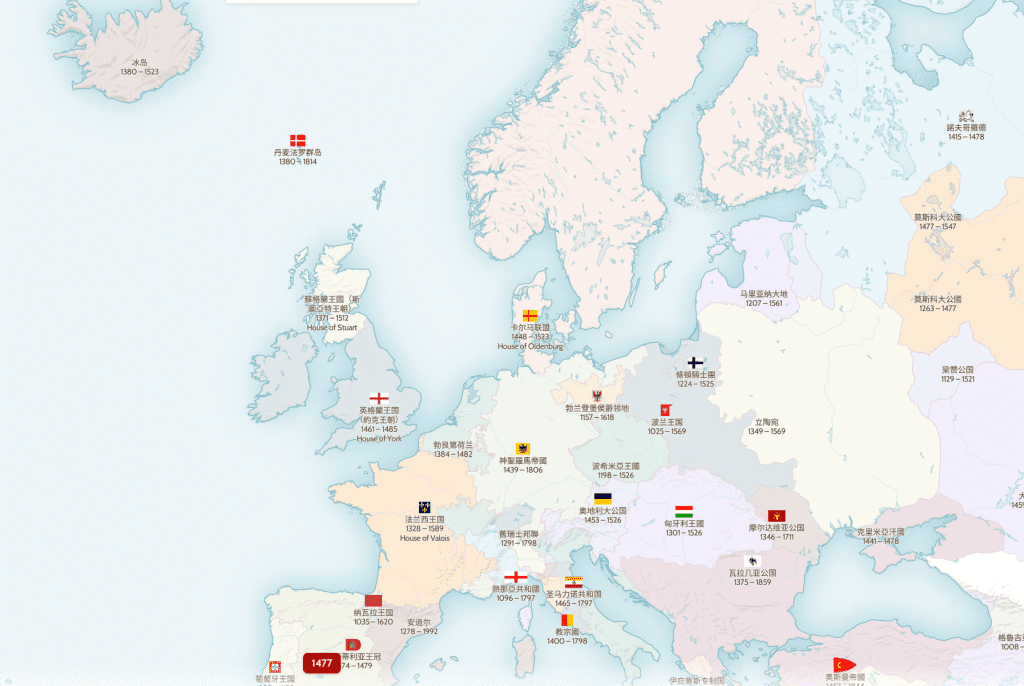
On the political and national level, Europe at the time was like a civilization playing a game that could only be won by military force; the powers were like pieces on a chessboard, constantly reshaping the balance of power through their maneuvers. The Hundred Years’ War between France and England (1337–1453) was awakening from a long nightmare, trying to heal its wounds and re-weave the fabric of nations under the banner of royal authority. On its flank, the court of the Duchy of Burgundy (918–1477) radiated the final glory of molten gold at sunset—a hothouse of etiquette, fashion, and art that nurtured the earliest masters of the Franco-Flemish School.
The territorial evolution of the Burgundian dynasty
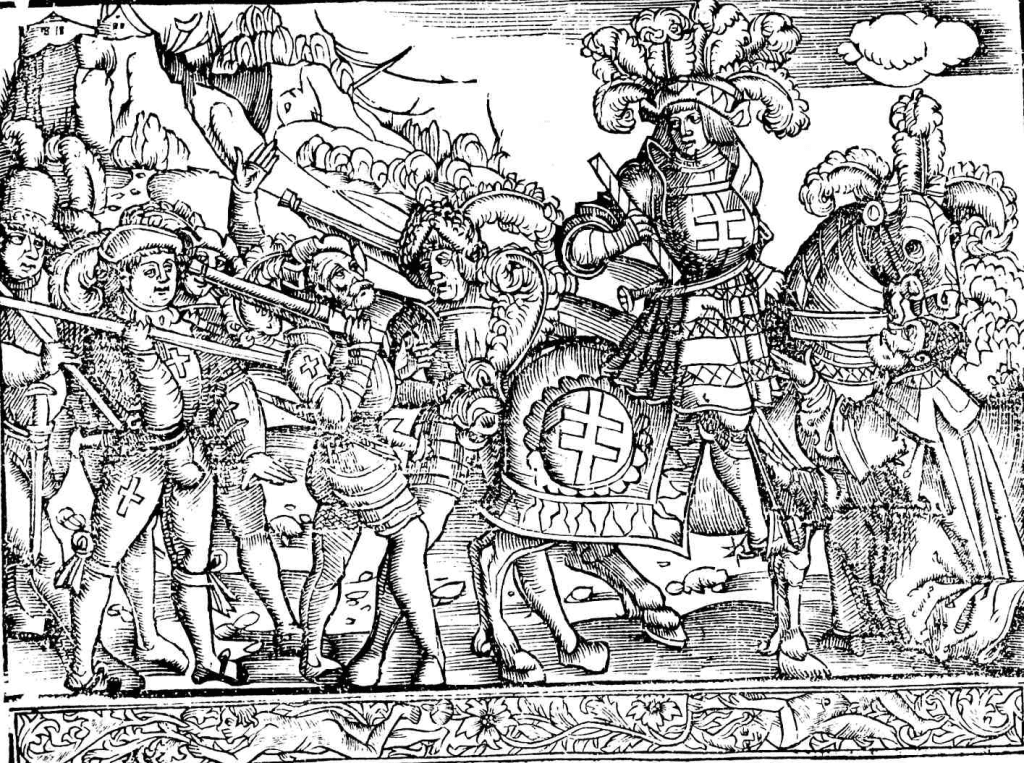
Yet the chessboard would always shake. On January 5, 1477, the defeat at the Battle of Nancy felled Charles the Bold—not merely a military event, but a cultural rift that profoundly affected Europe. The Burgundian dream shattered; the musicians who had once enjoyed such generous treatment fled like migratory birds stripped of shelter, seeking new directions. They flew south across the Alps, carrying the refined polyphonic texture of the North into the blazing sunlight of the Italian states.
A restored wooden carving depicting the Battle of Nancy, artist unknown
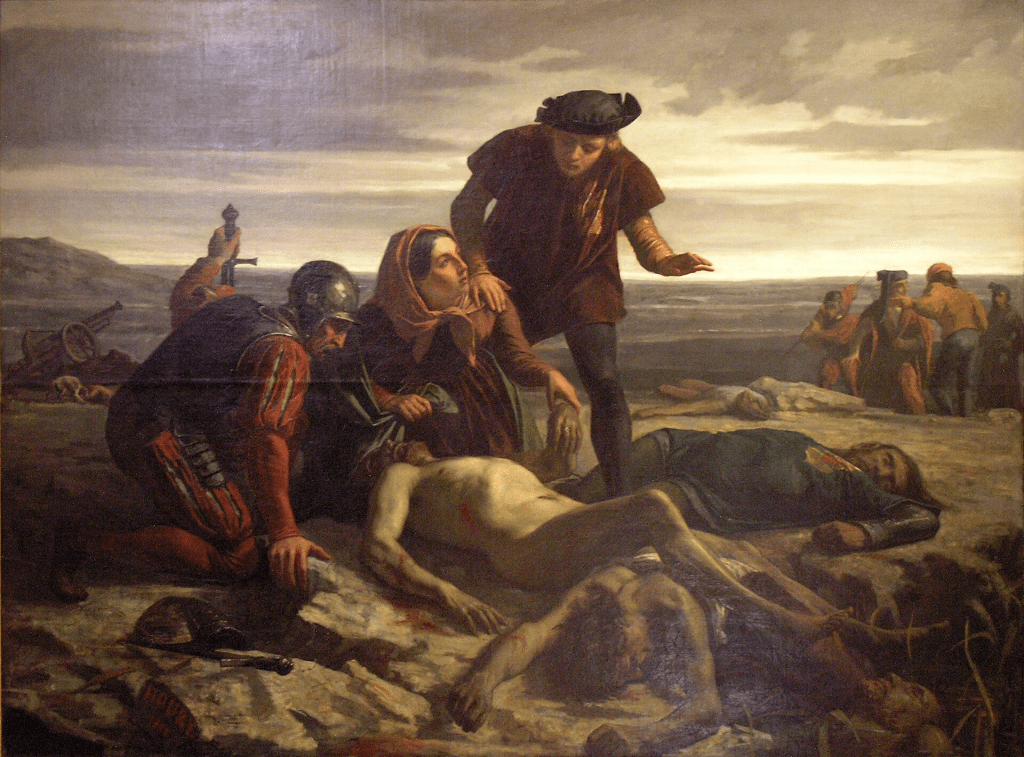
Charles the Bold’s body discovered on the battlefield, artist unknown
Did You Know: What Is Polyphonic Texture?
[Expand / Collapse]
If homophonic music is a painting with a clear subject and background, then polyphonic texture is a sculpture you can walk around and admire, or a brilliant conversation running on many parallel threads. It lies at the heart of Renaissance music, especially the works of Josquin des Prez and his contemporaries.
1. Core Definition: A Symphony of Independent Melodies
Polyphonic texture, in short, is built fromtwo or more independent melodic lines, which proceed simultaneously and interweave under the rules of vertical harmony, forming a musical structure.
“Horizontal” Independence: Each melody (corresponding to one voice in vocal music, such as soprano or tenor) is itself a complete, beautiful, and logically coherent line. You can listen to any single voice alone, and it remains a moving melody.
“Vertical” Harmony: When these independent lines sound simultaneously, they must also form a harmonious consonance with one another, creating a unified, full-bodied sonic whole.
2. Key Techniques: Imitation and Counterpoint
This texture is constructed primarily through two key techniques:
Imitation: This is the most iconic device of polyphonic music. One voice sings a melody first, and the others enter in turn by imitating it, producing a “catch-me-if-you-can” effect. Its strictest form is the “round” (canon).
Counterpoint: This is the technical system for composing polyphonic music, akin to the grammar of writing. It precisely governs how these independent melodic lines can be combined harmoniously.
3. Historical Evolution: From Homogeneous Structure to Heterogeneous Expression
The use of polyphonic texture was not fixed; it underwent a profound evolution:
Ockeghem’s “Homogenizing” Exploration (Structural Integration): In the hands of Josquin’s predecessors such as Johannes Ockeghem, polyphonic texture tended toward a kind ofstructural “homogenization”. Through consummate craftsmanship, he made the voices interweave with greater equality and balance in rhythm and melody, forming a highly unified, tightly structured polyphonic web. In his late works, such as the groundbreaking “parody Mass,” he wove multiple voices of a pre-existing song into the composition, giving the Mass’s texture an inner unity at the level of its source material.His aim was to build a polyphonic edifice of perfect structure and smooth operation.
Josquin’s “Heterogenizing” Breakthrough (Emotional Expression): Josquin fully inherited this technically perfected edifice, but he used it in service of a higher goal:emotional expression. To this end, he boldly introduced “heterogenizing” treatment.
Serving the Text: To make the lyrics clearly intelligible and to heighten their emotion, he would suddenly have all voices adoptdeclamatory homophony, creating a chordal, declamatory effect.
Creating Weight and Contrast: He no longer sought perpetual equilibrium among the voices; instead, following the content of the text, he flexibly let certain voices stand out while others provided support, creating a rich play of light and shadow and of tension.
Word-Painting: He used music to “paint” the text—for example, an ascending melodic line to depict the “Ascension.” His goal was to use his fully matured contrapuntal technique as a supple tool for expressing human emotion, to make music “speak.”
Summary:
Thus polyphonic texture is far more than a technique; it is a way of thinking in music. It evolved fromthe “homogenizing” integration oriented toward architectural structure in Ockeghem’s era, tothe “heterogenizing” use oriented toward emotional expression in Josquin’s era. This evolution is precisely the key sign of music moving from the mystical abstraction of the Middle Ages toward the humanist spirit of the Renaissance.
When you listen to Josquin’s motets, you hear not only a finely engineered acoustic architecture but also an emotional drama woven from four or more “threads of sound.”
When a whale falls, a thousand creatures thrive. The life path of this issue’s protagonist, Josquin, epitomizes the era’s artist—from the Milanese court of the Sforza to the papal chapel in Rome, and on to the presence of the King of France; his footsteps alone form a living map of how power and art nourished each other in the fifteenth century.
Did You Know: The Impact of the Battle of Nancy on Burgundy
[Expand / Collapse]
I. The Fall of an Ambitious Man: The Battle of Nancy
“Charles the Bold” was the last Duke of the Valois-Burgundy lands. He was no ruler content with the status quo: his lifelong ambition was to unite his scattered territories—including the wealthy Flanders, the Duchy of Burgundy, and Franche-Comté—into an independent and powerful “Kingdom of Middle Francia,” elevating himself from a vassal of the King of France to a king on equal footing with the French king and the Holy Roman Emperor.
Yet his policy of expansion made him countless enemies. To win control of Lorraine, he took up arms against René II, Duke of Lorraine. In January 1477, Charles led his elite army to besiege Nancy, the capital of Lorraine. By then he had suffered several military setbacks; his army was weary and his prestige damaged.
The decisive battle erupted on a cold winter morning. René II’s allied army (made up of Lorrainer, Swiss, and Alsatian troops) exploited its knowledge of the terrain and the foul weather to launch a fierce assault on the Burgundian forces. Charles’s army, though well equipped, was tactically rigid, and its line collapsed under the impact of the Swiss pike squares. In the chaos, Charles himself was gravely wounded, fell from his horse, and finally died beside a frozen pond. His body was not found until days later, his face so gnawed by wolves as to be unrecognizable; he could be identified only by his attendants, his scars, and his long fingernails.
II. The “Cultural Rift”: The Shattering of the Burgundian Dream
The death in battle of “Charles the Bold” meant far more than a military defeat. Since he left no male heir, his only successor was his daughter, Duchess Mary, just nineteen years old. This sudden power vacuum instantly turned the Duchy of Burgundy into prey for its powerful neighbors.
The Disintegration of a Political Entity: King Louis XI of France acted at once, declaring as liege lord the reversion of the Duchy of Burgundy (the ducal territory) itself and absorbing it into the direct domains of the French crown. The wealthier northern provinces of the Burgundian inheritance (such as Flanders and the Low Countries), however, fell to the House of Habsburg through Mary’s marriage—she was compelled to wed the future Holy Roman Emperor Maximilian I. From then on, the dream of the Duchy of Burgundy as an independent political entity was thoroughly shattered, its inheritance divided between the two dynasties of France and Habsburg.
The End of an “Artistic Utopia”: This is the heart of the so-called “cultural rift.” Under “Charles the Bold” and his predecessor “Philip the Good,” the Burgundian court had been the most dazzling center of culture and art in all of Europe. It was not onlythe Burgundian School‘s birthplace and sanctuary, but also the patron of Flemish painting masters such as the van Eyck brothers and Memling. The court was famed for its unparalleled splendor, refined etiquette, and generous patronage of the arts. Musicians such as Guillaume Dufay and Antoine Busnois had all composed some of the most exquisite polyphony here.
With the collapse of the duchy, this painstakingly built cultural ecosystem instantly fell apart. The court ceased to exist, and the stable source of patronage dried up with it.
In the economic sphere, the merchant ships of the Hanseatic League (the German commercial league) moved like floating city-states between the Baltic and the North Sea; the Medici bank in Florence, through its bill-of-exchange business, let capital flow across regions for the first time; in the weaving workshops of Flanders, broadcloth was not only a commodity against the cold but had become a luxury sold as far away as the Mediterranean. This new commercial network was quietly reshaping the ecology of art.
The North Sea–Baltic trade zone
In Bruges, the guild halls built by merchants proclaimed the city’s pride more than the church bell towers; in Antwerp, the founding of the stock exchange marked capital finding its institutional home. The accumulation of wealth gave birth to an entirely new demand for art—no longer rooted in religious piety, but in displaying personal success and taste. When merchants commissioned portraits from painters, they demanded that ledgers, Venetian glassware, and Oriental carpets appear in the background—details that were not merely symbols of wealth but a celebration of worldly life.
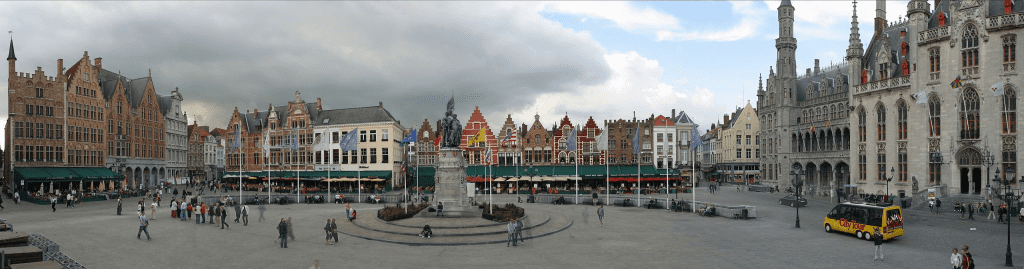
Bruges’s market square, also called the Grote Markt, surrounded largely by guild halls, fully renovated in 1995
This transformation of the economic base directly affected the path of musical development. Wealthy citizens began forming private ensembles and commissioning secular songs; music sank from the vaults of churches down into citizens’ parlors. The festivals held by commercial guilds needed celebratory music, and noble marriages called for commemorative songs. These new demands gave composers creative space beyond the Church. The subjects of music began boldly embracing secular emotion, and the joys and sorrows of human life began to flow through its melodies.
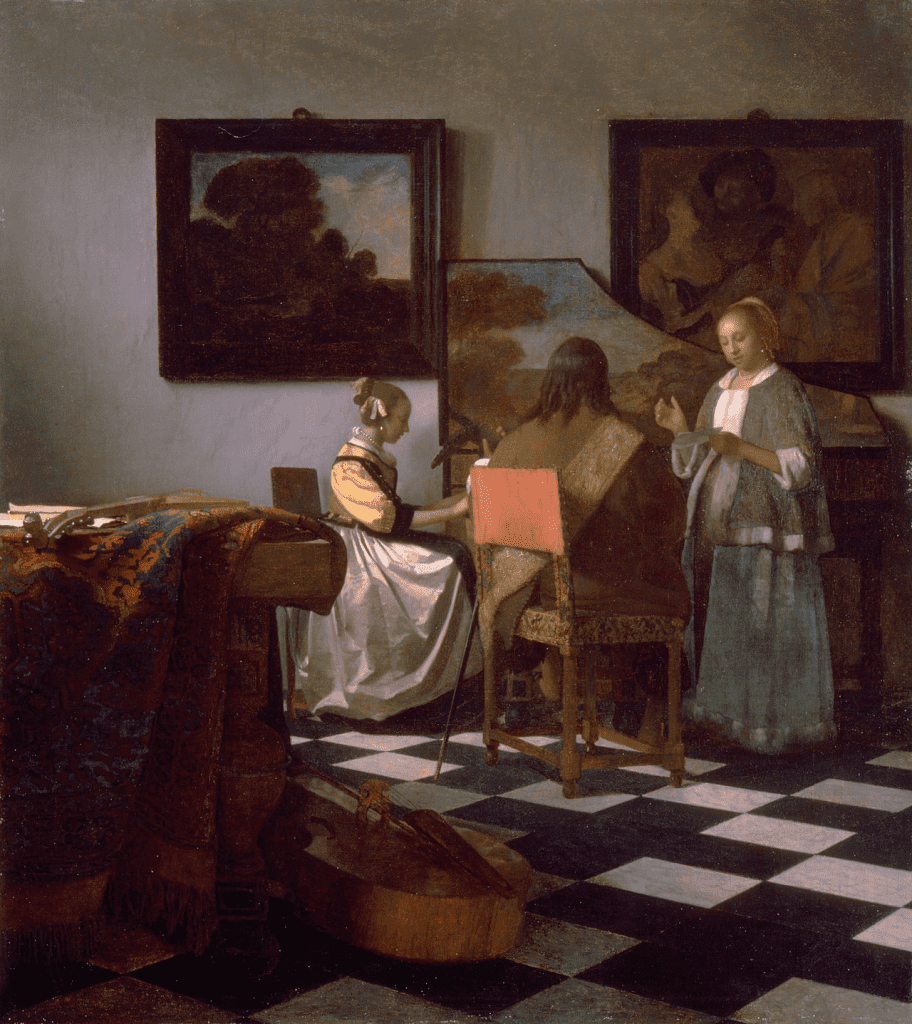
The Concert (Dutch: Het concert), a work by the seventeenth-century Dutch painter Johannes Vermeer. The painting depicts three people performing at home, fully showing that instruments (such as the viol, the lute, and the harpsichord) had become standard furnishings of middle-class households—a direct vehicle for “secular emotion” and “the joys and sorrows of human life.”
The circulation of gold and silver, the establishment of credit, the expansion of trade networks—these economic activities that seemed unrelated to art were in fact loosening the bonds on artists. When the value of a work of art could be measured by the market, when musical composition could earn worldly remuneration, creators began to transform from anonymous craftsmen into artists with independent personalities. The wound dealt to musicians by the fall of the Burgundian court was rapidly being healed by the power of economics; the musicians forced out of the “court” discovered a vast stage called “the world,” quietly laying the firmest foundation for the arrival of the Renaissance.
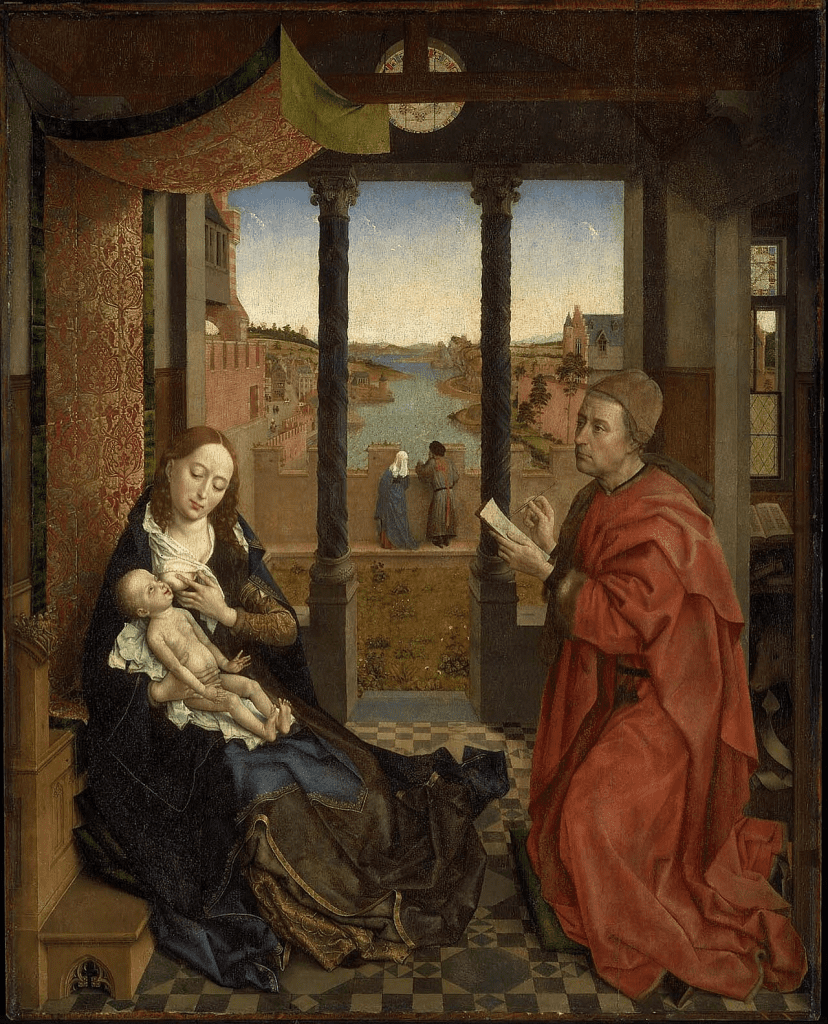
Saint Luke Drawing the Virgin, a work by the Netherlandish painter Rogier van der Weyden. The face of Saint Luke in the painting is widely recognized as van der Weyden’s self-portrait. It is among the earliest works of the Northern Renaissance to depict the artist as an individual with independent thought and creativity.
In technology, since Gutenberg’s printing press (Western movable type) was invented around 1450, it had matured through decades of development. When the Venetian publisher Petrucci made an epoch-making decision in 1502—devoting an entire book of Masses (Petrucci’s Misse Josquin) to Josquin, a living composer—the history of music turned.
Did You Know: The World’s First Printed Collection of Masses by a Single Composer
[Expand / Collapse]
One of Ottaviano Petrucci’s earliest publications—and the oldest printed music we possess devoted to a single composer—is a collection of Josquin’s Masses printed in 1502.
This meant that music was no longer merely the private possession of some church or court; it became a commodity that could be copied, sold, and carried to any corner of Europe. For the first time, a composer’s fame could be built through the circulation of printed matter, freed from the limits of word of mouth. Josquin was fortunate enough to be a surfer on this first wave: his works were reprinted again and again and spread widely. The modern concept of the “composer” as an independent creative artist grew ever clearer precisely through this technological transformation.
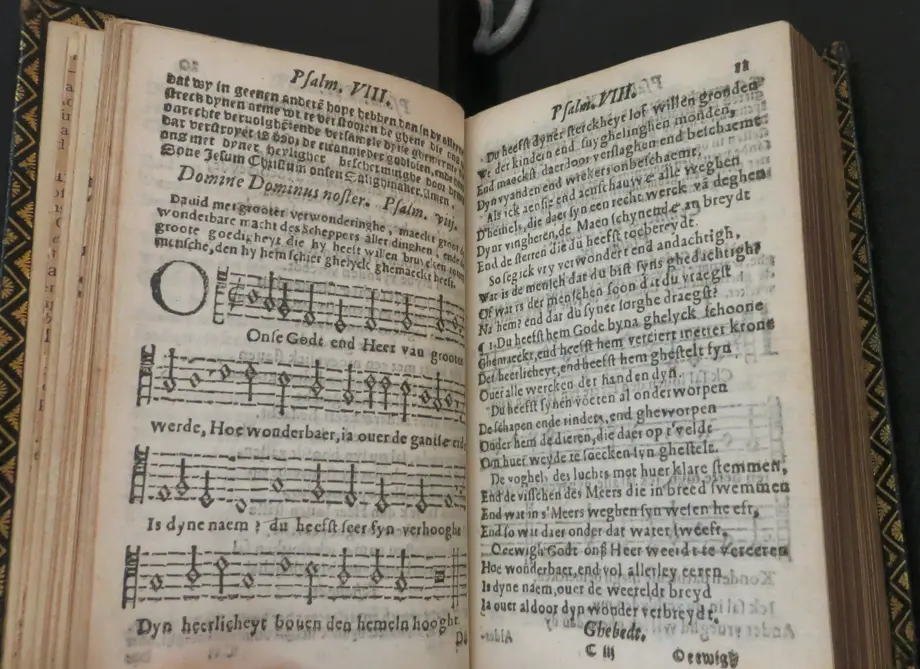
A Dutch metrical Psalter printed in 1566 on an early wooden printing press, by Jan Utenhove.
First Movement: The Prophecy of Compère
Josquin Lebloitte dit Desprez was born around 1450 to 1455 into a bailiff’s family in the French-speaking region of Flanders. As for his exact birthplace and early education, the sources are vague; one can only trace a faint outline from scattered records and the research of later scholars.
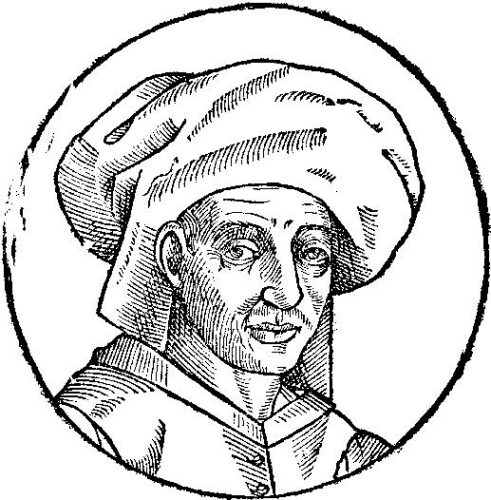
A 1611 woodcut portrait of Josquin des Prez, possibly copied from a now-lost oil painting made during his lifetime. Whether the portrait reflects his true appearance has long been questioned.
A seventeenth-century account records that Josquin des Prez, together with Jean Mouton (the future chief composer of the French royal chapel), became choirboys at the collegiate church of Saint-Quentin. Contemporary writers such as Gioseffo Zarlino (a celebrated music theorist and composer of the Renaissance) and Lodovico Zacconi (one of the most distinguished music theorists of the late Renaissance) also claimed that he studied under Johannes Ockeghem.
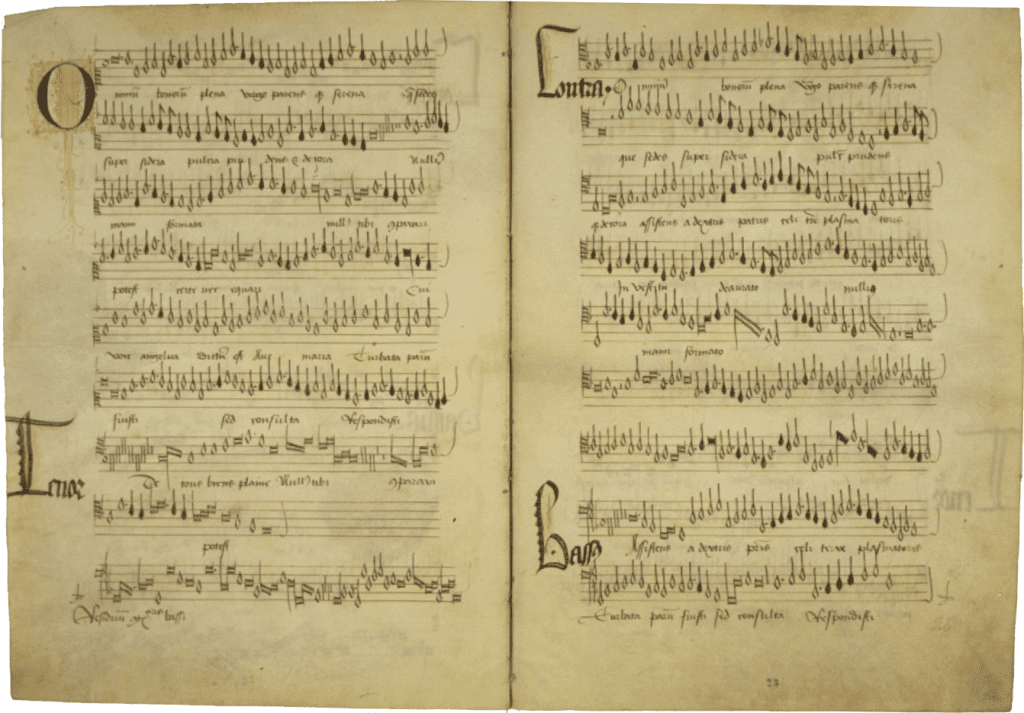
The young Josquin displayed astonishing, unignorable talent at the very start of his career. As a singer or a fledgling composer, his gift had already caused a stir in the small world of music. On July 2, 1472, in the motet Loyset Compère composed for the consecration of Cambrai Cathedral—Omnium bonorum plena—the name “des Prez” is mentioned. “ac Okeghem, des Pres, Corbet,” clearly sets “des Pres” alongside other celebrated composers such as Ockeghem. Though this list in the text may not exactly amount to a modern “lifetime achievement award,” Compère’s gesture was undoubtedly a prophetic recognition, declaring to the world that a genius capable of inheriting and glorifying the tradition of the Franco-Flemish School had stepped onto the stage of history.
The precious manuscript of Omnium bonorum plena
Did You Know: Omnium bonorum plena (Full of All Good Things) — Latin Text and Translation
[Expand / Collapse]
Part One: In Praise of the Virgin
Original text: Omnium honorum plena,
Translation: You are full of all honor,
Original text: Virgo parensque serena,
Translation: Virgin and serene mother,
Original text: quae sedes super sidera
Translation: You who sit enthroned above the stars,
Original text: pulchra prudens et decora.
Translation: Beautiful, wise, and graceful.
Original text: Assistens a dextris Patris,
Translation: You stand at the right hand of the Father,
Original text: caeli terrae plasmatoris,
Translation: the Creator of heaven and earth,
Original text: in vestitu deaurato
Translation: In garments gilded with gold,
Original text: nullius manu formato.
Translation: Woven by no human hand.
Original text: Nullus tibi comparari
Translation: No one can be compared to you,
Original text: potest certe nec equari
Translation: nor indeed can anyone equal you;
Original text: cui voce angelica
Translation: To you the angel’s voice
Original text: dictum est: ‘Ave Maria’.
Translation: Spoke the words: ‘Hail Mary.’
Original text: Turbata parum fuisti
Translation: You were somewhat troubled,
Original text: sed consulta respondisti,
Translation: but, after reflection, you replied:
Original text: ‘Ecce ancilla Domini
Translation: ‘Behold, I am the handmaid of the Lord,
Original text: sicut refers fiat mihi!’
Translation: let it be done unto me according to your word!’
Original text: Dulcis fuit responsio
Translation: Sweet was the response,
Original text: data cœlesti nuntio
Translation: given to the heavenly messenger.
Original text: per quam statim concepisti
Translation: Through it you straightway conceived,
Original text: natum Dei et portasti
Translation: bore the Son born of God,
Original text: illum necnon peperisti
Translation: and also gave birth to him,
Original text: et post partum permansisti
Translation: and after childbirth you remained
Original text: Virgo pura et nitida
Translation: a pure and shining Virgin,
Original text: virgoque immaculata.
Translation: a Virgin without stain.
Part Two: A Prayer for the Musicians
Original text: Omnium bonorum plena,
Translation: You are full of all goodness,
Original text: peccatorum medicina,
Translation: medicine for sinners,
Original text: cujus proprium orare
Translation: whose very office is to pray
Original text: est atque preces fundare,
Translation: and to pour forth prayers,
Original text: Pro miseris peccantibus
Translation: For the wretched sinners,
Original text: a Deo recedentibus
Translation: those who have turned away from God:
Original text: funde preces ad Filium
Translation: pour forth prayers to your Son,
Original text: pro salute canentium.
Translation: for the salvation of those who sing.
Original text: Et primo pro G. Dufay
Translation: First for Guillaume Dufay,
Original text: pro quo me, mater, exaudi
Translation: for him, O Mother, hear me,
Original text: luna totius musicae
Translation: he is the moon of all music,
Original text: atque cantorum lumine.
Translation: and the light of singers.
Original text: pro Jo. Dussart, Busnois, Caron,
Translation: For Johannes Dussart, Busnois, Caron,
Original text: magistris cantilenarum
Translation: masters of songs;
Original text: Georget, de Brelles, Tinctoris,
Translation: For Georget, de Brelles, Tinctoris,
Original text: cimbalis tui honoris,
Translation: (they are) the cymbals of your glory (that is, your praisers);
Original text: ac Okeghem, des Pres, Corbet,
Translation: and Ockeghem,des Prez, Corbet,
Original text: Hemart, Faugues et Molinet
Translation: Hemart, Faugues, and Molinet,
Original text: atque Regis omnibusque
Translation: and Regis and all
Original text: canentibus, simul et me
Translation: singers, together with me
Original text: Loyzet Compere orante
Translation: —Loyset Compère—praying,
Original text: pro magistris puramente;
Translation: sincerely praying for my masters;
Original text: quorum memor virgo vale
Translation: mindful of them, O Virgin, farewell,
Original text: semper Gabrielis ave.
Translation: ever with Gabriel’s ‘Hail!’
Original text: Amen.
Translation: Amen
Did You Know: Do des Pres and des Prez Refer to the Same Person?
[Expand / Collapse]
It almost certainly refers to the same person: the composer Josquin des Prez.
1. Spelling Variants of the Surname
In the fifteenth century, the spelling of surnames was far from standardized. It wasextremely commonfor the same person’s name to appear with different spellings in different documents.
“Standard” Form:Josquin des Prez(or des Prés)
Common Variants:des Pres、des Prés、Desprez、a Prato、de Prato、Pratensis etc.
In poetry and music, it is very common to adjust a name slightly to fit syllabification, meter, or rhyme.“des Pres” is precisely “des Prez” the most direct and reasonable variant spelling.
2. Context Is the Key Evidence
The two motets of that time (Compère’s Omnium bonorum plena and Regis’s Clara sonent organa) function as a “roll call of composers,” intended to list the most eminent musical masters of the day.
In the list of Regis’s Clara sonent organa, mention is made of Okeghem(Ockeghem),Du Fay(Dufay),Busnois(Busnois), and other acknowledged masters.
将 “des Pres” it among this company, from the standpoint of both historical and musical context, apart from that rising young geniusJosquin des Prez, there is hardly any other plausible candidate.
3. The Consensus of Scholarship
Musicology generally agrees that the des Prez / des Pres in these two lists refers to the composer Josquin. This identification rests on:
Contextual analysis: as noted above, he is listed alongside the other masters.
Elimination: among the musicians known at the time, no other figure of comparable importance and renown bore this name.
Documentary support: it corroborates other documents about Josquin’s life discovered later, showing that he was already gaining renown in that period.
This early reputation quickly opened the doors of Europe’s leading courts to him. Between 1477 and 1478, Josquin des Prez began serving the ruler of Provence: René, Duke of Anjou, “Good King”.
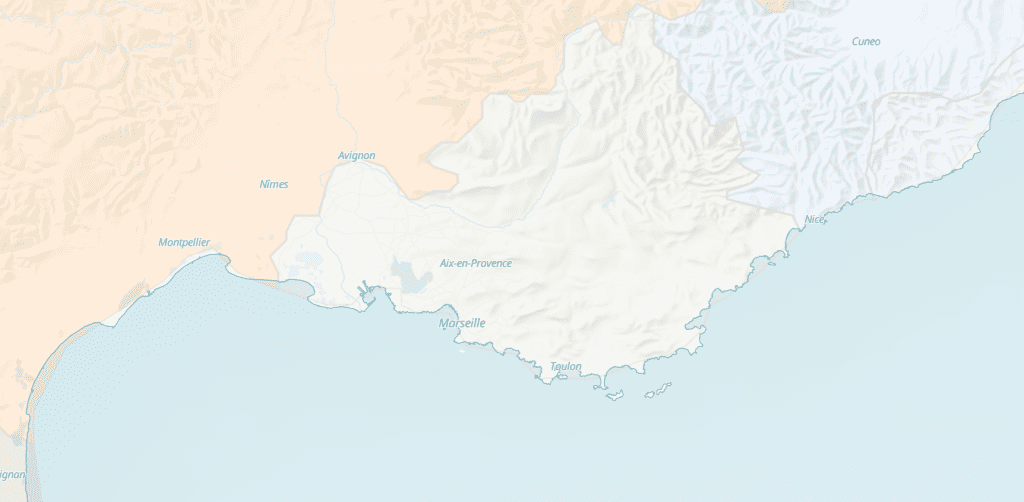
At the center of the map lies the County of Provence, whose capital was Aix (Aix-en-Provence).
Records show Josquin had become a singer at René’s court in Aix-en-Provence. René’s court was a famed cultural crucible of southern Europe; here the young Josquin not only honed his craft but also absorbed an early draught of the artistic air of the Italian Renaissance.
Did You Know: “René I,” Duke of Anjou, and His “County of Provence”
[Expand / Collapse]
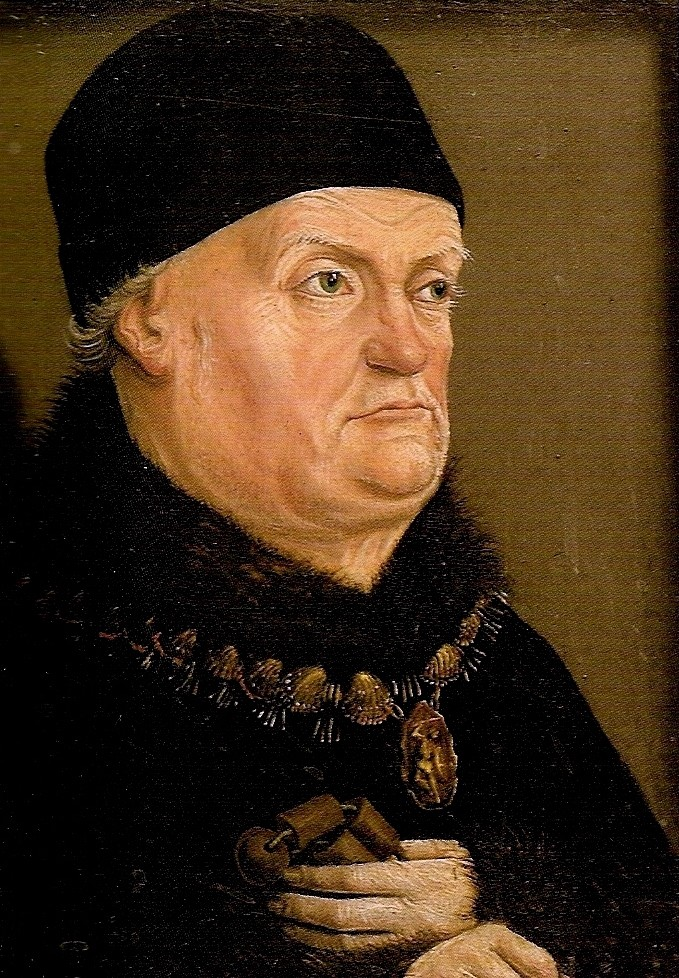
René I (of Anjou), commonly known as “Good King René” , was a prince of the early Renaissance steeped in legend. His life was full of dramatic quests for thrones and brutal political struggles, yet he ultimately found his true home in art and learning.
I. An Overview of His Life
Life span: January 10, 1409 – July 10, 1480
Titles: He held, or laid claim to, a great many titles, including:
Duke of Anjou
Duke of Lorraine
Duke of Bar
King of Naples(nominal)
King of Jerusalem(nominal)
King of Aragon and Sicily(nominal)
Center of rule: His ultimate power base and place of repose was in southern France: theCounty of Provence, with its capital atAix。
II. A Turbulent Political Career: From Prince to “King Without a Crown”
René’s life was an epic of throne-chasing, yet the outcome was repeated frustration:
Inheritance and Contention: Through inheritance and marriage he acquired claims to vast territories including Lorraine and Anjou. His grandest ambition was to seizethe throne of Naples. After years of war (1438–1442), he was ultimately defeated by his rival Alfonso V of Aragon and lost his Italian lands.
The Origin of the “Good King”: Despite his military and political failures, René was renowned in the lands he directly ruled—especially Provence—for just, merciful, and effective governance, and so earned the sobriquet “Good King René.”
Retreat to Provence: After abandoning his Italian ambitions, he turned all his energy to governing Provence, making the court at Aix one of the most brilliant cultural centers in southern Europe.
III. A Prince of the Renaissance: Patron of Art and Learning
It was in Provence that René left his greatest legacy. He himself was a versatile Renaissance man:
Writer: He wrote the famous chivalric romance The Castle of the Heart’s Assault, an exquisite allegorical work.
Painter: Though no authenticated paintings survive, contemporary accounts describe him as an accomplished painter.
Scholar and Patron: This was his most central role. His court drew painters, sculptors, writers, musicians, and scholars from all over Europe.
IV. Music at René’s Court: Josquin’s Point of Departure
For music history, René’s court was crucial:
A Musical Center: His court maintained an outstanding church choir, whose musical standard rivaled those of the Burgundian court and the papal chapel.
Musical Style: The music of René’s court blended the contrapuntal craft of northern France with the melodic style of southern Italy—an environment of fusion highly favorable to the growth of a young musician.
Josquin’s Opportunity:In 1477, Josquin des Prez is recorded as a singer at René’s court. This was a crucial starting point for Josquin’s career:
A High Starting Point: To gain entry to so prestigious a court was in itself proof of his early talent.
Broadening Horizons: Here he could encounter the most advanced musical styles and theory in Europe and work alongside first-rate musicians.
Crucial Connections: René was closely connected to the French royal house (he was the uncle of King Louis XI). The connections Josquin forged here likely paved the way for his later entry into the French royal chapel.
V. Historical Image and Legacy
Image: In later Romantic depictions, René is often idealized as a “happy failure,” a wise ruler far from the struggles for power, devoted to art and to pastoral life.
Legacy: His greatest legacy lies not in the kingdoms he lost, but in his generous patronage of art and knowledge as a true Renaissance pioneer. His court at Aix was the cradle of the Renaissance in southern France.
Josquin’s steps did not stop in southern France. Around 1484 he moved to one of the most prominent families in Europe—Milan’s Sforza family, serving the all-powerful Cardinal Ascanio Sforza. In Milan he found himself in an outstanding artistic circle made up of masters such as Leonardo da Vinci and Bramante. This environment profoundly shaped his musical outlook, prompting him to begin fusing the complex polyphony of the North with Italian melodic beauty and clarity of structure.
Did You Know: The System of Polyphonic Music
[Expand / Collapse]
Homophonic music is like aspeech. There is a protagonist (the main melody) speaking, while the others (the chordal accompaniment) merely echo and support him on the side. The vast majority of the pop songs and folk songs you hear take this form.
Polyphonic music is instead like alively symposium或debate. There aretwo or moreindependent “voices” (whether human voices or instrumental parts) speaking at the same time; each has an equal, independent, and beautiful melodic line, yet they are deftly interwoven into a harmonious, rich whole.
Key Characteristics of Polyphonic Music
Independence of Melody: Each voice has its own melodic motion, not simply serving as the accompaniment of another. As you listen, you can try following just one of the voices, and it alone resembles a complete piece.
Diversity of Rhythm: To heighten independence, different voices typically use staggered, complementary rhythms. While one voice holds a long note, another may be running quickly.
Equality of Status: In pure polyphony there is no absolute “primary and secondary”; every voice is equally important.
Harmonious Unity: Although the voices are independent, when combined they must obey the rules of harmony, sounding harmonious and euphonious rather than a chaotic noise.
The Most Classic Polyphonic Device: Counterpoint
“Counterpoint” is the technique and the law of composing polyphonic music. The most common contrapuntal device is imitative counterpoint, and its most famous form is the “canon”。
Canon: The one we know best is “Two Tigers” —a perfect canon. When one voice sings “Two Tigers,” the second voice, slightly later, imitates it from the beginning. This polyphonic form, in which one voice imitates another, is the canon.
Fugue: This is the most complex and dramatic form of polyphonic music, which can be regarded as an “upgraded canon.” It typically has a short, distinctive “subject” that appears, develops, and interweaves in turn across different voices and keys, building a rigorous and magnificent musical architecture.J.S. Bach‘s The Art of Fugue and The Well-Tempered Clavier are the summits of fugue.
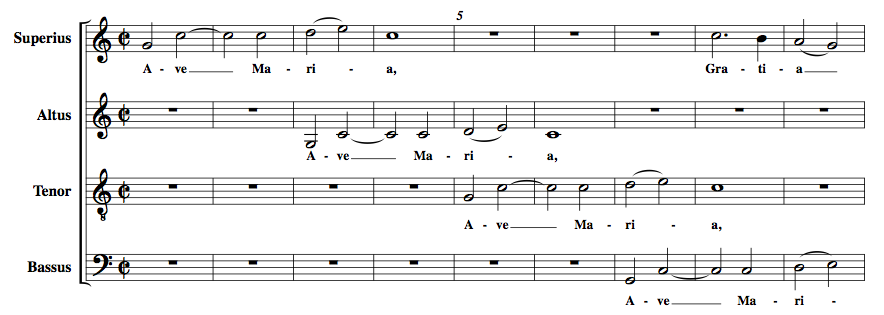
The works of this period already showed the germ of his future innovations. Josquin’s most famous early masterpiece—the motet “Ave Maria, gratia plena, Dominus tecum, Virgo serena.” (commonly shortened to Ave Maria)—was most likely written in the mid-1480s. Unlike the dense, long-breathed, hard-to-segment polyphonic style of his predecessor Ockeghem, Josquin adopted a clearly sectional structure in this work. The whole piece can be clearly divided into:
Final prayer: “O Maria … nos exaudi” Opening salutation: matching the words “Ave Maria … Virgo serena” The five virtues of the Virgin: matching “Mater … pia, dulcis et benigna” and so on The narrative of the Annunciation: beginning from “Caelestia, terrestria,” telling the biblical story
This structure lets listeners easily follow the progress of the text and grasp its meaning, embodying the Renaissance pursuit of clarity, order, and reason. The opening of the work is one of the most classic moments in music history: the four voices do not enter together, but in imitative counterpoint, sounding one after another like a solemn dialogue. I suggest putting on headphones and listening carefully to the opening “A – v e – M a – r i – a …” to experience for yourself the wonderful moment of imitative counterpoint.
Highest voice (Superius): A – v e – M a – r i – a … Next-highest voice (Altus): A – v e – M a – r i – a … Tenor voice (Tenor): A – v e – M a – r i – a … Lowest voice (Bassus): A – v e – M a – r i – a …
Did You Know: Imitative Counterpoint
[Expand / Collapse]
Imitative counterpointis a polyphonic technique, an important subcategory of contrapuntal craft. It means thata melodic fragment (called the “subject” or “motive”), after appearing in one voice, is immediately repeated in another voice, like an echo, or like a group of people playing a game of “copy it without alteration.”
“Counterpoint”: refers to several independent melodic lines proceeding and interweaving simultaneously.
“Imitation”: refers to the relationship among these melodic lines in which “you imitate me, and I imitate you.”
By listening to this immortal classic, we learn that Josquin stood at the center of European sacred music, with access to the richest musical resources, and that his writing achieved a delicate balance between technical complexity and emotional expressiveness. His innovations are mainly embodied in three respects:
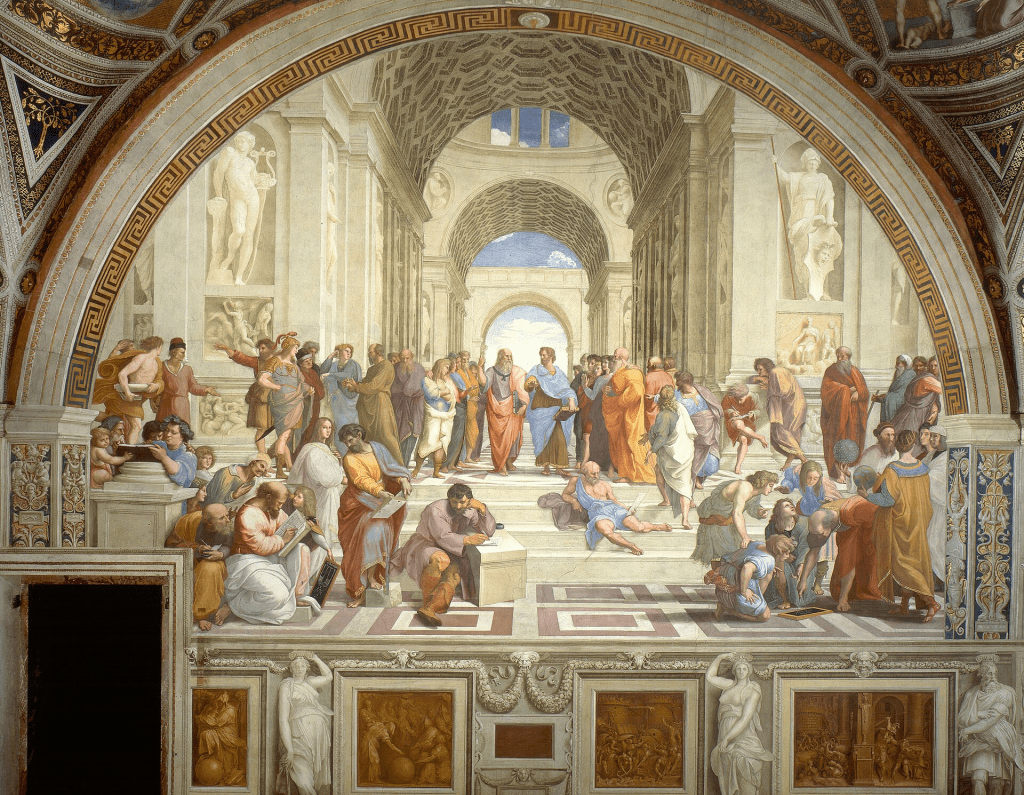
The masterly use of imitative counterpoint became the signature of his music. He developed a more mature technique of “imitative counterpoint,” letting the voices unfold like a precise dialogue: an idea introduced by one voice is imitated and followed in turn by the others. This device both guarantees the music’s logical rigor and imparts a constant forward drive to the work. Just as Raphael’s The School of Athens, painted in the same period, embodies the Renaissance pursuit of reason, order, and harmonious structure—with its figures appearing in groups, their poses echoing one another to form a complex visual balance—so too in Josquin’s music each voice is independent and equal, and through imitation and echo they together build a grand and harmonious whole.
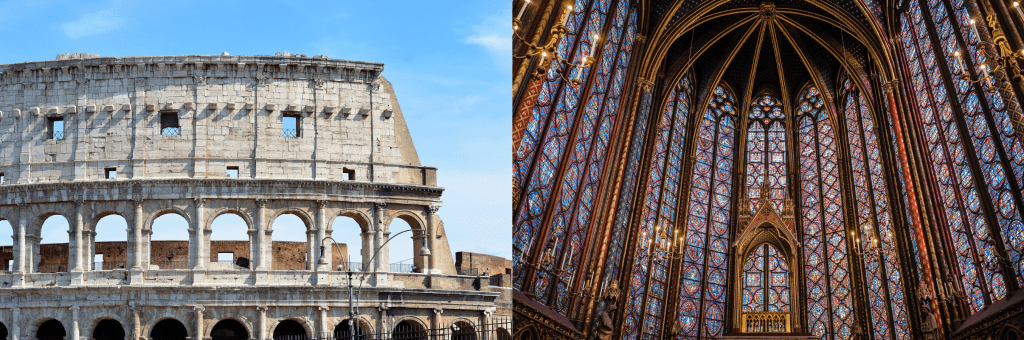
Clear musical structure replaced the long, unsegmentable melodic lines of early polyphony. He favored short, easily recognizable motives passed between voices, creating a sonic texture both unified and richly varied. Look at the left of the image below: the Roman Colosseum uses repeated arches and columnar orders as its basic building units; these units, repeated and combined, form a grand, clear, rhythmically articulated whole—just as Josquin’s short motives, through repetition and variation, build vast musical spans. On the right below, the interior of a Gothic church: pointed arches and clustered columns draw the eye upward, producing a continuous soaring sensation that reaches toward heaven, its structural units less distinct than those on the left. This resembles the musical style of Josquin’s predecessor Ockeghem, with long melodic lines and blurred structural boundaries.
On the left are the ruins of the ancient Roman amphitheater; on the right side stands the Sainte-Chapelle in Paris
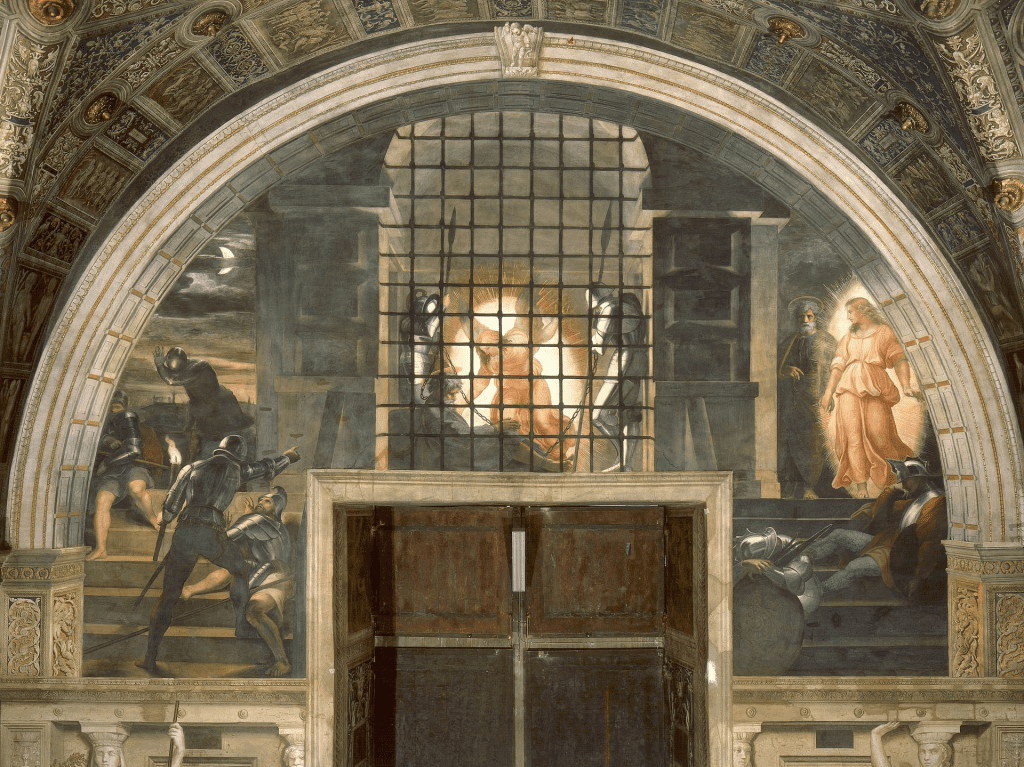
The deep integration of music and text embodied his humanist aspiration. He made music actively serve the emotion and content of the words, pioneering the technique of “word-painting” and turning notes into vehicles for conveying textual meaning. Look at the fresco The Liberation of St Peter by Raphael below: it perfectly embodies the Renaissance’s clear structure and narrativity, and can be matched one-to-one with Josquin’s musical innovations. First, the balance of composition and inner drama—the same spirit as Josquin’s music: within a rigorous framework, injecting expressive emotional tension, achieving a delicate balance between technical complexity and emotional expressiveness. Second, a clear three-part structure: the scene is naturally divided into three episodes by walls and railings, like the three sections of a piece of music—the left section: an angel awakens St Peter; the middle section: the angel leads St Peter out of the cell; the right section: the guards startle awake in the light, in confusion. This clear, easily understood narrative structure, this device of using light of different qualities to symbolize the meaning of different things, is precisely the visual equivalent of Josquin’s “word-painting.” For instance, he uses pure high voices and consonant intervals when writing of “light,” and the low register and dissonant intervals when writing of “darkness” or “imprisonment.”
Sensory impression:Stable, euphonious, calm, relaxed. When they sound, you feel the phrase could rest here, temporarily or permanently, with a sense of completeness.
Uses in Josquin’s Music:
To depict heaven, light, peace, the divine, love and other positive, stable concepts.
They form music’sskeleton and points of stability, usually appearing at the end of a phrase.
Typical examples:
Perfect octave (e.g., one sings “Do” while another, an octave higher, also sings “Do”) —> Utterly fused, almost the same note.
Perfect fifth (e.g., Do and Sol) —> Open, stable—the cornerstone of medieval and Renaissance music.
Major third (e.g., Do and Mi) —> Bright, cheerful.
Josquin’s usage: when the text sings of “Pax” (peace), “Lux” (light), “Caelum” (heaven) , he very likely used consonant intervals—especially the bright major third—to create a harmonious, serene auditory experience.
2. Dissonant Intervals
Sensory impression:Unstable, harsh, tense, conflict-ridden. Your ear expects it to continue onward and ultimately “resolve” to a consonant interval, thereby releasing the tension.
Uses in Josquin’s Music:
To depict pain, grief, sin, darkness, struggle and other negative, turbulent concepts.
Creatingdramatic conflictand forwardmomentum。
Typical examples:
Minor second (e.g., Do and D-flat) —> Extremely crowded, grating.
Major seventh (e.g., Do and high Si) —> Full of tension, urgently demanding resolution.
Tritone (e.g., Fa and Si) —> In the Middle Ages it was even called the “devil in music.”
Josquin’s usage: when the text sings of “Dolor” (pain), “Mors” (death), “Peccata” (sin), “Tenebrae” (darkness) , he would deliberately use dissonant intervals to produce auditory discomfort and tension, letting you directly “feel” the anguish the text expresses.
This deep fusion of music and text not only created rich layers of sound but also endowed the music with a rigorous logic and drive. It became one of the core techniques of polyphony in the centuries that followed (including Bach’s fugues), and Josquin was the key figure who perfected it and brought it to center stage.
The ending of the work displays his mastery of tradition and his personal transcendence of it. The melody of the final line, “O Mater Dei, memento mei,” was not original but quoted from a widely known plainchant (Gregorian chant) of the time. Yet Josquin did not simply borrow it. He placed the ancient melody in the highest voice, making it clearly audible, and wove a new, harmonious contrapuntal web for it in the three voices below. This is at once a tribute to the musical tradition and a re-creation of it through personal genius. The device perfectly symbolizes his historical position as one who carried on the past and opened the way to the future, and it fully confirms Compère’s foresight.
At the same time, Josquin also produced many outstanding chansons, such as the enormously popular “Adieu mes amours” (Farewell, my love). The emotional core of the piece is the parting and grief of the courtly-love tradition; with its simple, touching melody and sincere feeling it spread widely across France at the time, showing Josquin’s superb ability to command different genres.
Unlike his Masses and motets, this chanson has a relatively simple, direct structure that follows the stanzas of the poem. Josquin deftly wove the imitative counterpoint and word-painting at which he excelled into this secular song, so that it brims with feeling yet is easier to listen to than sacred polyphony.
“Adieu mes amours” has further distinctive value. First, the work has survived in many forms, including a purely vocal version and arrangements for instruments (such as the lute), showing that it was welcomed across different social strata and performance settings. Second, the melody of “Adieu mes amours” was quoted extensively by later composers—for instance, the contemporary Heinrich Isaac used it as a “cantus firmus” in his own Mass. This is rather like the feeling that today’s fan-work creators in the Eastern music scene hold for ZUN. Finally, it was included in song collections published by the world’s earliest music printer. Their boss, Petrucci, was a shrewd businessman; the works he chose to publish were bound to be “hot numbers” with strong market demand and guaranteed sales.
Second Movement: The Giant Who Led an Age
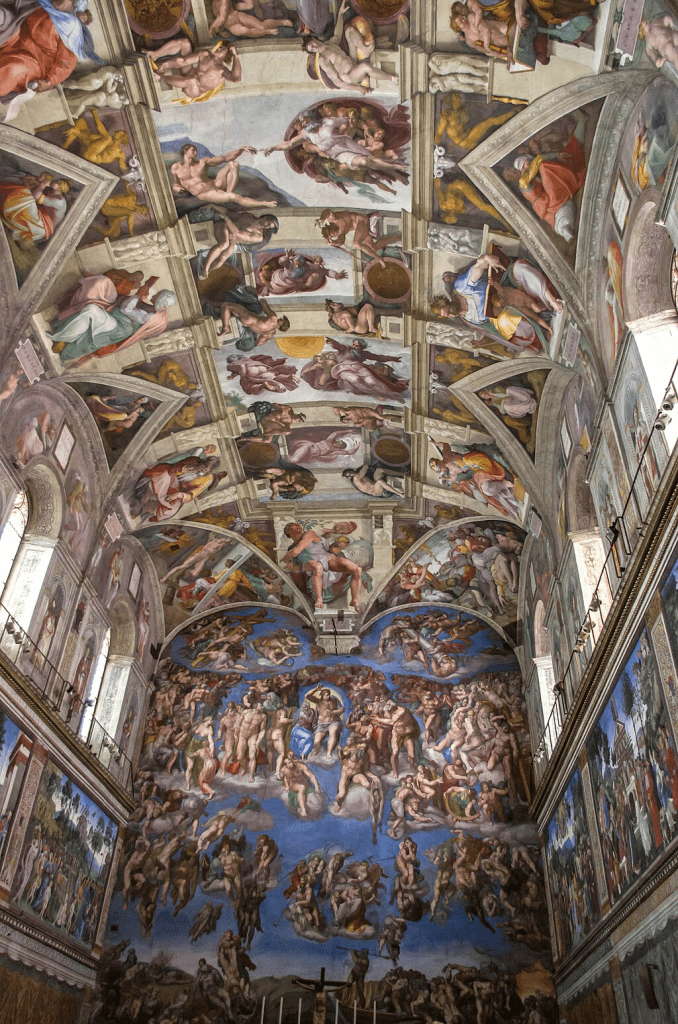
In June 1489 Josquin formally entered the papal chapel in Rome, becoming a member of the Sistine Chapel choir. The attainment of this important post very likely came from an exchange of interests arranged within the Sforza family—Ludovico Sforza (the head of the Sforza house, and the elder brother of the above-mentioned Cardinal Ascanio Sforza) sent his own composer Gaspar van Weerbeke to the Curia and, as part of the return on this investment, also sent Josquin into the Curia as a sort of visiting student.
Interior view of the Sistine Chapel, showing the relative positions of the ceiling frescoes and the other murals. Near the top of the photo, Michelangelo‘s The Creation of Adam can be seen
Did You Know: The Trading of Musicians
[Expand / Collapse]
1. A Peculiar “Gift Economy” and a Display of Soft Power
In Renaissance court culture, outstanding artists (musicians, painters, and scholars alike) were not mere employees; they were themselvesliving symbols of a ruler’s wealth, taste, and power. Presenting them as “gifts” to other rulers was a sophisticated way of forging or cementing alliances, expressing goodwill, and displaying one’s own cultural superiority.
Ludovico Sforza’s Calculation: By sending the Pope a composer who was already established and dependable (Weerbeke), he offered a “tribute” that brought enormous face. The gesture seemed to say: “Look—my court can cultivate and retain such an excellent artist; I now present him to you as a token of my respect and loyalty to the Holy See.” This greatly raised his standing and favor in the Pope’s eyes.
The Pope’s Gain: In receiving a mature musician, the Pope directly strengthened the musical forces of his own chapel—a genuinely substantial “gift.”
2. Talent Circulation and “Artistic Investment”
Ludovico was not making a loss-making deal; he was making a shrewd long-term investment.
Weerbeke Was a “Mature Asset”: Weerbeke was an established master whose value and style were relatively fixed. Sending him away meant some loss, but it bought back far more precious resources.
Josquin Was a “Growth Stock”: At the time, Josquin was “a northern genius just coming into his own,” with limitless potential. Ludovico’s sending him to the foremost musical institution in Europe—the papal chapel—for advanced training was like sending one’s most promising student to Harvard or Oxford. The experience of the papal chapel would let Josquin encounter the most cutting-edge musical ideas and the richest resources, and exchange with Europe’s musical elite, enabling him to grow at lightning speed.
The Future Return: Ludovico most likely expected that once Josquin had made his name in Rome, he would return to Milan to serve him. Then a super-master refined by “papal-grade” training would carry Milanese court music to unprecedented brilliance—a prestige far exceeding what keeping a Weerbeke would have brought. It resembles today’s tech companies sending promising employees for advanced study at top institutions.
3. The Extension of Political Influence
Planting one’s “own man” beside the Pope had always been a goal of rulers everywhere. Though musicians did not directly take part in decisions, as members of the Pope’s intimate daily circle they could become important channels of information and cultural emissaries.
Josquin’s fame in Rome was in itself a constant reminder to the Curia and the other Italian courts:this genius comes from Milan—he is a Ludovico Sforza “product.”This invisibly raised Milan’s status and influence in the cultural map of the whole of Italy.
In the Eternal City of Rome, Josquin found an ideal stage for his talents. As a papal singer, he not only enjoyed a generous salary but also obtained an enviable “non-residence” privilege: he could draw several unrelated benefices at once without residing locally or knowing the local language. Within only two months of arriving in Rome, this shrewd musician began claiming his first benefices, including posts at churches in places such as Notre-Dame de Paris, Cambrai, and Saint-Omer. The surviving papal bulls show that some of his applications were approved, even though he appears never actually to have taken up these distant posts.
Did You Know: The “Non-Residence” Privilege
[Expand / Collapse]
Regarding thebeneficesthat Josquin could draw “without residing locally or knowing the local language,” here is the basis:
Institutional background: Within the church system of the time, there was a common practice called “pluralism” 或 “exemption from residence” —a common practice. A cleric could hold several benefices at once (that is, “pluralism”), and by obtaining a special dispensation from the Pope or a bishop, be excused from the obligation to reside where the benefice was located.
Josquin’s case: As a member of the papal chapel, Josquin automatically gained priority in applying for such dispensations. His duty was to serve the Pope in Rome, which in itself constituted legitimate grounds for being unable to reside in Paris or Cambrai. In claiming these benefices, he was in essence after themonetary incomethey produced, not the fulfillment of local pastoral duties. The day-to-day religious duties locally would be discharged by a lower-ranking cleric on a modest salary.
The most direct evidence of Josquin’s claims and receipt of benefices comes from thepapal bulls。
What is a papal bull? It is an official legal document issued by the Pope, used to confer offices, privileges, or to settle disputes. Such documents were carefully registered and preserved.
The specific records: Scholars (such as David Fallows and Richard Sherr), while studying these records, found several bulls relating to Josquin. For example:
A bull dated August 18, 1489 records that Pope Innocent VIII, at Josquin’s request, granted him a benefice.
This document confirms that withinonly two monthsof arriving in Rome, Josquin had already begun actively pursuing economic gain for himself—consistent with his image as a “shrewd musician.”
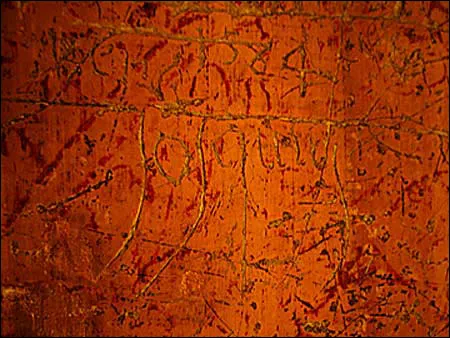
During the restoration work of the late 1990s, workers found the graffito signature “JOSQUINJ” on the wall of the Sistine Chapel’s choir gallery. It is one of nearly four hundred signatures on the wall, of which about a hundred can be confirmed as the work of papal singers of various eras. Though this is not, strictly speaking, an autograph, the modern scholar Richard Sherr holds: “Although this is not a genuine autograph, the probability that Josquin des Prez himself left it during his time in the papal chapel is very high.” This may be the closest thing to the master musician’s own hand that we can touch.
During the Vatican restoration, hundreds of signatures were found in the Sistine Chapel’s choir loft, the cantoria
In this period Josquin reached his peak in both technique and spiritual maturity. On the technical level, he composed “Missa L’homme armé super voces musicales” (the Mass on “The Armed Man,” on the musical notes). Though the date of this Mass is debated, many scholars regard it as representing his highly complex contrapuntal craft from his middle to mature years—a technical step beyond the Ave Maria—and as eminently suited to displaying the side of him that had attained the acme of skill. On the level of inner attainment, he composed “Miserere mei, Deus” (Have mercy on me, O God); its profound emotion and mature technique make it perfectly suited to describing the artistic realm he reached after his Roman years.
But the most distinctive work Josquin composed in this period is surely “Missa Hercules Dux Ferrariae” (the Mass of Hercules, Duke of Ferrara), which employs an unprecedented compositional device—”soggetto cavato.” He transformed the Latin name of his patron, the Duke of Ferrara “Hercules,” into musical notes: the vowels of Hercules Dux Ferrariae correspond to the solmization syllables Re-Ut-Re-Ut-Re-Fa-Mi-Re (that is, D-C-D-C-D-F-E-D). This tone-series born of the name, serving as a “cantus firmus,” runs through every movement of the Mass, becoming the unshakeable foundation of the entire work.
Yet Josquin’s excellence lies in the fact that he never let this device degenerate into mere display. In movements such as the Agnus Dei (the fifth section of the Mass), this melody, which could have seemed stiff, is wrapped by him in rich, fluent contrapuntal voices, producing a sonority at once solemn, majestic, and emotionally abundant. This perfectly embodies his mature style: seamlessly fusing the strictest rational design with the most expressive emotional utterance.
The very existence of this Mass is proof of Josquin as a mature, confident court composer. It is not merely liturgical music but a finely crafted “political artwork” that both celebrates the glory of its patron and displays, to the full, the incomparable talent of the composer himself. Through this work, Josquin proclaimed that he now stood at the summit of European music.
During his years in Rome, Josquin’s music manuscripts began to circulate throughout Europe. In August 1494, when he briefly returned to Cambrai, the local church presented him with a “wine of honor,” a witness that this wandering son had already become the pride of his homeland. Although the papal chapel records for 1494–1500 were unfortunately lost, so that we cannot know exactly when he left Rome, those Roman years unquestionably established his standing as a master of his generation. Here he was transformed from a gifted northern composer into a musical giant who inaugurated an era.
Third Movement: Freedom and the Final Years
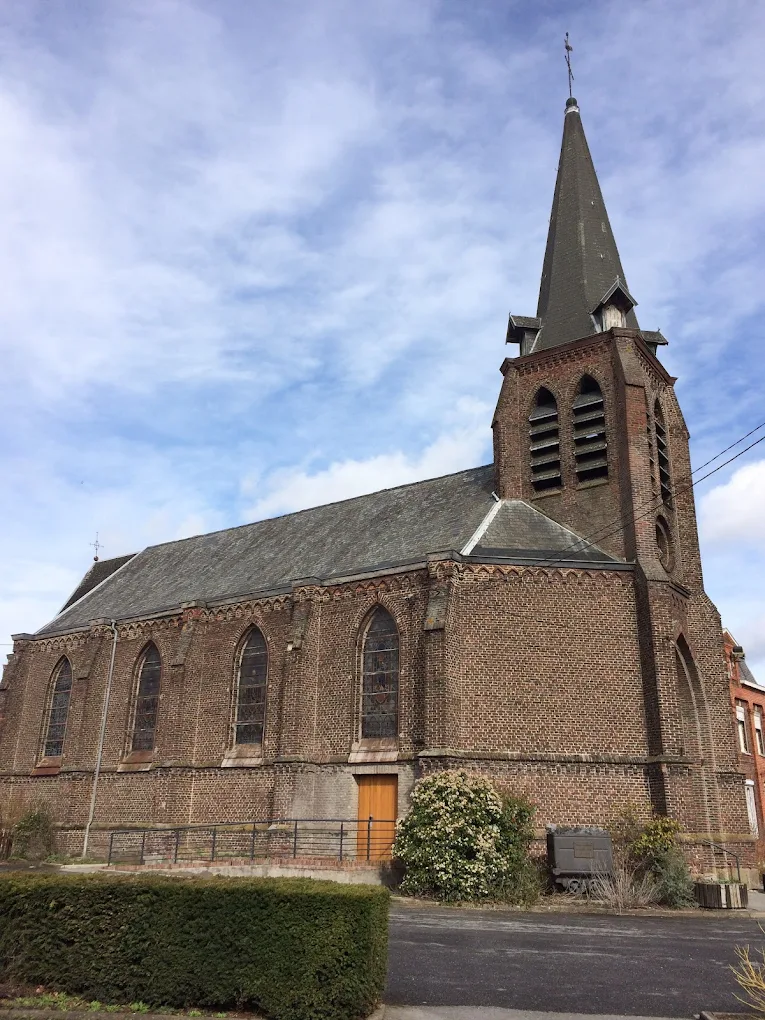
Josquin des Prez quietly left Italy in the spring of 1504. This time his destination was not another bustling court but the home of his spirit—Condé-sur-l’Escaut (Condé), near his birthplace. Here he accepted the post of provost of the Collégiale Notre-Dame de Condé-sur-l’Escaut (the collegiate church of Notre-Dame at Condé-sur-l’Escaut). This was no sinecure but an important office carrying real administrative responsibilities, governing a large religious community that included chaplains, priests, and choirboys.
The collegiate church of Notre-Dame in Condé, France
Did You Know: Why He Chose Condé
[Expand / Collapse]
1. The Call of Emotion and Kinship
A True Homeland: Though his exact birthplace remains disputed (possibly Beauvoir or its vicinity), the region of Condé was beyond doubt his “native soil.” His family had roots here; his uncle and aunt had lived here and may have died in 1478 during Louis XI’s siege of Condé, and Josquin returned here in 1483 to inherit their estate. This land carried his family memory and personal history.
Cultural Belonging: This was the French-speaking part of Flanders—his native language and cultural milieu. After spending much of his life as a “foreigner” in Italy, returning to a familiar cultural context was a profound emotional need.
2. An Ideal Final Station of a Career
The Collegiate Church of Notre-Dame at Condé-sur-l’Escaut was no ordinary village church; it was amajor regional center of religion and music。
A Distinguished Post: The church’sprovost was a post of great prestige and grave responsibility. The provost was not only a spiritual leader but also an administrator, governing a body that included dozens of clergy, musicians, and choirboys. For an aging artist, this was the highest social standing and professional honor.
A First-Rate Musical Institution: The collegiate church of Condé possessed achoir and musical tradition of outstanding renown. Its musical standard in the county of Hainaut was second only to Cambrai Cathedral and the Church of St. Vincent in Soignies. For Josquin, here was a ready-made, high-level musical ensemble that could immediately perform his complex works—an attraction of enormous power.
A Choice by Contrast: Compared with the intrigue-filled Italian courts (such as Ferrara, which he had just fled because of plague) or the fiercely competitive papal chapel, Condé offered astable, respected position with artistic autonomy. He was no longer a servant but a leader.
3. Shrewd Practical Considerations
Wealth and Security: The post of provost of the collegiate church carried with itample benefices. This ensured he could enjoy a wealthy, secure life in his later years, without having to scurry about for a living.
A Stable Political Environment: By this time, Condé lay under the rule of the powerfulHabsburg dynasty. Compared with the turbulent Italian peninsula, the political situation here was far more stable—an ideal place to spend one’s final years.
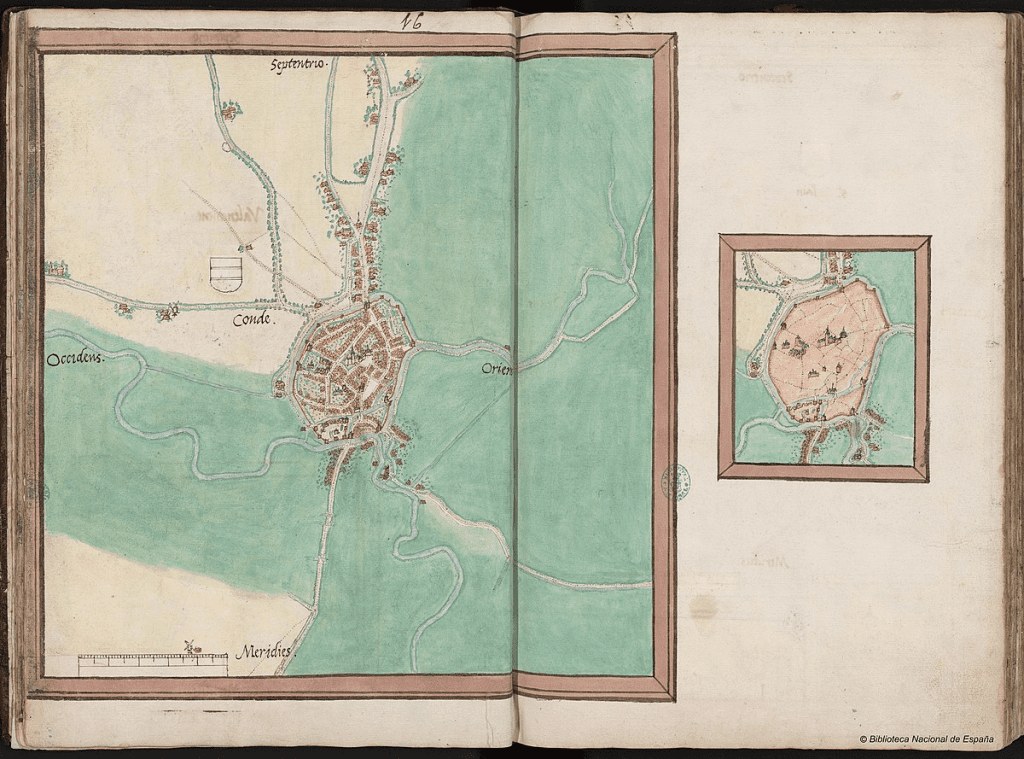
This mid-sixteenth-century map precisely depicts the little town of Condé, where Josquin spent the last seventeen years of his life. Its tranquillity stands in stark contrast to the intrigue and clamor he had experienced in Milan, Rome, and Ferrara. In the final stage of his life, Josquin chose to return to his native soil. As a master already famous across the continent, he no longer needed to attach himself to any prince. This unprecedented freedom profoundly influenced his late style. His music shed the outward virtuosity of “Missa Hercules Dux Ferrariae” (the Mass of Hercules, Duke of Ferrara), turning instead toward a deeper, more introspective spiritual expression. His technique had reached the acme, but every device now receded behind the scenes, wholly at the service of more profound emotion and devout meditation.
In this period Josquin’s representative works shifted from Masses to motets and chansons. Among them, the motet “Miserere mei, Deus” (Have mercy on me, O God) stands as a monument of emotional memorial, widely recognized as one of the greatest works of the sixteenth century and the summit of Josquin’s art of “word-painting.” The work is based on Psalm 51 of the Bible, beginning with nothing more than a simple plainchant melody as its seed. Through layer upon layer of imitative counterpoint, Josquin lets the plea “Miserere mei, Deus” (Have mercy on me, O God) recur and surge among the voices in turn, like a heavy confession a soul cannot shake off. He employs dramatic rests, producing sudden silence amid the dense sonority, as if grief had reached the point of speechlessness, enormously intensifying the emotional tension.
This is no longer mere display of technique, but a vast emotional edifice built in sound. The music pushes confession, fear, and supplication to their limits, wielding a direct, soul-shaking power—the union of his late profound introspection and his ultimate emotional expression. It fuses the most rigorous contrapuntal technique with the deepest human feeling, representing the emotional depth that Renaissance sacred music could attain.
Did You Know: A Structural Analysis of “Miserere mei, Deus”
[Expand / Collapse]
Act One: Grievous Confession
Complete text with translation:
“Miserere mei, Deus, secundum magnam misericordiam tuam. Et secundum multitudinem miserationum tuarum, dele iniquitatem meam. Amplius lava me ab iniquitate mea, et a peccato meo munda me. Quoniam iniquitatem meam ego cognosco, et peccatum meum contra me est semper. Tibi soli peccavi, et malum coram te feci; ut iustificeris in sermonibus tuis, et vincas cum iudicaris. Ecce enim in iniquitatis conceptus sum, et in peccatis concepit me mater mea. Ecce enim veritatem dilexisti; incerta et occulta sapientiae tuae manifestasti mihi.”
(Have mercy upon me, O God, according to thy lovingkindness, according unto the multitude of thy tender mercies blot out my transgressions. Wash me thoroughly from mine iniquity, and cleanse me from my sin. For I acknowledge my transgressions: and my sin is ever before me. Against thee, thee only, have I sinned, and done this evil in thy sight: that thou mightest be justified when thou speakest, and be clear when thou judgest. Behold, I was shapen in iniquity; and in sin did my mother conceive me. Behold, thou desirest truth in the inward parts: and in the hidden part thou shalt make me to know wisdom.)
Musical analysis: The music is founded on alow, slow plainchant motive, with the voices entering indense imitative counterpointone after another. When it reaches “peccatum meum contra me est semper” (my sin is ever before me), the voices interweave ever more tightly, and the harmonic progressions arecautious and conservative, the color leaning dark. At “Ecce enim in iniquitatis conceptus sum” (I was shapen in iniquity), the music uses a descending melodic line to portray the fallenness of human nature, vividly depicting the sinner’s trembling and anguish before God.
Act Two: Earnest Purification
Complete text with translation:
“Asperges me hysopo, et mundabor; lavabis me, et super nivem dealbabor. Auditui meo dabis gaudium et laetitiam, et exsultabunt ossa humiliata. Averte faciem tuam a peccatis meis, et omnes iniquitates meas dele. Cor mundum crea in me, Deus, et spiritum rectum innova in visceribus meis. Ne proiicias me a facie tua, et spiritum sanctum tuum ne auferas a me.”
(Purge me with hyssop, and I shall be clean: wash me, and I shall be whiter than snow. Make me to hear joy and gladness; that the bones which thou hast broken may rejoice. Hide thy face from my sins, and blot out all mine iniquities. Create in me a clean heart, O God; and renew a right spirit within me. Cast me not away from thy presence; and take not thy holy spirit from me.)
Musical analysis: Here the musical mood undergoes anevident shift. When it reaches “Asperges me hysopo” (purge me with hyssop), the melodic lines becomemore fluid, taking on the rising-and-falling, wave-like “washing” scales. At “Cor mundum crea in me” (create in me a clean heart), the voice-leading shows an upward yearning. Especially at “super nivem dealbabor” (I shall be whiter than snow), the harmonic color brightens, and the music begins to glow faintly with a pure radiance, symbolizing the emotional transition from confession to hope.
Act Three: Ecstatic Redemption
Complete text with translation:
“At “Redde mihi laetitiam salutaris tui, et spiritu principali confirma me. Docebo iniquos vias tuas, et impii ad te convertentur. Libera me de sanguinibus, Deus, Deus salutis meae, et At “exsultabit lingua mea iustitiam tuam. Domine, labia mea aperies, et os meum adnuntiabit laudem tuam. Quoniam si voluisses sacrificium, dedissem utique; holocaustis non delectaberis. Sacrificium Deo spiritus contribulatus; cor contritum et humiliatum, Deus, non despicies. Benigne fac, Domine, in bona voluntate tua Sion, ut aedificentur muri Hierusalem. Tunc acceptabis sacrificium iustitiae, oblationes et holocausta; tunc imponent super altare tuum vitulos.”
(Restore unto me the joy of thy salvation; and uphold me with thy free spirit. Then will I teach transgressors thy ways; and sinners shall be converted unto thee. Deliver me from bloodguiltiness, O God, thou God of my salvation: and my tongue shall sing aloud of thy righteousness. O Lord, open thou my lips; and my mouth shall shew forth thy praise. For thou desirest not sacrifice; else would I give it: thou delightest not in burnt offering. The sacrifices of God are a broken spirit: a broken and a contrite heart, O God, thou wilt not despise. Do good in thy good pleasure unto Zion: build thou the walls of Jerusalem. Then shalt thou be pleased with the sacrifices of righteousness, with burnt offering and whole burnt offering: then shall they offer bullocks upon thine altar.)
Musical analysis: Here the music moves toward itsdouble climax of emotion and technique. When it reaches “At “Redde mihi laetitiam” (restore unto me the joy), the voices ascend to thebright high register, and the texture becomesexceptionally rich. At “At “exsultabit lingua mea” (my tongue shall sing aloud), the voices unfold withthe most complex contrapuntal technique, the melodic lines brimming with vitality. Finally, in the collective praise of “Tunc acceptabis” (then shalt thou be pleased), the music reaches a glorious summit, bursting forth with the ecstasy and release that follow the remission of sin.
Besides motets, Josquin’s chanson “Mille Regretz” (A Thousand Regrets) is likewise recognized as a crowning achievement of secular song. This French chanson proves that Josquin’s supreme accomplishment was not confined to the sacred realm. In the secular sphere, too, he distilled the most universal of human emotions.
Did You Know: The Text of “Mille Regretz”
[Expand / Collapse]
Mille regretz de vous abandonner A thousand regrets at abandoning you Et d’eslonger vostre fache amoureuse, And at drawing away from your loving face, Jay si grand dueil et paine douloureuse, I have such great grief and sorrowful pain, Quon me verra brief mes jours definer. That one will soon see my days come to an end.
Unlike the delicate structure of his early chansons, this work is compact in form and intensely concentrated in feeling. It casts aside complex love allegories and, with unadorned directness, expresses an unappeasable, thousand-fold regret and sorrow. With its profound emotional pull it swept across all of Europe and was even hailed as “the Emperor’s chanson” —said to be the song that Charles V, Holy Roman Emperor, most wanted to hear as he lay dying. It marks Josquin’s deep insight into, and empathy with, human nature at the end of his life. Whether in sacred prayers written in Latin or in secular laments sung in French, he could touch the deepest places of the human heart. It is the summit of Josquin’s secular output, transcending the limits of genre and language through the sheer force of its emotion, and becoming the shared emotional symbol of a generation.
“Miserere mei, Deus” is a cry to God, a soul’s deep confession; while “Mille Regretz” is a whisper to humanity, the ultimate sorrow of the earthly world. These two swan songs, one sacred and one secular, are like two voices echoing to each other from the aged Josquin in his native Condé, together establishing his place as an eternal master who could not only command complex craft but also touch the very core of human emotion.
Finale: Returning to Stillness
On August 27, 1521, Josquin died in Condé. In accordance with his last wishes, his estate was used to support the singing of his motet “Pater noster – Ave Maria” in church processions in later years. He was finally laid to rest before the choir stall of the collegiate church—a king of music who had traveled across half of Europe, at last finding eternal stillness in the sanctuary of his homeland.
Did You Know: About “Pater noster – Ave Maria”
[Expand / Collapse]
“Pater noster – Ave Maria” is an extremely famousdouble motetcomposed by Josquin in his late years, and also the work he explicitly stipulated in his will to be sung at the ceremonies held in the town of Condé after his death.
What makes the piece special is that it combines the two most central Christian prayers:
“Pater noster”: that is, the “Our Father” 或 the “Lord’s Prayer”, the prayer Jesus himself taught to his disciples.
“Ave Maria”: that is, the “Hail Mary”, the prayer of homage and supplication addressed to the Virgin Mary.
A detailed reading of the work:
1. Musical Structure and Style
The work is an exemplar of Josquin’s latepure polyphonic style. Unlike his Masses, itmakes no use of any pre-existing plainchant or secular melody as a cantus firmus, but is freely composed entirely on the Latin text of the prayer.
Imitative counterpoint: He employs a mature and fluent imitative counterpoint; the voices interweave densely, yet the overall effect is remarkablyclear, solemn, and introspective。
Text–music relationship: The music serves the text perfectly. Its mood is grave and devout, without the dramatic contrasts or forceful “word-painting” of the earlier works; it is more like asustained, profound meditation. The music’s momentum comes from the inner tension of the contrapuntal lines themselves, not from outward display.
2. Historical Significance and Josquin’s Will
The most moving thing about the work is its close bond with Josquin’spersonal will.
According to the will he left at Condé, he donated a sum of money and required the local religious communityto walk in procession past his former residence on fixed days each year, stop before the street-side image of the Virgin, and sing this “Pater noster – Ave Maria” of his, praying for the repose of his soul.
This act carries profound historical meaning: It shows that Josquin regarded the work as hisfinal expression of personal faith和artistic testament. He was no longer composing for an employer or patron, but for the repose of his own soul. This profoundly embodies the awakening of individual self-awareness among Renaissance artists—his music, in the end, returned to and served himself.
3. Circulation and Controversy in Later Centuries
Widely circulated: The work was widely copied and printed in the sixteenth century, attesting to its popularity.
Attribution dispute: Historically, the work was also attributed to another contemporary composer, Jean Mouton . However,modern scholarship (including the editors of the New Josquin Edition), on the basis of stylistic analysis and historical documents, generally tends to re-confirm it as an authentic work of Josquin. The explicit record in his will is the strongest evidence supporting this conclusion.
Josquin remained a professional singer all his life, and his works are almost entirely vocal. His output mainly spans three genres: Masses, motets, and chansons (with French texts). Across a fifty-year creative career, the sheer quantity of Josquin’s output far exceeded that of most contemporary composers; perhaps only Isaac and Obrecht could rival him.
Later musicologists have summarized the three most important contributions Josquin made to advancing Renaissance music: 1. He gradually moved away from long florid melodic lines and turned instead toward refined motivic units. These “motivic cells,” as short, easily recognizable melodic fragments, pass among the voices within the polyphonic texture, creating an inner unity. 2. Imitative polyphony became increasingly prominent, achieving a balanced dialogue among the voices—a device that “both realizes the rational fusion and homogeneous integration of musical space and imparts an inexhaustible forward drive to the rhythm.” 3. He emphasized textual expressiveness, making music serve the meaning of the words, forming the early shape of word-painting.
In fact, these three points are the overall direction of European music throughout the entire Renaissance. The musicologist Jeremy Noble concluded that these innovations trace a stylistic evolution from the early music of Dufay and Ockeghem, through Josquin’s successors Adrian Willaert and Jacques Arcadelt, and ultimately to the late-Renaissance composers Palestrina and Lasso.
The death of Josquin des Prez marked the end of an era. Yet through the new art of printing, his music traveled farther than he ever did. As a famous witticism of the time put it: “Though Josquin is now dead, he leaves more works behind than he wrote in his lifetime.” This speaks to the chaos of publishers misattributing works for profit, and even more, from another angle, confirms the greatness of his fame—his name itself had become a byword for greatness. From a choirboy in Flanders to the continent-wide acknowledged “king of music,” the life of Josquin des Prez not only wrote the most splendid pages of Renaissance music but also shaped, with his own hands, the modern image of the “composer” as an independent, great creative artist.
Afterword: The Renaissance
Congratulations, congratulations—congratulations to myself. The mid-Renaissance chapter has finally been completed. I can truly feel the series getting smoother to write; collecting and cross-referencing material has become more effortless, and I’ve created more “Did You Know” entries to make reading easier. But the trade-off is that the articles keep getting longer, images load more and more slowly, and it somewhat runs against the original aim of casually learning classical music. Still, this is the best the BLOG owner can do. During the writing process, the BLOG owner discovered a new issue: the QQ Music embeds only let VIP songs be previewed for one minute before cutting off. The BLOG owner has chosen the VIP-preview option wherever possible, but if a song truly cannot be found, you’ll have to search for the song titles yourselves (the BLOG owner has provided the original titles of all the songs).
Back to the “Classical Diary” series. Looking at it now, the BLOG owner has finally passed the stage where “the hardest part of everything is the beginning.” Though each article takes longer to write than the last, fortunately the BLOG owner is in no hurry; quality is certainly worth more than speed, and since the BLOG owner does not live off this, there is no need to fret about pace. The first Classical Diary post was published on September 9, and by the end of October the five articles had accumulated over 5,400 clicks—far beyond what the BLOG owner expected, given that reading them is comparable in difficulty to a thesis… The next part, on the late Renaissance, will introduce three figures: Palestrina, Lasso, and Byrd. I’m afraid I won’t finish it before the new year; I’ll try to complete it before the Lunar New Year.
Finally, about the plan to go video—I am indeed considering making a Classical Diary video, but exactly how and when it will be done is still unplanned. In any case, thank you all for your enthusiasm and support; I look forward to the day this series is completed =W= (total 23,584 characters).