HIFI Diary: An In-depth Analysis of the Global Music Report 2026
HIFI Diary Series
[Expand / Collapse]
-
A Casual Talk on the Music Industry, from Digital Players to CD Interfaces
2020 industry observation and analysis: a brief look at digital playback and its impact on the music industry
-
Demystifying the Hi-Fi Myth, Returning to the Essence of Music
In-depth observation and analysis of the Hi-Fi consumer product industry in 2025
-
Global Music Report 2025: An In-Depth Interpretation
2025 industry analysis report: an in-depth analysis of the latest GMR report released by IFPI
-
Global Music Report 2026: An In-Depth Interpretation
2026: focusing on the further development of AI music, and getting to know every detail unfolding both on stage and behind the scenes.
Before we knew it, IFPI’s Global Music Report 2026 has already arrived. Under the impact of the AI wave, the global music market can be described as teeming with vitality, with everything racing to grow. Good or bad aside, it is at least remarkably eventful. That is why the BLOG owner has spent considerable time interpreting and organizing, and has finally, halfway through the year, completed this blog’s fourth HIFI Diary entry — also its flagship article — offering everyone a one-of-a-kind in-depth reading of the industry. In short, let us step into the vortex of the global music industry’s development in 2025 and listen to the echoes of sound under the tide of digital AI.
I. Sources
The report analyzed this time comes from the official IFPI website’s “GLOBAL MUSIC REPORT 2026”. We are analyzing the industry edition, the “Global Music Report – State of the Industry”; as for the more advanced “Global Music Report – Premium Edition,” the BLOG owner cannot afford it, so it will not be covered.
II. Current State of the Global Music Market (2025)
1. Overall Market
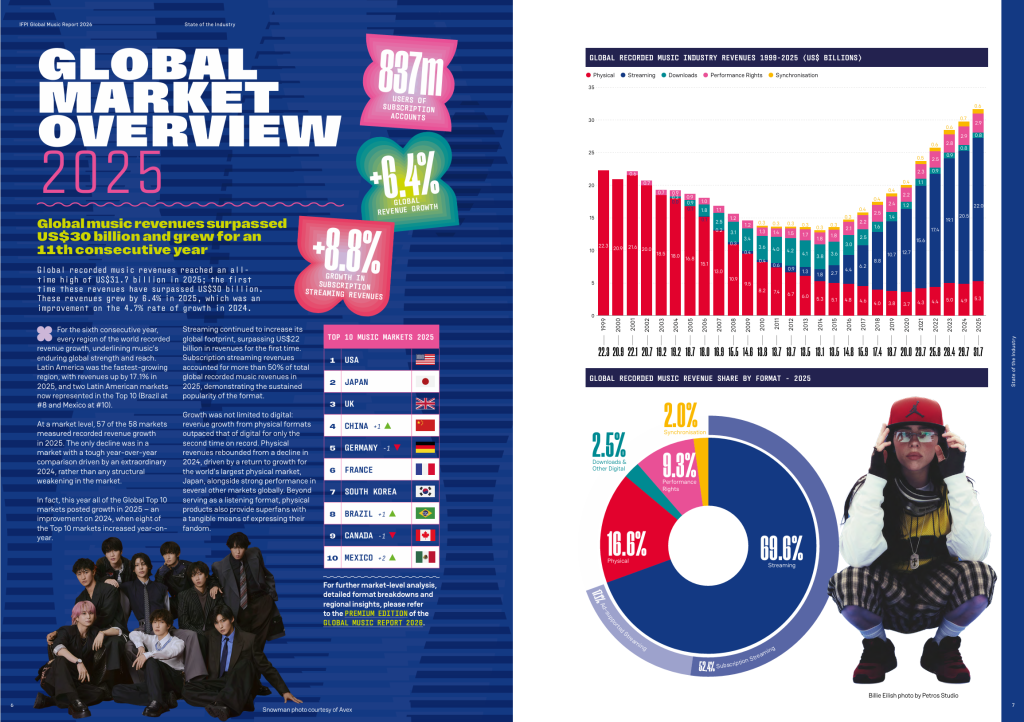
2025 was a milestone year for the global recorded music industry. According to IFPI’s “Global Music Report 2026”, global total revenue broke through the US$30 billion mark for the first time, reaching $31.7 billion, up 6.4% year on year — a clear acceleration from 2024’s 4.8%. It was also the industry’s 11th consecutive year of positive growth, with every region of the world recording growth (the sixth consecutive year). Below, we examine three core dimensions — the overall market, streaming, and physical music — and compare them with 2024 and 2023.
| Year | Global total revenue | Growth rate | Number of growing markets |
|---|---|---|---|
| 2023 | $28.3B | +10.2% | 55 |
| 2024 | $29.6B | +4.8% | 55 |
| 2025 | $31.7B | +6.4% | 57 |
Growth Accelerates Again
The 2024 growth rate (4.8%) was the lowest in five years (except for 2020), and 2025 rebounded to 6.4%, showing that the industry has re-entered a steady upward channel after a post-pandemic adjustment. Of the 58 markets, 57 recorded growth; only one market declined because of an unusually high base in 2024 (no structural weakness). By comparison, three markets declined in 2024.

Ranking Changes
| Rank | Market | Change (vs 2024) |
|---|---|---|
| 1 | United States | Unchanged |
| 2 | Japan | Unchanged |
| 3 | UK | Unchanged |
| 4 | China | ↑1 |
| 5 | Germany | ↓1 |
| 6 | France | Unchanged |
| 7 | South Korea | Unchanged |
| 8 | Brazil | Unchanged |
| 9 | Canada | Unchanged |
| 10 | Mexico | Unchanged |
The Chinese Market
China’s market grew 9.6% in 2024 and continued its strong performance in 2025, jumping to fourth place globally. Germany dropped one spot to fifth. This is China’s highest-ever ranking on this list.
The Mexican Market
In 2024 Mexico entered the top ten for the first time (replacing Australia), and in 2025 it held on to tenth place. The Latin American market has grown for 15 consecutive years, with streaming accounting for as much as 87.8% and physical music having almost disappeared.
The US Market
The US grew 3.3% in 2025 (2.2% in 2024) — a slight acceleration, yet still below the global average, reflecting saturation in a mature market.
The Brazilian Market
As one of the fastest-growing markets in the top ten, Brazil grew 21.7% in 2025 (not given directly in the report; it can be inferred from Latin America’s 17.1% and Brazil’s weight within it), further consolidating its position as the eighth-largest market.
2. Streaming
| Indicator | 2023 | 2024 | 2025 |
|---|---|---|---|
| Total streaming revenue | approx. $19.3B | approx. $20.4B | >$22B |
| Growth rate | +10.4% | +9.5% | +7.7% |
| Share of global revenue | 67.5% | 69% | >70% (subscription streaming over 50%) |
| Number of subscribers | approx. 667 million | 752 million | expected to exceed 800 million |
Growth Continues to Slow
Streaming growth fell from 9.5% in 2024 to 7.7%, yet the absolute increase was still as high as $1.6 billion, keeping streaming the industry’s primary growth engine. The slowdown reflects easing user growth in mature markets (North America, Europe); future growth will come more from emerging markets such as Southeast Asia, Latin America, and Africa.
Subscriptions Accelerate
Paid subscription streaming’s share exceeded 50% for the first time — a historic moment. More than half of global recorded music revenue now comes from paid subscriptions, and paying users have become the industry’s most stable cash cow.
Downloads Are Dead
In 2025, “downloads and other digital” revenue accounted for only 2.5%, declining for the 13th consecutive year. Users have fully embraced the “subscription-equals-access” model, and per-track/album purchases now survive only among audiophiles and in specific scenarios. The BLOG owner also gave it some thought and realized he has never bought a single track on QQ Music — which perhaps supports the notion that download revenue is thoroughly dead and buried.
Paid Penetration
In Iberia (Spain, Portugal), household penetration of paid streaming is only slightly above 20% — far below other European markets (the UK, Germany, and France typically range between 40% and 60%). This means some European countries still offer vast, untapped markets.
ARPU (Average Revenue Per User)
We discussed this last year too: Asia’s ARPU is low compared with Europe and the US. In fact, Latin America’s streaming revenue share is as high as 87.8%, yet its ARPU is even lower than Asia’s. As in Asia, ARPU is currently driven mainly by currency exchange rates and pricing strategies. This also reflects the core economic problem of severely unequal currency values around the world today. However, this is not an economic analysis article, so we will skip that.
The Matthew Effect Intensifies
The “playlist culture” and algorithmic recommendations of streaming platforms have further strengthened the Matthew effect for top artists. In 2025, the global Top 10 artists were almost entirely dominated by the English-speaking world (especially the US) and K‑Pop, leaving Chinese-language and Japanese-language acts struggling to break through. Given Asia’s continued market growth, this lopsided ecosystem, if it carries on this way, is bound to be unsustainable.
TikTok
Short-video platforms remain “hit-single factories.” In 2025, several of the global top ten singles — such as Benson Boone’s “Beautiful Things” and Sabrina Carpenter’s “Espresso” — went viral through short-video challenges, reflecting how deeply “fragmented consumption” has reshaped the music industry.
3. Physical Music
| Format | 2023 | 2024 | 2025 |
|---|---|---|---|
| Total physical revenue | approx. $4.5B | $4.8B (down 3.1%) | $5.3B (up 8.0%) |
| Vinyl | +14.5% | +4.6% | +13.7% |
| CD | +2.3% | -6.1% | +3.7% |
| Music video (DVD/BD) | / | -15.5% | +10.8% |
| Physical share of global revenue | approx. 15% | approx. 16% | approx. 16.7% |
Physical Revenue Rebounds
The 3.1% decline in physical revenue in 2024 had raised fears that “the physical revival was over,” but 2025 made a strong comeback with 8.0% growth — even outpacing streaming (7.7%). This is only the second time on record that physical growth has exceeded digital growth.
Vinyl
Vinyl grew for the 19th consecutive year, with growth leaping from 4.6% in 2024 to 13.7%, back into double digits. Vinyl is no longer a curiosity collectible but has become the core medium through which superfans express loyalty. Vinyl editions from artists such as Taylor Swift, Billie Eilish, and Stray Kids often come with exclusive content or limited-edition colored pressings, driving high-ticket purchases. It is worth noting, however, that the vinyl market is concentrated mainly in North America and Europe; Asia’s enthusiasm for vinyl has yet to be truly ignited.
CD Recovers
After falling 6.1% in 2024, CDs grew 3.7% in 2025, driven mainly by renewed growth in Japan — still the world’s largest physical music market. In addition, CD albums from K-pop groups such as SEVENTEEN and Stray Kids often include value-added content like photo cards and photobooks, a strategy that fuels fans’ enthusiasm for “multi-version purchasing.”
Music Video (DVD/BD)
After plunging 15.5% in 2024, music video sales unexpectedly grew 10.8% in 2025. This may be related to a recovery in concert-disc sales from Japan’s idol industry (such as Johnny’s and the AKB franchise) and the nostalgia economy. But with Japan’s economy continuing to slide, whether growth can be sustained in 2026 remains highly uncertain.
The Superfan Economy
If we reflect on why physical music has felt like it was dying since last year, the main reason is that the impact of the superfan economy was overlooked. Streaming satisfies “listening”; physical formats satisfy “owning.” Fans are willing to pay a premium for limited editions, signed copies, and deluxe packaging. To a certain extent, the CD is no longer a carrier of music, but a carrier of something else.
Tour Synergy
Every time Taylor Swift’s “Eras Tour” hits a city, local physical sales soar. Vinyl and CDs sold at tour merchandise booths have become a significant revenue source. This is no small figure — it is estimated that each city drives sales in the millions.
4. Performance Rights and Sync Revenue
| Indicator | 2023 | 2024 | 2025 |
|---|---|---|---|
| Performance rights revenue | $2.74B | $2.9B (+5.9%) | $2.9B (+0.3%) |
| Share of global revenue | 9.7% | 9.7% | 9.3% |
| Sync revenue | approx. $620M | $650M (+4.8%) | $641M (-1.4%) |
| Share of global revenue | 2.1% | 2.2% | 2.0% |
Performance Rights Growth Plummets
Growth fell from +5.9% in 2024 to +0.3% — nearly stalled. Performance rights revenue comes from public performances such as radio, television, shopping malls, and restaurants. Possible reasons include: continuing listener attrition from radio; incomplete broadcasting rights in some countries (such as the US and Japan), meaning rightsholders cannot obtain fair remuneration; and cooling interest in variety shows, reducing music usage.
Sync Revenue Declines for the First Time
This ended four consecutive years of growth. Sync revenue depends on the film, television, gaming, and advertising industries. Possible causes include the lingering effects of the 2024‑2025 Hollywood strikes and streaming platforms cutting budgets for original content. But the BLOG owner believes a more hidden cause may be the continued evolution of AI music, which has not only reduced demand for sync music but also weakened its bargaining power. In any case, the 2.0% share remains stable and will not significantly affect the overall picture.
5. Other Regional Markets
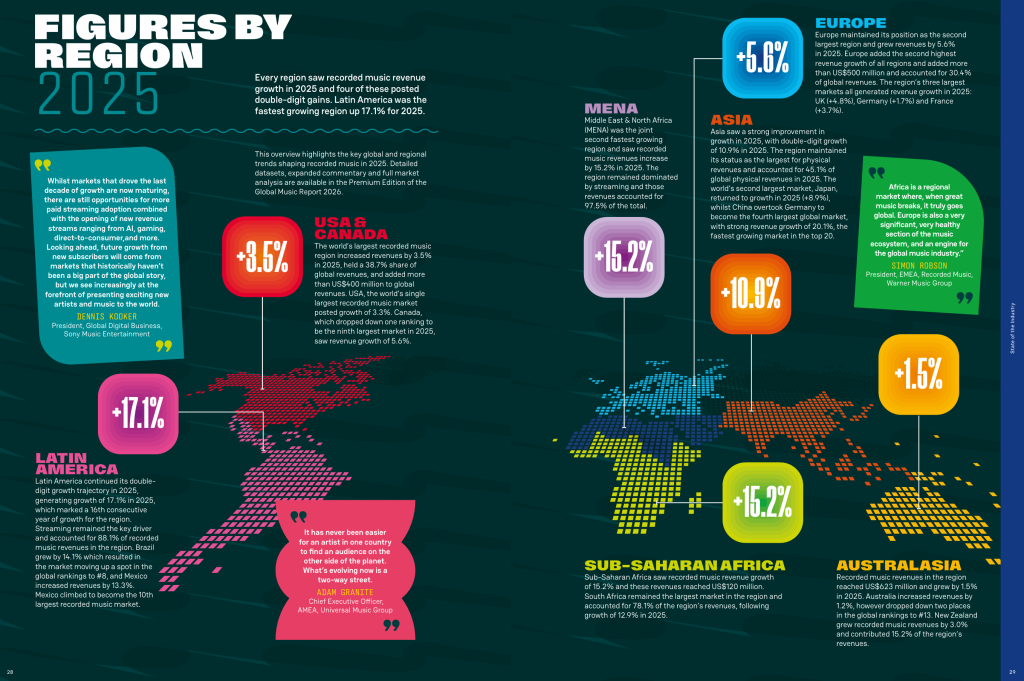
The Iberian Market (Spain + Portugal)
As Europe’s gateway to Latin America, local artists such as Rosalía have gone global through long-term investment. But paid-streaming penetration is only around 20%, far below the European average, making it a bottleneck for growth.

The Mexican Market
“Música Mexicana” has evolved from a regional genre into a global movement. Warner Music has broken down borders by building a unified US-Mexico team, helping artists such as Codicado reach the international stage.

The Southeast Asian Market (led by Thailand)
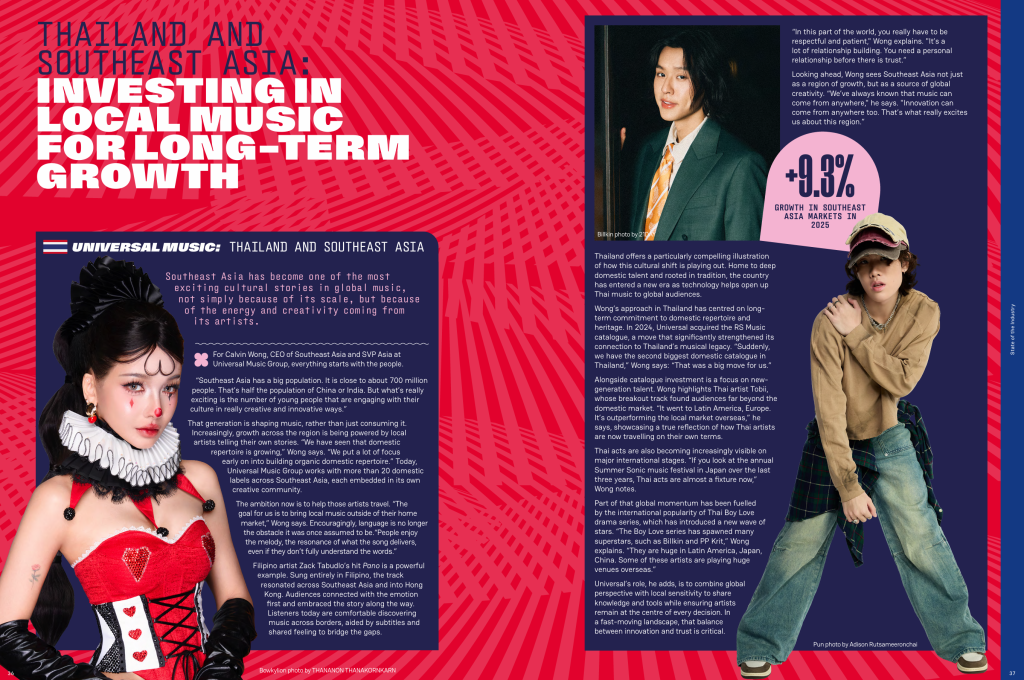
With a population of nearly 700 million, the region has highly active young users. Universal Music acquired Thai label RS Music’s catalog and has pushed artists such as Tobii into Latin America and Europe. Stars spawned by Thai “Boy Love” dramas — Bilkin and PP Krit — have large fan bases in Latin America, Japan, and China.
6. Production Capacity Bottlenecks
As vinyl sales climb, many friends may still not understand what the vinyl market is really like. In fact, understanding the entire LP industry is not hard — just analyze it through the lens of production capacity bottlenecks and everything becomes clear. Starting in 2020, the vinyl market entered a period of major growth, which actually left a huge amount of market demand pent up. By 2021, global annual vinyl production was about 160 million units, while actual market demand was roughly between 320 million and 400 million units — a capacity shortfall of more than double. This figure was also confirmed by media such as The Paper. The direct consequence of insufficient supply was that independent labels’ order schedules were postponed indefinitely, with the backlog peaking in 2024.
But it was also starting in 2024 that new LP manufacturers entered the market and existing ones finally brought new production lines online. By 2025, the lead time for vinyl from order to delivery had come down from a peak of nine months to around three months. The dramatic growth in vinyl this year compared with last year is, to a large extent, a benefit of that pent-up capacity being released; as capacity continues to ramp up, we can expect this growth figure to persist in the short term.
New openings in 2024
- Disker Pressing Plant (Valencia, Spain): focused on a local boutique route, specializing in small batches of 100-500 records for independent labels
- FRYK Vinyl Pressing (South Korea): runs German Newbilt presses, producing 180g vinyl and colored vinyl with a lead time of about 8 weeks
- Paramount Pressing (Denver, USA): Colorado’s first-ever vinyl pressing plant, launched production in July 2024
New openings in 2025:
- Anthem Vinyl (Ireland): Ireland’s only vinyl pressing plant, equipped with 2 presses
- Seabass Vinyl (Scotland): opened in 2023, certified in 2025 as the UK’s first carbon-neutral pressing plant
- AudioWax (Maia, Portugal): Portugal’s second pressing plant, using Newbilt presses, promising a 45-day delivery time, and using eco-friendly PVC
- SouthBound Press (Rende, Italy): started pressing in 2024
New entrants also keep coming. Upstream supplier (PVC raw material) GZ North America announced a $10 million expansion of its Wedlake Industries plant in Lewis County, Tennessee. With Wedlake being a vinyl compound manufacturer, this expansion will make it North America’s largest vinyl compound manufacturer, resolving the supply bottleneck at the PVC raw-material level.
III. Music and the Development of AI
The relationship between AI and music is the most central and dramatic storyline of the global music industry in 2025-2026. Compared with the initial shape of the “litigation of the century” that the BLOG owner laid out in last year’s report (in June 2024 the RIAA sued Suno and Udio on behalf of the three major labels), over the past year or so this contest has rapidly evolved from a “courtroom showdown” into a complex landscape of “partial settlements, all-out battles for the rest, and an industry-wide shift toward licensing partnerships.” At the same time, the 2026 IFPI report explicitly positions AI as “a license to innovate,” making clear policy arguments, and the global AI music market is expected to see explosive growth in 2026.
1. IFPI’s Position

The third section of IFPI’s 2026 report, “AI & MUSIC: LICENSE TO INNOVATE,” systematically sets out the industry’s position on generative AI. The report states at the outset: “Music companies have a strong track record of embracing and advancing innovation. AI represents the next generation of innovation, and record labels are at the forefront, actively engaging with AI developers to develop new licensing business models and create new revenue streams for artists.”
This is actually quite a down-to-earth statement, and the IFPI report immediately follows up using KLAY’s case as its core argument. In November 2025, Los Angeles-based music tech company KLAY Vision signed separate AI licensing agreements with Universal Music Group, Sony Music Entertainment, and Warner Music Group as well as their respective publishing arms — the first time the three majors completed comprehensive licensing with the same AI company. KLAY’s core difference is that its “large music model” is trained entirely on licensed music, rather than being a tool that, like Suno and Udio, defends itself with “fair use” — it is both a subscription-based interactive streaming service that lets users create AI covers and reimaginations of licensed songs, and a royalty-clearing platform that places every operation within a trackable, revenue-sharing framework. The three majors hope this will absorb AI demand within a controlled ecosystem rather than let AI music drift beyond their copyright system, and they see it as a “strategic weapon” against the wave of AI music generation.
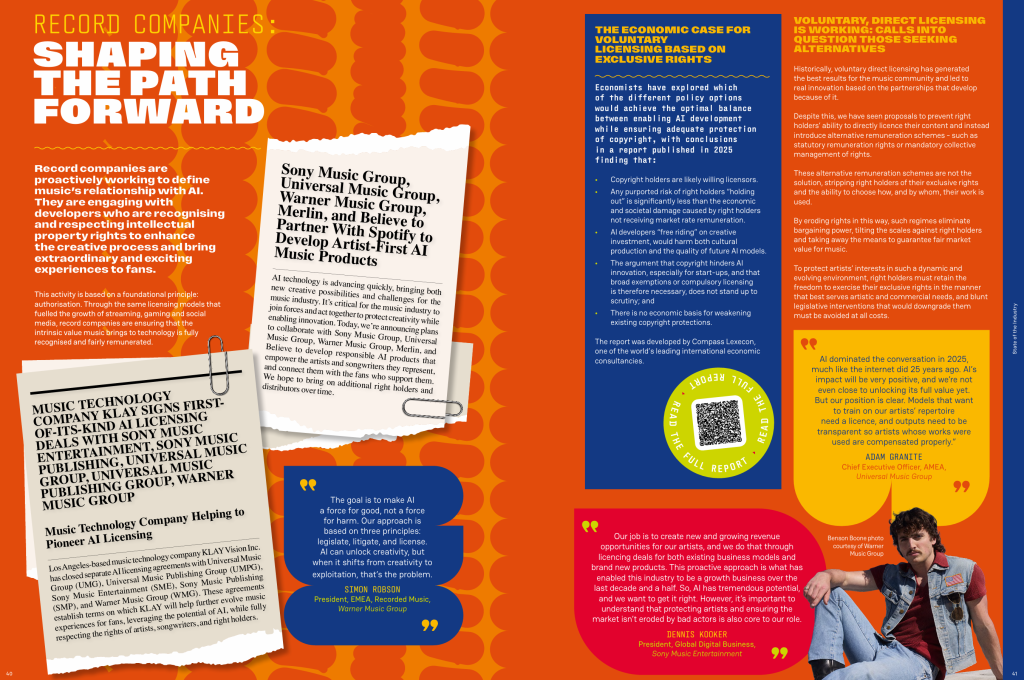
The report notes that record labels have proactively established dozens of licensing partnerships, building relationships with AI developers that respect creators’ rights. But the report also issues a stern warning to policymakers: AI developers must obtain rightsholders’ authorization before using copyrighted music to train models. Any attempt to weaken this principle by creating “fair use” exceptions or compulsory licensing will cause “irreparable harm” to creativity.
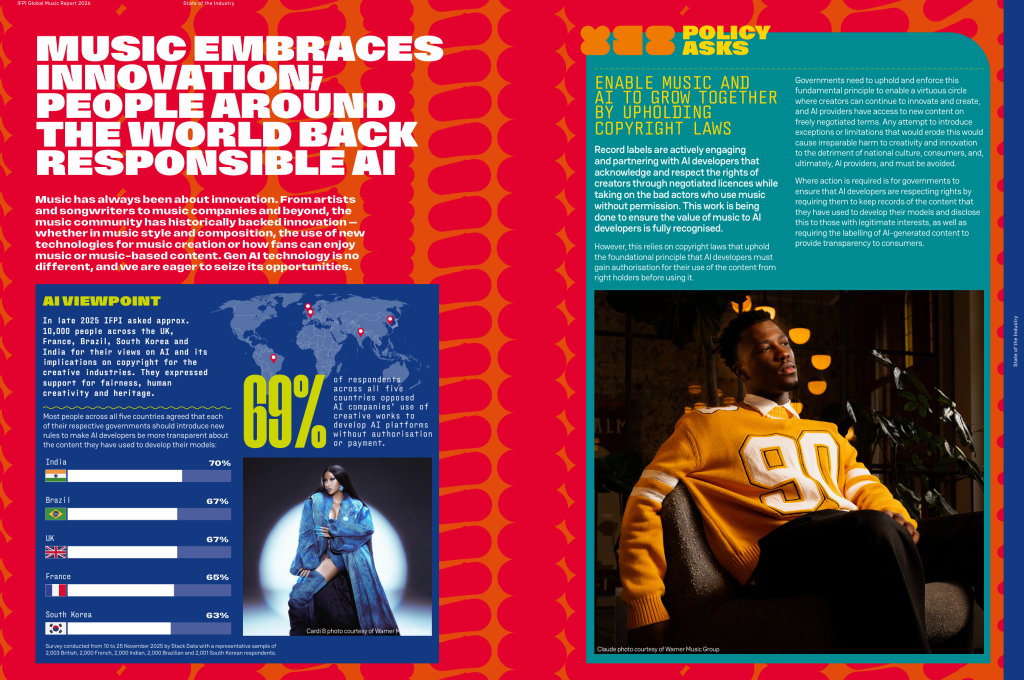
This is consistent with what the BLOG owner noted in the 2025 report about IFPI calling on “policymakers to oppose amendments to copyright law that would harm rightsholders’ freedom of choice,” but the wording is tougher and the position more fully developed. IFPI CEO Victoria Oakley elaborated on this position in public interviews after the report’s release. She noted that the industry has signed numerous licensing agreements through voluntary negotiation, and is using this to pressure governments against broader text-and-data-mining exceptions or compulsory licensing regimes, stressing that the latter would undermine the rights market built through negotiation.
2. The Evolution of the Lawsuit of the Century
If the three majors’ joint lawsuit against Suno and Udio in June 2024 was still a unified-front collective action, then by the end of 2025 the strategies of these three industry giants had clearly diverged. The whole process has been like a real-life Romance of the Three Kingdoms — extraordinarily entertaining.
Warner Music Group
In November 2025, Warner reached settlements with Suno and Udio respectively, in effect converting litigation relationships into commercial partnerships, prioritizing the establishment of licensing frameworks to expand AI music’s commercial avenues.
Universal Music Group
Selective settlement. In October 2025, Universal reached a settlement with Udio and established a joint AI music platform licensing partnership, but has still not reached an agreement with Suno; the two sides’ negotiations reached a standstill in April 2026. According to the Financial Times, Universal and Sony wanted equity in Suno as well as higher per-stream royalty guarantees, but Suno firmly resisted. Universal’s Chief Digital Officer Michael Nash made it clear in early 2026 that Suno’s refusal to adopt a “walled garden” model — namely, that AI-generated audio should serve interactive experiences rather than be flooded out to streaming platforms — is the fundamental reason Universal has not settled with it.
Sony Music Entertainment
The only label to hold the litigation line across the board. Sony has settled with neither Suno nor Udio and continues to push both cases toward trial. The Sony v. Udio case is expected to see a substantive ruling on the fair use doctrine in the summer of 2026, a decision that could become a landmark case in AI music copyright.
The key turning point in this litigation came in September 2025, when the three majors added more serious allegations on top of the original copyright infringement claims: that Suno and Udio obtained training data by ripping audio from YouTube streaming, in violation of the Digital Millennium Copyright Act. In April 2026, Udio publicly admitted using tools such as YT-DLP to download audio from YouTube for training, greatly increasing its legal exposure. If the court sides with Sony on the DMCA stream-ripping claims, both companies will face separate statutory damages beyond copyright infringement.
Meanwhile, Suno also faces independent infringement lawsuits in Europe from Denmark’s Koda and Germany’s GEMA. Under the EU copyright framework there is no room for a US-style “fair use” defense, increasing its legal exposure in Europe.
3. KLAY Vision’s Entry
In short, this lawsuit of the century is far from over, and the emergence of KLAY Vision makes the position of Suno and Udio look even harder. But based on experience, the BLOG owner is actually not optimistic about KLAY Vision’s development. Contradictions among the three major labels already exist, and the idea that they would sit down together to arrange a game that would shape their own next few decades simply does not look plausible, however you view it. Let’s take a closer look at KLAY Vision’s personnel structure.
Looking at the résumés, apart from Thomas Hesse’s solid record as a record-label executive, the rest — especially CEO Ary Attie — look more like “deal assemblers,” little-known figures whom few in the industry truly understand. The team’s core strengths lie in “industry relationships” and “engineering delivery,” with no top-tier AI scientists comparable to those at Google DeepMind or OpenAI.
KLAY Vision did secure licensing from all three majors, but that does not mean the three “united to jointly fund one company” — each of them signed separate, independent agreements with KLAY. KLAY is merely an “intersection point,” not a platform jointly governed by the three. The three have not truly “acted in unison” within KLAY; they have simply, at their own respective levels, chosen the same compliance-route counterparty.
If we compare licensing to renting houses: the three majors are each their own “landlord,” and KLAY is a “tenant” renting from all three at once — not a “property management company” the three run together. The conclusion is that this model of “signing separate agreements → converging on one company” is far from reaching the level of “united licensing to build one company.”
When KLAY Vision first announced its partnership with Universal Music in October 2024, it said it “planned to launch a product in the coming months”. At the time it claimed to be developing in “stealth mode.” By November 2025, KLAY announced comprehensive licensing from the three majors and again said it “planned to launch a product in the coming months.”
More than a year has now passed (from October 2024 to June 2026), and the actual product still has not been publicly launched. Its official website offers nothing but a “Join Waitlist” option, with the tagline “Music set free,” and no further information beyond that. To this day, no user has actually experienced its functionality.

Therefore, the BLOG owner believes that KLAY Vision is a company built primarily on diplomatic ability, with technical capability playing a supporting role. Its “core competitiveness” lies in maneuvering among the three companies and securing licensing agreements. But the moment it steps out of the comfort zone of licensing into the deep waters of product competition, it lacks both the technical accumulation of AI companies like Suno/Udio and the user base of platforms like Spotify. Unless it can quickly deliver a truly stunning product, this licensing game will sooner or later hit its ceiling.
4. AI Music Regulation
From 2025 through early 2026, the world’s major economies intensively introduced a number of legal frameworks in the field of AI copyright regulation.
European Union
The core provisions of the AI Act took effect mandatorily in August 2025, setting clear requirements for training-data transparency of general-purpose AI models. In March 2026, the European Parliament further adopted the Report on Copyright and Generative Artificial Intelligence, requiring all providers of general-purpose AI models offered in the EU market to disclose an itemized list of copyrighted content used for training, with the transparency obligations equally applying to downstream uses such as inference, retrieval-augmented generation, and fine-tuning. If an AI provider fails to fully comply with its transparency obligations, it is presumed to have used the relevant copyrighted works for training or inference. Meanwhile, in November 2025, the Regional Court Munich I issued a first-instance judgment in the GEMA v. OpenAI case, finding that OpenAI’s unauthorized use of copyright-protected music lyrics to train ChatGPT models constituted infringement — making it “Europe’s first generative-AI copyright case.” In addition, Denmark’s Koda and Germany’s GEMA have each filed separate lawsuits against Suno; the lack of US-style “fair use” defenses within Europe’s copyright protection framework significantly increases AI companies’ legal risk.
United States
In February 2026, bipartisan US senators jointly introduced the Copyright Labeling and Ethical AI Reporting Act, requiring AI developers to submit to the US Copyright Office a detailed summary of each copyrighted work in their training datasets (limited to formally registered works) and to establish a publicly accessible database. The bill has received public support from more than 30 creative industry organizations, including the American Federation of Musicians, the American Society of Composers, Authors and Publishers, and the Recording Industry Association of America (RIAA). The bill is currently under review in the relevant Senate committee. Earlier, in early 2025, the US Copyright Office released a report on artificial intelligence stating clearly that “users who merely provide prompts to an AI system do not provide sufficient control to be considered authors of the output” — fundamentally rejecting the possibility that “prompt engineering” alone can support a copyright claim over AI-generated content.
China
In November 2025, China completed a major revision of the Guidelines for Patent Examination, adding standards for AI ethics review, examples of inventive-step determination, and drafting rules for patent application documents, effective January 1, 2026. In March 2026, Tencent Music CEO Liang Zhu said on an earnings call that AI-created songs had appeared on music charts in the previous three months and were growing explosively. On domestic social platforms, the topic of “a man using AI to write songs and earning the equivalent of US$15,000–30,000 a month” once shot to the hot-search list. According to analysis, however, the model relies mainly on uploading AI-generated songs to platforms such as QQ Music and NetEase Cloud Music and monetizing them through streaming-royalty share. The creator-revenue-sharing mechanisms of domestic music platforms are generally opaque: revenue per thousand plays of a single track typically ranges from a few fen to one or two mao — roughly a tenth of a US cent to three US cents — so earnings at the level of US$15,000–30,000 a month are in practice extremely hard to achieve through organic traffic, and a considerable share of it involves gray-market stream manipulation.
But from a legal standpoint it is also clear that only the mainstream AI players are qualified to set the rules. From this perspective, China has already firmly boarded the high-speed train of AI audio, and the future direction remains within controllable bounds.
5. The Structural Explosion of the AI Music Market
If last year’s report (2024) still stopped at the qualitative judgment that “AI music is in its early stages,” then in 2025 AI music completed the critical leap from “technically feasible” to “commercially viable.”
Suno’s Commercialization Milestones
Following the trajectory shown in Suno’s investor pitch materials that the BLOG owner cited in his previous report: the platform had about 1 million paying subscribers in November 2025, with subscriptions up a staggering 300% year over year — and that figure doubled within just three months, reaching 2 million paying subscribers by February 2026, with annual recurring revenue (ARR) hitting $300 million.In June 2026, Suno closed a $400 million Series D round led by Bond Capital, with its valuation doubling from $2.45 billion to $5.4 billion in seven months. According to its fundraising materials, nearly 100 million people worldwide have created music on the platform, with more than 7 million AI songs generated per day; the scale of generation from those nearly 100 million users reveals the real existence of AI music demand.Suno has also strengthened its team, hiring former Merlin CEO Jeremy Sirota as Chief Business Officer to keep building out commercialization capabilities and industry connections.
Market Size
According to Business Research Company, the global AI-in-music market was $4.48 billion in 2025, expected to grow to $5.55 billion in 2026 — a compound annual growth rate of 23.7% — and projected to reach $12.86 billion by 2030. Another report notes that the generative AI music segment was worth about $280 million in 2025 and is expected to grow to $356 million in 2026, a CAGR of 30%. Terrifying, indeed.
6. Still Chaotic
The AI audio space today is still far from a clear shift “from confrontation to symbiosis.” Industry consensus remains mostly at the level of internal agreements among traditional music companies, rather than genuine settlements with independent AI companies like Suno and Udio. Suno’s trajectory proves exactly this: it is still growing wildly amid high-speed confrontation — surpassing 100 million users, doubling paying subscribers to 2 million in three months, touching $300 million in annual recurring revenue, and simultaneously pushing its valuation to $5.4 billion through a $400 million Series D. The signal behind these numbers is that, in the AI era, traffic and user scale are themselves the hardest currency of influence; the capital markets are willing to pay for that momentum rather than to stand up for the “morality” and “compliance” in litigation.
With the continued backing of multiple rounds of top-tier capital (including Bond Capital’s lead investment), Suno’s influence is shifting from “technical challenger” toward “industry power player.” It does not need to settle with every label immediately — first lock in the Warner license, then use its user base to pry open the negotiating table with Universal and Sony. This strategy of “sustaining the fight to fund the fight” is taking effect. Traditional companies try to define the rules through “compliance exemplars” like KLAY Vision, but in the face of more than 7 million songs generated daily by Suno’s hundreds of millions of monthly active users, any licensing platform without traffic will find it hard to truly steer the industry. The endgame of AI music may not be a “symbiosis rule” unilaterally written by traditional companies, but a prolonged tug-of-war fought jointly by traffic, capital, and law.
IV. Streaming Fraud
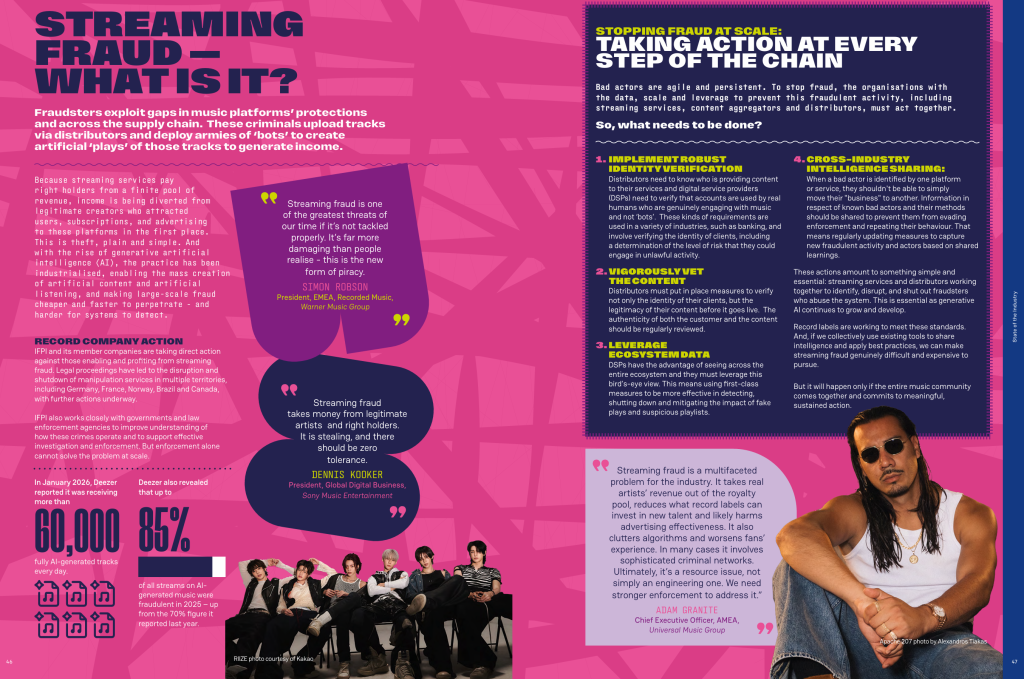
The fourth section of this year’s IFPI report discloses several astonishing figures:
- Deezer receives more than 60,000 fully AI-generated tracks every day
- Of these, 85% of AI music streams were confirmed to involve fraud (worse than last year’s 70%)
- In 2025 alone, Spotify removed 75 million “junk tracks,” many involving AI-generated stream-manipulation content

1. What Does Junk Audio Actually Affect?
From a commercial standpoint, streaming fraud is essentially a “raid” on the royalty pool. The mainstream streaming platforms generally use a pro-rata distribution model: the platform pools all subscription and advertising revenue into a single royalty pool, then distributes income according to each song’s share of total streams. The logic behind this mechanism is meant to be “to each according to their streams,” yet it has a fatal inherent flaw: when the system contains a large number of fake plays, every fake play dilutes the distribution weight of every dollar in the royalty pool. Deezer’s data shows the platform receives nearly 75,000 AI-generated songs a day, accounting for 44% of newly uploaded music, of which as much as 85% of plays are identified as fraudulent — meaning these plays generate no real listening value at all, yet still claim a place in the royalty distribution formula.
Apple Music detected and voided about 2 billion fraudulent streams in 2025, recovering approximately $17 million that would otherwise have flowed to fraudsters — and this is only what a single platform could catch: the tip of the iceberg. An even more striking case came in March 2026, when North Carolina man Michael Smith was prosecuted by US authorities: he used AI to generate hundreds of thousands of songs, produced billions of fake plays through thousands of bot accounts, and defrauded over $8 million in royalties from platforms including Spotify and Apple Music — the first case in the US in which AI-assisted streaming fraud led to criminal prosecution. Behind every fake play, the income rightfully due to some real creator is being quietly diverted.
From the user’s perspective, the impact of junk audio is subtler yet equally far-reaching. Spotify’s AI-detection data shows that a music library bulk-uploaded and played by bots seriously interferes with the platform’s recommendation algorithms — once the recommendation engine is “fed” with massive amounts of fake stream data, the playlists and “Discovery Weekly” pushed to users drift further and further from their real tastes. A Deezer study also reveals a deeper dilemma: as many as 97% of listeners cannot tell the difference between AI-generated music and human-created music. This means users have not actively chosen AI music; rather, they are unknowingly being fed large amounts of content of dubious origin. Worse still, a considerable portion of this fraudulent content is attributed to fictional artists (such as the AI-generated fake names “Calm Baseball” and “Calm Connected” in the Smith case) — listeners think they’ve discovered a new act, when in fact it is just a royalty shell company. Music streaming platforms were supposed to be spaces of discovery and connection, yet under the manipulation of fraudsters they have been reduced to an illusion system controlled by algorithms and machines.
2. The Domestic Gray Market
If AI music fraud in overseas markets mostly manifests as large-scale stream manipulation by professional criminal gangs, then the situation domestically is already more mature. Participants in the gray market each play their part, together forming a fully closed loop from creation to monetization.
The starting point of this chain is AI bulk song production. Unlike overseas AI music tools such as Suno and Udio that target consumers directly, a large auxiliary ecosystem has emerged in China that specifically serves “mass-producing music works” — from tutorials on tools like Suno and Sponge Music, to the abundant “make music with AI and upload it to NetEase Cloud Music” hands-on experience shared across forums. You name it, it’s there.
A user once recounted that in April of last year he made dozens of songs with AI and uploaded them to NetEase Cloud Music, yet by this year he had earned only US$119 in royalties. “Without stream-boosting, the earnings are just too low to bother with — but boosting streams makes you easy to flag by risk control.” He later switched to helping others get verified as NetEase Cloud musicians. But this is only the tip of the iceberg. In April 2025, a programmer with no music-theory background named Yang Ping released “Seven-Day Lover” (created through AI prompts) on NetEase Cloud Music, and it surpassed 2 million listens within just four days; the copyright was sold outright for US$7,410. When bulk song production is combined with a social-media matrix, “betting on a hit” becomes a game of probability — multiple industry insiders have revealed that some small companies or individuals upload hundreds or even thousands of AI songs at a time, betting on a viral hit as if buying lottery tickets. A traditional pop song typically takes anywhere from a month to six months to produce, while AI can complete the entire process from lyrics and composition to arrangement in tens of seconds, costing only a few cents (US$0.01–0.04). The cliff-like drop in cost has turned “gambling on a hit” into a quantifiable, replicable systematic operation.
The middle of the chain is the contest between platform policies and the gray market. NetEase Cloud Music and Qishui Music both attract creators through “musician programs” that share streaming revenue — intended to nurture the ecosystem of original music, yet unexpectedly becoming an “incentive signal” for the stream-boosting underworld. Some speculators use plug-in programs to manufacture plays in bulk, forming a closed “boost → cash out → reinvest” loop. Facing this dilemma, platforms keep upgrading their risk-control systems — NetEase Cloud Music announced in March 2025 that it had cracked down on more than 10,000 accounts that used “listening plug-ins” to boost streams, and Qishui Music has even upgraded its risk control to detect emulator multi-instancing and directly ban IPs. Yet the platforms’ responses are rife with contradictions: even while cracking down on gray behaviors, the major platforms are accelerating their AI music moves — NetEase Cloud Music launched “NetEase Tianyin,” Tencent Music launched “Weiyin VEMUS,” with cumulative AI-generated works surpassing 26 million, and ByteDance’s Qishui Music has fully integrated AI music with Douyin short videos. One insider told the media that a leading platform even uses algorithmic weighting to encourage users to upload more than 10 tracks a day, following a strategy of “scale first, worry about compliance later.” This seemingly contradictory stance actually reflects the platforms’ deep dilemma between “seizing the first-mover advantage in AI music” and “curbing the gray market’s erosion of the ecosystem.”
The end of the chain is cash extraction and derivative services. Once bulk-produced songs accumulate a respectable number of plays through organic traffic or stream-boosting, speculators can cash out through the platform’s revenue-sharing system. A more advanced move is to directly “sell accounts” — helping others get verified as musicians, selling musician accounts that have already accumulated a certain fan base, or even packaging AI-generated songs into a “mass-produced viral hit methodology” for paid knowledge-training courses. As a result, the whole gray chain has formed a self-recycling, fully closed loop: low-cost production → multi-account distribution → organic or boosted promotion → royalty cash-out → replicating and scaling the playbook. And in this loop, what is constantly harmed is the economic return of genuine creators and the trust ecosystem of the whole music community.
3. Which Side Do Platforms Choose?
On the surface, streaming fraud is the platforms’ “common enemy,” and platforms have incentives to fight it: fraud reduces the total royalties platforms pay to legitimate rights holders, distorts recommendation algorithms, hurts the user experience, can bring legal risk, and consumes substantial storage and computing resources to manage the flood of junk tracks. In September 2025, Spotify announced it had removed 75 million tracks classified as “junk” from its catalog, while also launching a new anti-impersonation policy explicitly banning unauthorized AI voice cloning and deepfakes. Deezer has gone even further — not only actively excluding AI music from algorithmic recommendations and editorial playlists and stopping storage of high-definition versions, but also, in June 2026, rolling out a free cross-platform AI-music detection tool for the public, letting users scan playlists across more than 20 platforms including Spotify and Apple Music.
But dig one level deeper, and you will find that the platforms’ stance is far from monolithic. As early as 2023, Universal Music Group CEO Sir Lucian Grainge complained that the flood of “functional, low-quality content” was diluting the royalty pool for human artists. Until recent years, the industry’s collective interest has lain in maintaining a certain appearance: that anyone can record music and submit it to digital services, and that with enough talent and effort anyone can become the next superstar. The underlying logic of this narrative is that a music platform is essentially a “long-tail traffic distribution business” — every additional track in the platform’s inventory, whether genuine creation or junk content, formally increases the platform’s “content value” and gives the platform material for its story to investors. One industry insider put it bluntly: AI’s unlimited supply of content solves the pain point of “algorithm-material exhaustion.” “Algorithm-material exhaustion” refers to the fact that platforms need enormous amounts of content to feed their recommendation systems and sustain user engagement time — and when it comes to feeding the algorithm, junk content and genuine content make no essential difference to a platform. What is even more telling is that although Deezer has adopted an aggressive policy of removing AI music from recommendations, its CEO also called in the same statement for “the entire music ecosystem to join us,” hinting at the dilemma of fighting alone — if only Deezer excludes AI music, fraudsters will pour all their firepower into other platforms with weaker detection.
A deeper problem is that the existing revenue-distribution mechanisms of platforms may themselves be fueling the incentive to commit fraud. A study published by an academic institution points out that the mainstream pay-per-stream royalty model not only fails to prevent fraud but, on the contrary, makes the computational detection of fraudulent activity extremely difficult. Fraudsters can pay for subscriptions with dirt-cheap bot accounts (a few dollars a month), then generate thousands or tens of thousands of fake plays to collect far more in royalties than the subscription cost, forming an arbitrage loop of “low cost, high return.” The study also proposes a new distribution rule called ScaledUserProp, designed to suppress manipulative incentives at the root. Such systemic reform, however, requires industry-wide consensus and coordination — and currently the platforms are not moving in lockstep on AI music governance: Deezer is aggressively cracking down, Spotify is following close behind, and Apple Music also voided about 2 billion fraudulent streams in 2025. Yet on AI-music detection technology and inter-platform sharing of fraud information, the industry still lacks a genuine coordination mechanism.
For domestic platforms, then, the true essence of the AI music gray market is a “prisoner’s dilemma” pulled between multiple interests. On one hand, faced with the flood of AI-generated songs, platforms must act to clean house, or the charts and recommendation systems will completely fail, the user experience will deteriorate, and advertisers will lose confidence. But on the other hand, overly aggressive and hasty crackdowns could undermine a platform’s “myth of content supply,” squeeze the living space of ordinary AI music creators, and weaken the synergies with the short-video ecosystem. Whether to first build the dikes and dams or first channel water for irrigation — this contest will, for a long time to come, remain a decisive variable hanging over the music streaming industry at home and abroad.
V. IFPI’s Industry Influence and Lobbying Power
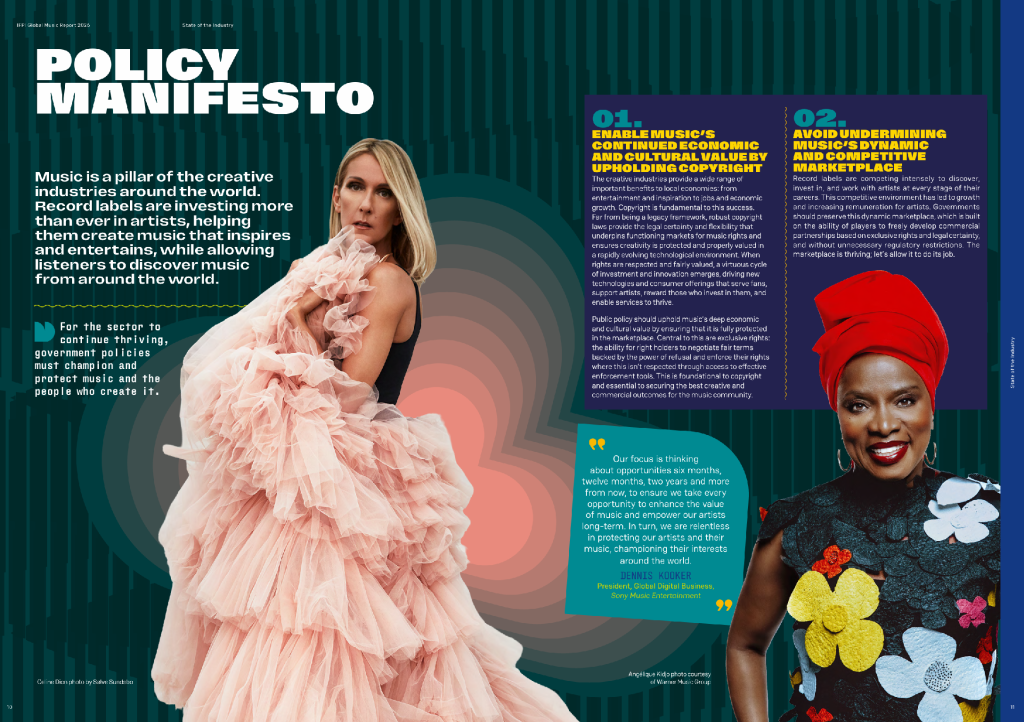
In this year’s annual report, IFPI put forward five policy proposals:
- Letting music and AI develop together
- Establishing and supporting effective performance rights (criticizing incomplete broadcasting rights in the US and Japan)
- Combating streaming fraud
- Protecting the fundamental principles of copyright law (opposing “fair use” exceptions)
- Governments should require AI developers to disclose training data and label AI-generated content

To discuss these five points, we first need to focus on IFPI itself. In the BLOG owner’s previous analyses, we have kept discussing music industry trends, data, lawsuits, and AI technology — yet there has always been a key player, deliberately or otherwise, left in the background: IFPI itself. What exactly is its background? What role does it play on the chessboard of the global music industry? And why should its policy positions be taken seriously?
1. Who Is IFPI?
The International Federation of the Phonographic Industry (IFPI) was founded in 1933. Its headquarters are in Zurich, Switzerland, and its registered office is also in Zurich — but its true command center (the secretariat) is in London, responsible for overall coordination of the formulation and execution of international strategy. The current CEO is Victoria Oakley. It is a non-governmental, non-profit international industry organization. Where does its money come from? It receives financial support from its members, national groups, and their affiliates. To put it bluntly, it is funded by the big record companies and regional industry associations. (just an aside =W=)
So whom does it represent? IFPI represents more than 1,400 record companies across 66 countries and regions; if its national-group network is included, the number swells to over 8,000 members spanning more than 70 countries and regions. Its reach extends across the globe: it maintains regional offices in Brussels (facing the EU directly), Hong Kong (covering Asia-Pacific), Miami (covering Latin America), Abu Dhabi, Singapore, and Nairobi; it has also set up offices in mainland China, Singapore, and South Korea, with the Beijing representative office approved by China’s National Copyright Administration in 1994. From its founding in 1933 onward, IFPI has left its footprints on the negotiation of a series of international copyright treaties — the 1961 Rome Convention, the 1971 Phonograms Convention, and the 1996 WPPT — making it a genuine “century-old establishment” of the industry.
As for its day-to-day work, the core responsibilities of IFPI’s London secretariat cover anti-piracy enforcement, technology, government lobbying, representation in international organizations, legal strategy, litigation, and public relations. To put it in plainer terms, it is the “legal department + PR department + intelligence bureau” of the global record industry, all in one. At the same time, it also carries out market research and data statistics for the recorded music industry, and is one of the most authoritative sources of information in this regard. It maintains regional bodies in Africa, Asia, the CIS countries, Europe, and Latin America, with each regional board coordinating local lobbying strategy; members of these regional boards include executives of multinationals and independent labels alike, ultimately converging in IFPI’s global main board.
In short: IFPI is an NGO funded by industry giants, an industry coalition whose highest goal is protecting its members’ interests. Every one of its policy positions clearly reflects the shared interests of the “Big Three” — Universal, Sony, and Warner — along with independent labels worldwide.
2. What Are the Five Policy Declarations Really Fighting For?
IFPI’s five policy positions list five items on the surface, but the core spirit is a single sentence: the rules must be set by rightsholders, not unilaterally drawn up by tech companies or legislators.
The first item, “letting music and AI develop together.” In essence, this is IFPI’s signal to the AI industry: you want to use our music? Fine — but you must follow the rules, you must have licensing agreements, and you must pay. Note the wording is “develop together,” not “let things develop unchecked” — the precondition is licensing. KLAY Vision is regarded as an industry benchmark precisely because it secured licenses from all three major labels before training its models — exactly the compliance path IFPI most wants to see.
The second item, “establishing and supporting effective performance rights.” This may seem unrelated to AI, but in fact it is IFPI continuously “firing at” the US and Japan, the world’s two largest economies. The report directly points out that both countries still lack complete broadcasting rights and public performance rights, so the industry cannot obtain fair remuneration from them. The extremely influential US broadcasting industry has long obstructed the legislative process for complete broadcasting rights for record producers; Japan, likewise, driven by its own industry interests, has long taken a reserved stance in negotiations on relevant international treaties.
The third item, “combating streaming fraud.” The BLOG owner has already discussed this in depth above; here we will only add one point: AI’s industrial-scale generation capacity has driven the cost of fraud down to nearly zero, and IFPI wants a unified industry standard to close the loopholes, rather than letting each platform fight alone.
The fourth item, “protecting the fundamental principles of copyright law,” i.e., opposing “fair use” exceptions. This is a direct challenge to those AI companies that use “fair use” as a shield to dodge licensing, especially Suno and Udio. Their core defense in litigation is that “training AI models constitutes transformative use and does not infringe,” and IFPI’s policy declaration is a head-on confrontation with the Sunos of the world, responding to this dispute at the level of industry legislation.
The fifth item, “governments should require AI developers to disclose training data and label AI-generated content.” Who exactly do the “governments” refer to here? Not some one market, but the US government and the EU. In February 2026, US Senators Adam Schiff and John Curtis formally introduced the CLEAR Act (the Copyright Labeling and Ethical AI Reporting Act), requiring all AI companies, before releasing generative AI models to the public, to submit to the Copyright Office a sufficiently detailed summary of the copyrighted works in their training datasets — with the requirement applied retroactively to already-released models. Non-compliant companies would face civil penalties, and the US Copyright Office would establish a publicly searchable database for creators to monitor. From the moment it was introduced, the bill won joint support from more than 30 creative industry organizations, including the American Federation of Musicians, SAG-AFTRA, the Society of Motion Picture and Television Engineers, the Writers Guild of America, the Directors Guild of America, the National Music Publishers’ Association, SoundExchange, and the Recording Industry Association of America — and IFPI played a key supporting role behind the scenes.
And across the Atlantic, the core provisions of the EU’s AI Act took effect mandatorily in August 2025, requiring general-purpose AI models to provide training-data transparency lists. In March 2026, the European Parliament passed — by an overwhelming majority (460 in favor, 71 against, 88 abstentions) — the report on copyright and generative AI, whose core demand is that generative AI systems should be subject to European copyright law regardless of where their training took place, and that AI companies must obtain the rightsholders’ explicit permission before training, rather than remediating afterwards. Following that, the EU level also proposed establishing a central registry database managed by the EU Intellectual Property Office, specifically recording which copyrighted works have been used in AI training and which creators have chosen to exclude their works from AI training datasets.
3. IFPI in China
Back home, the situation with broadcasting rights and public performance rights in China is considerably more complex. The newly revised Copyright Law took effect in June 2021, introducing for the first time the provision that “record producers enjoy broadcasting rights and public performance rights” — a historic advancement in China’s copyright system, meaning that radio stations, television stations, shopping malls, restaurants, bars, gyms, and live-streaming scenarios must all pay remuneration to record producers when using sound recordings. Research by the Audio-Visual Copyright Association (音集协) shows that there are approximately 6 million monthly-active live-stream rooms in pan-entertainment live-streaming alone, and about 88,000 more in e-commerce live-streaming; if the remuneration standards are properly implemented, this would be an extremely substantial source of income for record producers. The problem, however, is that the standards have still not been delivered: the industry remains deeply divided over data transparency, rate negotiation, third-party verification, and other issues. IFPI Chief Legal Officer Lauri Rechardt has also admitted in speeches that the collection of remuneration for broadcasting and public performance rights in China “is still in its infancy.”
Even more delicate is the question of whether foreign sound recordings enjoy this right in China. When China joined the WPPT (the WIPO Performances and Phonograms Treaty) in 2007, its domestic law did not yet provide for record producers’ broadcasting rights, so it entered a blanket reservation regarding the rights stipulated in Article 15 of the Treaty. But once the new Copyright Law took effect in 2021, China’s domestic law actually came into line with Article 15 of the WPPT. The question then follows: should China continue to treat foreign rightsholders according to the original “reservation,” or automatically grant them the same protection as domestic rightsholders under the national-treatment principle? In a speech at the end of 2024, Lauri Rechardt said clearly that IFPI’s research concludes China should automatically extend the relevant protection to foreign rightsholders from June 2021 onward, based on the national-treatment principle in Article 4 of the WPPT and the basic principle under the Vienna Convention on the Law of Treaties that international treaties must be performed in good faith. Moreover, the vast majority of contracting parties did not enter reservations on Article 15 when joining the WPPT; about 150 countries and regions around the world have already adopted legislation supporting record producers’ broadcasting rights and public performance rights. This is not merely IFPI’s position — it is a bargaining chip IFPI will use to keep exerting influence on the relevant parties in China. Whether foreign record companies can actually obtain broadcasting and public-performance royalty shares in China will directly determine how well the Chinese music market aligns with the international system.
4. Understanding IFPI
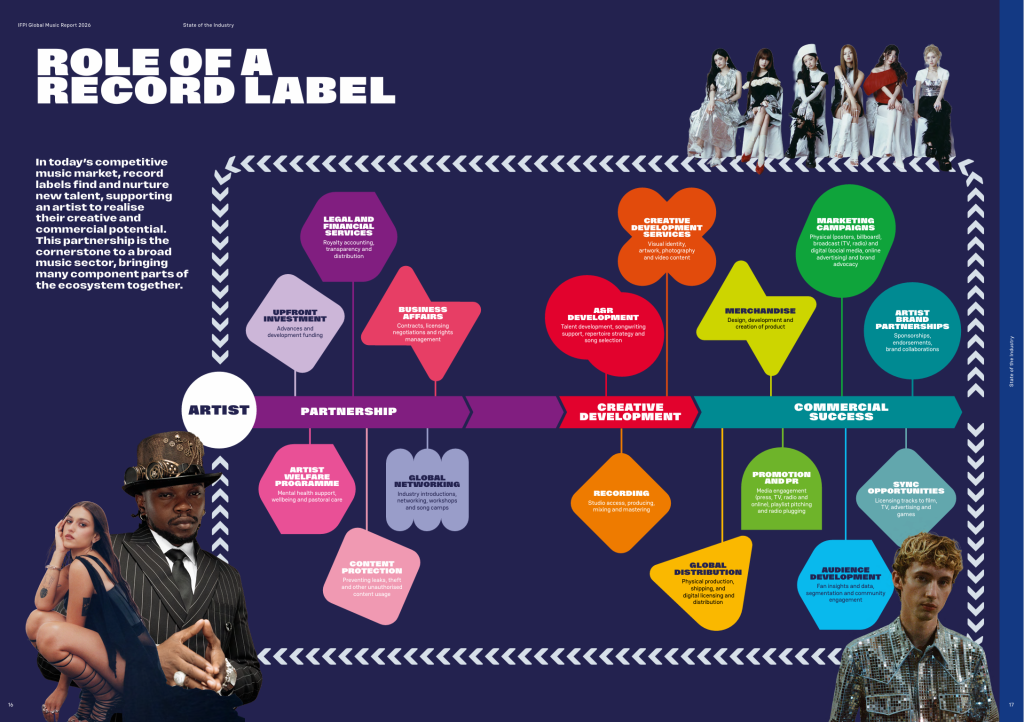
To sum up, IFPI’s role can be understood this way: it is not a referee; it is more like a sports agent, always securing the best interests of its players under contract. Its policy declarations are never academic discussions; they are a clear strategic combination of punches in the industry contest, every move a carefully crafted act of self-interest.
Comparing the pace of the CLEAR Act and the EU AI Act, it is clear that IFPI’s lobbying is no castle in the air. Behind the bipartisan US CLEAR Act winning endorsements from numerous creative industry organizations, and behind the European Parliament’s overwhelming passage of the copyright protection report, lie years of policy lobbying by IFPI and its members. It is a giant industry-coordination body with organization, funding, legal teams, and legislative reach. Every time it speaks, it can influence the direction of a copyright market worth hundreds of billions of dollars.
Of course, understanding IFPI is not the same as worshipping IFPI. It has its own boundaries of interest: its core mission is to protect the interests of its members, not to protect all music creators in the world. Independent musicians, small labels, and rightsholders not represented by the three majors do not always receive equivalent returns from IFPI’s policy positions. This is also the clear-eyed perspective we should maintain when reading IFPI reports: the data is objective, but the choices of which data to present, how to interpret it, and what policies to push with it all conceal a clearly defined standpoint.
From the tiny strength it had at its founding in 1933 to the powerful interest group that now steers the course of the global copyright industry, the road IFPI has traveled is itself a miniature history of the global music industry. And this Global Music Report 2026, together with the five policy declarations behind it, is merely the latest chapter of that history opening in the AI era. For any creator trying to understand the landscape of the global music industry, grasp the direction of the copyright contest in the AI era, or simply better protect and monetize their own work on platforms like QQ Music and NetEase Cloud Music, understanding IFPI’s logic is an unavoidable lesson.
VI. A Word for 2026
This year’s in-depth IFPI analysis removes the more entertainment-oriented content of last year: it no longer offers rankings of artists or albums, and no longer discusses the development cases of individual artists. The BLOG owner is guiding everyone to focus on grander propositions.
AI is the specter that this year cannot be avoided. In last year’s report, the BLOG owner dissected in detail the beginning of the “lawsuit of the century.” A year later, the situation has evolved from “the three majors uniting against outsiders” to “each player working their own angles.” Warner was the first to settle with Suno, Universal made peace with Udio, and only Sony is still fighting to the end. KLAY Vision, packaged as the “compliance exemplar,” secured licensing from all three majors — yet its product remains nowhere to be seen. As for Suno, its users have broken through 100 million, paying subscribers doubled in three months, and its valuation surged to $5.4 billion — a resounding slap across the face of the traditional companies with traffic and capital.
The BLOG owner has always believed that the rules of the game in the AI era cannot be written unilaterally by record companies. Traffic is the voice; capital is the voting machine. The Sunos of the world may lose a few lawsuits, but as long as users keep growing and capital keeps pouring in, they will never leave the poker table.
Streaming fraud, then, is the darkest corner of this contest. The essence of the problem is not that technology is doing evil, but that platforms simply have no incentive to eradicate it completely, because junk content and genuine content are no different when it comes to feeding the algorithm — and platforms need massive amounts of content to sustain the “long-tail story.” As long as the pay-per-stream royalty rule remains unchanged, fraud will keep its arbitrage space. This is not a technical problem; it is an incentive problem.
Writing here in 2026, the BLOG owner’s strongest feeling is this: never before has the music industry been so violently pulled at once by technology, capital, law, and human nature. AI will never replace artists, but it will completely reshape the power structure of who pays. Streaming is at its zenith, yet the foundations it is built on may already be a gray-brown river. IFPI and the three majors remain powerful, but their authority is being redefined bit by bit by Suno’s valuation, the advance of the CLEAR Act, and the rise of the Chinese market. As a once-a-year program, the BLOG owner hopes to help everyone stand taller and see farther, participate firsthand in the currents of this era, and become a surfer riding the AI wave.
This article comes from the blog of Mengyu Lingyin (夢雨玲音), 15,702 characters in total. Reprints are welcome; please credit the source. Thank you!


You May Also Like

Music Diary: Music Appreciation – Issue 1

HIFI Diary: Moondrop MM3A Active 3-inch Studio Monitor Speakers Comparison Review