HIFI Diary: A Primer on Digital Audio Formats and Technologies
HIFI: From Beginner to Cremation Series
[展开/折叠]
-
HiFi Beginner Q&A
Quick answers to common questions for beginners
-
How to Judge and Describe Sound Quality?
A brief analysis of every link affecting sound quality and understanding audio characteristics
-
What Is a DAC? What Is a Decoder?
An in-depth analysis of the differences between DACs and decoders
-
A Brief Introduction to Digital Audio Formats and Technologies
A comprehensive overview of digital audio formats
-
What Are Bluetooth Codecs SBC, aptX, AAC, and LDAC?
Everything you need to know about which Bluetooth codec is best
-
From Beginner to Advanced: Understanding Frequency Response Curves and Waterfall Plots
A quick guide to reading 2D and 3D spectrograms
-
How to Choose HiFi Products? How to Filter Useful Information?
A practical buying guide and pitfall avoidance for HiFi gear
-
How to Choose Desktop Speakers?
Choosing desktop speakers from scratch
-
Building a DIY HiFi System Like a DIY PC
The complete process of assembling a full HiFi system
-
Can’t Tell the Difference Between MP3, Lossless, and Hi-Res? Try the Golden Ears Test
The famous Golden Ears test everyone talks about is here!
-
Amplifier Power Calculation and Technical Guide
Is your headphone amp powerful enough? A dedicated calculator to help
-
DIY High-Performance Music Server
Building your own PC CORE and exploring its impact on sound quality
-
Choosing and Discussing Ethernet Cables
Exploring the impact of network cables on sound quality
-
Principles and Exploration of HiFi Network Switches
Analyzing the principles behind the trending HiFi network switches
-
The Ultimate Audiophile Mystery: Ground Box Comparison Test
A real-world comparative review of ground boxes from multiple brands
-
A Comparison of Solder Alloys
Exploring sonic differences between solder types in DIY cables
-
Comparing Audio Fuses Ranging from 2 to 1,380 RMB
A broad comparison across various fuse models and amperages
-
AudioQuest Diamond / Wireworld Platinum Starlight 7 / W4S / Xianyu Handmade IIS / HDMI Cable Comparison Test
Sonic comparison among HDMI cables from multiple HiFi brands
-
How USB Cables Affect Sound Quality
Selecting USB cables and exploring their impact on sound quality
-
Starting from SATA Data Cables: Discussing the Chaos in DIY Audio Cables
An in-depth look at HiFi SATA cables
This article serves as an introductory primer. It likewise originated when a friend of the BLOG owner who recently entered the audiophile hobby was frequently confusing fundamental concepts. While explaining them, the BLOG owner organized and wrote down these key points.
1. On Lossless Audio
We are accustomed to referring to CD-quality audio as “lossless audio.” In reality, what this concept actually means is “whether it losslessly retains the original information stored on the CD,” rather than “whether it losslessly reproduces the sound of the live recording session.” After all, an old standard like CD can no longer satisfy increasingly discerning audiophiles today.
As people pursue higher-precision audio, standards with superior sound quality and greater information density have emerged. The most familiar of these is the widely recognized Hi-Res standard today, which encompasses all music exceeding CD audio precision into its framework. Among these, the most common specifications are 88.2 kHz / 24-bit, 96 kHz / 24-bit, and 192 kHz / 24-bit.
Yet whether dealing with the aging CD standard or the newer Hi-Res standards, none can truly be called “lossless” in an absolute sense. After all, real-world sound is infinitely varied and dynamic, whereas digital audio can only ever approximate reality as closely as possible without becoming reality itself.
2. Audio Encoding Formats
Before introducing audio file formats, let us introduce two underlying technologies that we use every day yet might understand less: PCM and DSD.
PCM (Pulse-Code Modulation) is currently the most widespread audio encoding format. The vast majority of common audio formats are fundamentally PCM-encoded, such as MP3, FLAC, WAV, and others. These popular audio formats are essentially outer containers for PCM; their core data is all PCM, taking the form of MP3 or FLAC simply because different compression algorithms are applied. What we commonly refer to as “decoding” is actually the process of uncompressing formats like FLAC and MP3 back into raw PCM.
DSD (Direct Stream Digital) is a high-resolution digital audio specification jointly developed by Sony and Philips, announced in 1996. It is a high-bitrate audio encoding format utilizing 1-bit stream sampling with a sampling rate of 2.8224 MHz. Similar to PCM, DSD also has its own container formats: DSF, DFF, and DST. Among them, DSF and DFF are uncompressed, whereas DST is compressed; practically speaking, there is little functional difference between them.
While PCM and DSD emerged chronologically at different times, there is no absolute superiority or inferiority in actual sound quality. DSD simply began with a higher baseline; comparing high-bitrate DSD audio against CD-bitrate PCM naturally favors DSD. However, PCM also offers Hi-Res tier audio specifications that easily hold their own against DSD. That said, because PCM and DSD follow fundamentally different recording workflows, their sonic presentations exhibit distinct characteristics—though exploring that is beyond the scope of this article.
3. Classification of Common Audio Formats
We have mentioned a variety of container formats, including MP3, AAC, OGG, CDA, FLAC, APE, WAV, DFF, DSF, DST, and more. Below, we categorize them by their properties to help everyone gain a clearer understanding.
Lossy Compression: MP3, AAC, OGG
Lossless Uncompressed: WAV, CDA, DFF, DSF
Lossless Compressed: FLAC, APE, DST
As we can see, lossless containers are further divided into compressed and uncompressed types. This technology was developed primarily to facilitate digital audio transmission over networks. For instance, given identical PCM audio, FLAC compression yields a significantly smaller file size than uncompressed WAV, which is why FLAC has become today’s most prevalent lossless audio format.
4. What Is MQA?
MQA has recently captured widespread attention as a sleek and trendy newcomer. Many audiophiles have begun looking for DACs that support MQA playback. So, what exactly is MQA?
MQA stands for Master Quality Authenticated, an audio encoding technology developed under the leadership of Bob Stuart, co-founder of British audio firm Meridian. Conceptually, MQA is neither identical to PCM nor equivalent to container formats like FLAC or MP3; at its core, it is a “technology that packages PCM into FLAC.” As for why MQA uses FLAC as its carrier, it is primarily because FLAC is open-source and free, meaning MQA incurs no licensing fees for its container.
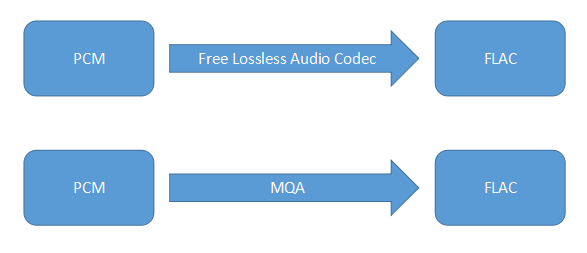
MQA files are packaged in the FLAC format. Using MQA’s proprietary “origami” folding technology, Hi-Res audio undergoes multi-layered compression to produce exceptionally compact files. A clear example: an uncompressed Hi-Res audio file in WAV format might be 100 MB, whereas the same audio compressed into FLAC using MQA technology is only about 50 MB—a 50% reduction! Another advantage of MQA is that if an audiophile’s DAC does not support MQA unfolding, the file can still be played back at standard lossless CD quality (44.1 kHz / 16-bit), eliminating the hassle of manual transcoding and downsampling.
Therefore, MQA is not quite as magical as marketed. The sole problem it truly solved was the tension between limited network bandwidth and large high-resolution audio file sizes during the early streaming era. However, the price paid for this is extraordinarily steep.
First, MQA is not an ISO industry standard; its beneficiaries are primarily high-res audio streaming platforms, while having no relevance to upstream physical audio production and mastering. Second, MQA requires dedicated hardware decoding support; faced with already pricey DACs, many audiophiles would need to purchase new equipment just to experience MQA. Yet this expense brings no real improvement in sound quality—it merely saves some hard drive space or network bandwidth.
Although certain manufacturers heavily promote MQA technology, it is fundamentally just a compression algorithm that offers no improvement to actual acoustic quality. Taking streaming provider TIDAL as an example, they offer both high-bitrate uncompressed audio and MQA options; in practice, for listeners with adequate bandwidth, there is no real audible advantage regardless of whether one possesses MQA hardware decoding.
And that concludes this edition of our technical primer. Hopefully, it answers some common questions for newcomers to the hobby. HiFi is an exquisitely rigorous science; we hope your journey ahead involves less wishful thinking, and more thoughtful inquiry and verification.


You May Also Like

Classical Diary: Budding Music, Hidden Epic — Guillaume Dufay (Part 3)
HIFI Diary: NICEHCK Rockies 1DD+2BA+2EST Earphone Sound Quality Review